Thank you for visiting SNEWPapers!
Sign up free
The New Hampshire Gazette
Portsmouth, Rockingham County, New Hampshire
What is this article about?
William T. Barry, Postmaster General, addresses the public defending his administration of the Post Office Department against a Senate committee's report. He refutes charges of financial mismanagement, explains independent departmental powers, justifies expansions and loans, corrects report errors, and attributes criticisms to partisan politics opposing President Jackson.
Merged-components note: This is a continuation of the Post-Master General's address across pages 1 and 2, ending with '[To be continued in our next.]' but appears complete here; relabeled the second part from 'story' to 'editorial' as it is an opinion piece/address.
Clippings
1 of 2
OCR Quality
Full Text
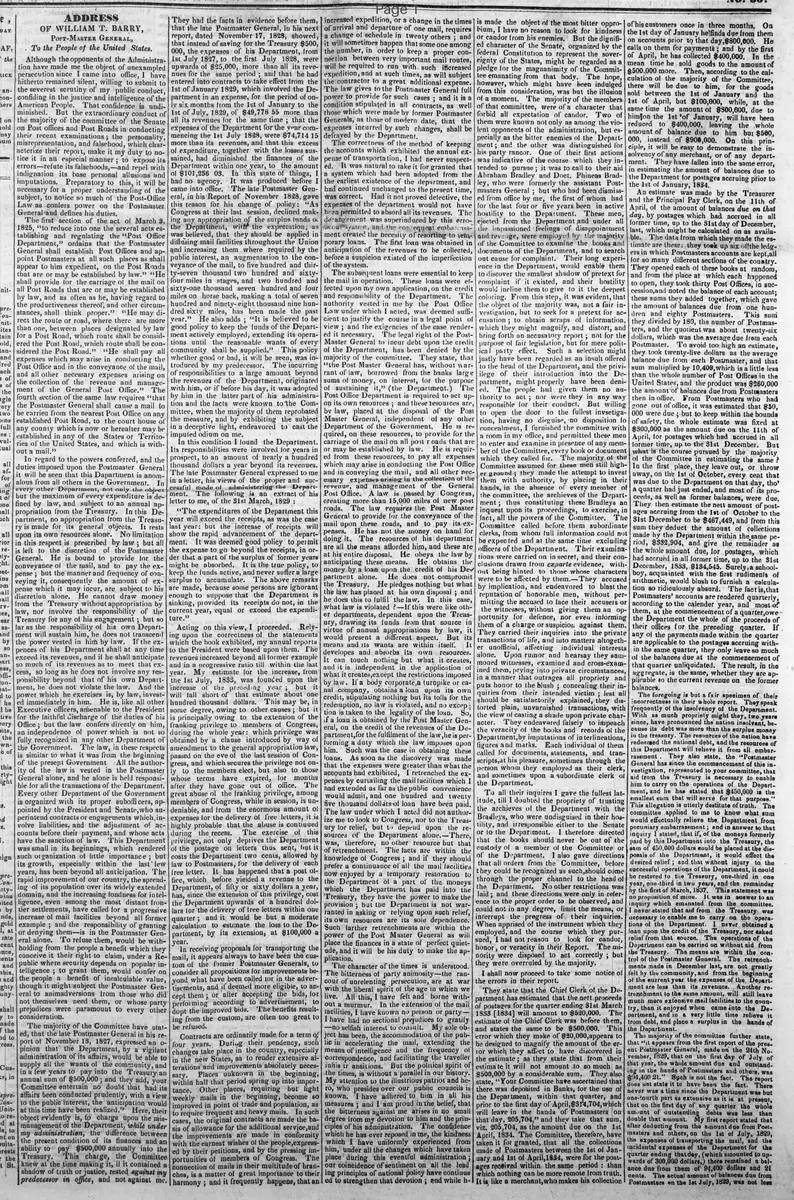
OF WILLIAM T. BARRY
Postmaster General
To the People of the United States.
Although the opponents of the Administration have made me the object of unexampled
persecution since I came into office, I have
hitherto remained silent, willing to submit to
the severest scrutiny of my public conduct,
confiding in the justice and intelligence of the
American People. That confidence is undiminished. But the extraordinary conduct of
the majority of the committee of the Senate
on Post Offices and Post Roads in conducting
their recent examinations; the personality,
misrepresentation, and falsehood, which characterize their report, make it my duty to notice it in an especial manner; to expose its
errors—refute its falsehoods,—and repel with
indignation its base personal allusions and
imputations. Preparatory to this, it will be
necessary for a proper understanding of the
subject, to notice so much of the Post-Office
Law as confers power on the Postmaster
General and defines his duties.
The first section of the act of March 3,
1825, "to reduce into one the several acts establishing and regulating the Post Office
Department," ordains that the Postmaster
General shall establish Post Offices and appoint Postmasters at all such places as shall
appear to him expedient, on the Post Roads
that are or may be established by law." "He
shall provide for the carriage of the mail on
all Post Roads that are or may be established
by law, and as often as he, having regard to
the productiveness thereof, and other circumstances, shall think proper," "He may direct the route or road, where there are more
than one, between places designated by law
for a Post Road, which route shall be considered the Post Road." "He shall pay all
expenses which may arise in conducting the
Post Office and in the conveyance of the mail,
and all other necessary expenses arising on
the collection of the revenue and management of the General Post Office." The
fourth section of the same law requires "that
the Postmaster General shall cause a mail to
be carried from the nearest Post Office on any
established Post Road, to the court house of
any county which is now or hereafter may be
established in any of the States or Territories of the United States, and which is without a mail."
In regard to the powers conferred, and the
duties imposed upon the Postmaster General
it will be seen that this Department is anomalous from all others in the Government. In
every other Department, not only the object
but the maximum of every expenditure is defined by law, and subject to an annual appropriation from the Treasury. In this Department, no appropriation from the Treasury is made for its general objects. It rests
upon its own resources alone. No limitation
in this respect is prescribed by law; but all
is left to the discretion of the Postmaster
General. He is bound to provide for the
conveyance of the mail, and to pay the expense; but the manner and frequency of conveying it, consequently the amount of expense which it may incur, are subject to his
discretion alone. He cannot draw money
from the Treasury without appropriation by
law, nor involve the responsibility of the
Treasury for any of his engagements; but so
far as the responsibility of his own Department will sustain him, he does not transcend
the power vested in him by law. If the expenses of his Department shall at any time
exceed its revenues, and if he shall anticipate
so much of its revenues as to meet that excess, so long as he does not involve any responsibility beyond that of his own Department, he does not violate the law. And the
power which he exercises is, by law, invested immediately in him. He is, like all other
Executive officers, amenable to the President
for the faithful discharge of the duties of his
Office; but the law confers directly on him,
an independence of power which is not so
fully recognized in any other Department of
the Government. The law, in these respects
is similar to what it was from the beginning
of the present Government. All the authority of the law is vested in the Postmaster
General alone, and he alone is held responsible for all the transactions of the Department.
Every other Department of the Government
is organized with its proper subofficers, appointed by the President and Senate, who superintend contracts or engagements which involve liabilities, and the adjustment of accounts before their payment, and whose acts
have the sanction of law. This Department
was small in its beginnings, which rendered
such organization of little importance; but
its growth, especially within the last few
years, has been beyond all anticipation. The
rapid improvement of our country, the spreading of its population over its widely extended
domain, and the increasing fondness for intelligence, even among the most distant frontier settlements, have called for a progressive
increase of mail facilities beyond all former
example; and the responsibility of granting
or denying them is in the Postmaster General alone. To refuse them, would be withholding from the people a benefit which they
conceive it their right to claim, under a Republic where security depends on popular intelligence; to grant them, would confer on
the people a benefit of incalculable value,
though it might subject the Postmaster General to animadversions from those who did
not themselves need them, or whose party
prejudices were paramount to every other
consideration.
The majority of the Committee have stated, that the late Postmaster General in his report of November 13, 1827, expressed an opinion that the Department, by a vigilant
administration of its affairs, would be able to
supply all the wants of the community, and
in a few years to pay into the Treasury an
annual sum of $500,000; and they add, your
Committee entertain no doubt that had its
affairs been conducted prudently, with a view
to the public interest, the anticipation would
at this time have been realized." Here, their
object evidently is, to charge upon the mismanagement of the Department, while under
my administration, the difference between
the present condition of its finances and an
ability to pay $500,000 annually into the
Treasury. This charge, the Committee
knew at the time making it, if it contained a
shadow of truth or justice, rested against my
predecessor in office, and not against me.
They had the acts in evidence before them,
that the late Postmaster General, in his next
report, dated November 17, 1828, showed,
that instead of saving for the Treasury $500,
000, the expenses of his Department, from
1st July 1827, to the first July 1828, were
upwards of $25,000, more than all its revenues or the same period; and that he had
entered into contracts to take effect from the
1st of January 1829, which involved the Department in an expense, for the period of only six months from the 1st of January to the
1st of July, 1829, of $49,778 55 more than
all its revenues for the same time; that the
expenses of the Department for the year commencing the 1st July 1828, were $74,714 15
more than its revenues, and that this excess
of expenditure, together with the losses sustained, had diminished the finances of the
Department within one year, to the amount
of $101,256 03. In this state of things, I
had no agency. It was produced before I
came into office. The late Postmaster General, in his Report of November 1828, gave
this reason for his change of policy: "As
Congress at their last session, declined making any appropriation of the surplus funds of
the Department, with the expectation, as
was believed, that they should be applied in
diffusing mail facilities throughout the Union
and increasing them where required by the
public interest, an augmentation to the conveyance of the mail, to five hundred and thirty-seven thousand two hundred and sixty-
four miles in stages, and two hundred and
sixty-one thousand seven hundred and four
miles on horseback, making a total of seven
hundred and ninety-eight thousand nine hundred sixty miles, has been made the past
year." He also adds; "It is believed to be
good policy to keep the funds of the Department actively employed, extending its operations until the reasonable wants of every
community shall be supplied." This policy
whether good or bad, it will be seen, was introduced by my predecessor. The incurring
of responsibilities to a large amount beyond
the revenues of the Department, originated
with him, or if before his day, it was adopted
by him in the latter part of his administration and the facts were known to the Committee, when the majority of them reprobated
the measure, and by exhibiting the subject
in a deceptive light, endeavored to cast the
imputed odium on me.
In this condition I found the Department.
Its responsibilities were involved for years in
prospect, to an amount of nearly a hundred
thousand dollars a year beyond its revenues.
The late Postmaster General expressed to me
in a letter, his views of the proper and successful mode of administering the Department. The following is an extract of his
letter to me, of the 31st March, 1829:
"The expenditures of the Department this
year will exceed the receipts, as was the case
last year: but the increase of receipts will
show the rapid advancement of the department. It was deemed good policy to permit
the expense to go beyond the receipts, in order that a part of the surplus of former years
might be absorbed. It is the true policy, to
keep the funds active, and never suffer a large
surplus to accumulate. The above remarks
are made, because some persons are ignorant
enough to suppose that the Department is
sinking, provided its receipts do not, in the
current year, equal or exceed the expenditure."
Acting on this view, I proceeded. Relying upon the correctness of the statements
which the book exhibited, my annual reports
to the President were based upon them. The
revenues increased beyond all former example and in a progressive ratio till within the last
year. My estimate for the increase, from
the 1st July, 1833, was founded upon the
increase of the preceding year; but it
will fall short of that estimate about one
hundred thousand dollars. This may be, in
some degree, owing to other causes; but it
is principally owing to the extension of the
franking privilege to members of Congress,
during the whole year: which privilege was
obtained by a clause introduced by way of
amendment to the general appropriation law,
passed on the eve of the last session of Congress, and which secures the privilege not only to the members elect, but also to those
whose terms have expired, for months
after they have gone out of office. The
great abuse of the franking privilege, among
members of Congress, while in session, is undeniable, and from the enormous amount of
expenses for the delivery of free letters, it is
highly probable that the abuse is continued
during the recess. The exercise of this
privilege, not only deprives the Department
of the postage on letters thus sent, but it
costs the Department two cents, allowed by
law to Postmasters, for the delivery of each
free letter. It has happened that a post office, which before yielded a revenue to the
Department, of fifty or sixty dollars a year,
has, since the extension of this privilege, cost
the Department upwards of a hundred dollars for the delivery of free letters within one
quarter; and it would be but a moderate
calculation to estimate the loss to the Department, by its extension, at $100,000 a
year.
In receiving proposals for transporting the
mail, it appears always to have been the custom of the former Postmaster Generals, to
consider all propositions for improvements beyond what have been called for in the advertisements, and if deemed more eligible, to accept them; or after accepting the bids, for
performing according to advertisement, to
adopt the improved bids. The benefits resulting from the custom, are often too great to
be refused.
Contracts are ordinarily made for a term of
four years. During their pendency, such
changes take place in the country, especially
in the new States, as to render extensive alterations and improvements absolutely necessary. Places unknown in the beginning,
within half that period spring up into importance. Other places, requiring but light
weekly mails in the beginning, become so
improved in point of trade and population, as
to require frequent and heavy mails. In such
cases, the original contracts are made the basis of allowance for the additional service, and
the improvements are made in conformity
with the earnest wishes of the people, expressed by their petitions, and by the pressing importunities of members of Congress. The
connection of mails in their multitude of branches, is a matter of great importance to their
harmony; and it frequently happens, that an
increased expedition, or a change in the times
of arrival and departure of one mail, requires
a change of schedule in twenty others; and
it will sometimes happen that some one among
the number, in order to keep a proper connection between very important mail routes,
will be required to run with such increased
expedition, and at such times, as will subject
the contractor to a great additional expense.
The law gives to the Postmaster General full
power to provide for such cases; and it is a
condition stipulated in all contracts, as well
those which were made by former Postmaster
Generals, as those of modern date, that the
expenses incurred by such changes, shall be
derayed by the Department.
The correctness of the method of keeping
the accounts which exhibited the annual expense of transportation, I had never suspected. It was natural to take it for granted that
a system which had been adopted from the
the earliest existence of the department, and
had continued unchanged to the present time,
was correct. Had it not proved defective, the
expenses of the department would not have
been permitted to absorb all its revenues. The
derangement was superinduced by this erroneous system, and the consequent embarrassment created the necessity of resorting to temporary loans. The first loan was obtained in
anticipation of the revenues to be collected,
before a suspicion existed of the imperfection
of the system.
The subsequent loans were essential to keep
the mail in operation. These loans were effected upon my own application, on the credit
and responsibility of the Department. The
authority vested in me by the Post Office
Law under which I acted, was deemed sufficient to justify the course in a legal point of
view; and the exigencies of the case rendered it necessary. The legal right of the Post-
Master General to incur debt upon the credit
of the Department, has been denied by the
majority of the committee. They state, that
"the Post Master General has, without warrant of law, borrowed from the banks large
sums of money, on interest, for the purpose
of sustaining it," (the Department.) The
Post Office Department is required to act upon its own resources; and these resources are,
by law, placed at the disposal of the Post
Master General, independent of any other
Department of the Government. He is required, on these resources, to provide for the
carriage of the mail on all post roads that are
or may be established by law. He is required from these resources, to pay all expenses
which may arise in conducting the Post Office
and in conveying the mail, and all other necessary expenses arising in the collection of the
revenue, and management of the General
Post Office. A law is passed by Congress,
creating more than 15,000 miles of new post
roads. The law requires the Post Master
General to provide for the conveyance of the
mail upon these roads, and to pay its expenses. He has not the money on hand for
doing it. The resources of his department
are all the means afforded him, and these are
at his entire disposal. He obeys the law by
anticipating these means. He obtains the
money by a loan upon the credit of his Department alone. He does not compromit
the Treasury. He pledges nothing but what
the law has placed at his own disposal; and
he does this to fulfil the law. In this case,
what law is violated?—If this were like other departments, dependent upon the Treasury, drawing its funds from that source in
virtue of annual appropriations by law, it
would present a different aspect. But its
means and its wants are within itself. It
developes and absorbs its own resources.
It can touch nothing but what it creates,
and it is independent in the application of
what it creates, except the restrictions imposed by law. If a body corporate, a turnpike or canal company, obtains a loan upon its own
credit, stipulating nothing but its tolls for the
redemption, no law is violated, and no exception is taken to the legality of the loan. So,
if a loan is obtained by the Post Master General, on the credit of the revenues of the Department, for the fulfilment of the law, he is performing a duty which the law imposes upon
him. Such was the case in obtaining these
loans. As soon as the discovery was made
that the expenses were greater than what the
accounts had exhibited, I retrenched the expenses by curtailing the mail facilities which I
had extended as far as the public convenience
would admit, and one hundred and twenty
five thousand dollars of loan have been paid.
The law under which I acted did not authorize me to look to Congress, nor to the Treasury for relief, but to depend upon the resources of the Department alone.—There,
was, therefore, no other resource but that
of retrenchment. The facts are within the
knowledge of Congress; and if they should
prefer a continuance of all the mail facilities
now enjoyed by a temporary restoration to
the Department of a part of the moneys
which the Department has paid into the
Treasury, they have the power to make the
provision; but the Department is not warranted in asking or relying upon such relief.
its own resources are its sole dependence.
Such farther retrenchments are within the
power of the Post Master General as will
place the finances in a state of perfect quietude, and it will be his duty to make the application.
The character of the times is understood.
The bitterness of party animosity—the rancor of unrelenting persecution, are at war
with the liberal spirit of the age in which we
live. All this, I have felt and borne without a murmur. In the extension of the mail
facilities, I have known no person or party—I have had no sectional prejudices to gratify
—no selfish interest to consult. My sole object has been, the accommodation of the public in accelerating the mail, extending the
means of intelligence and the frequency of
correspondence, and facilitating the traveller
in his transitions. But the political spirit of
the times, is without a parallel in our history.
My attention to the illustrious patriot and hero, who presides over our public councils is
known. I have adhered to him in all his
measures; and I am proud in the belief, that
the bitterness against me arises in no small
degree from my devotion to him and the principles of his administration. The confidence which he has ever reposed in me, the kindness which I have uniformly experienced from
him, under all the changes which have taken
place during this eventful administration;
our coincidence of sentiment on all the leading principles of national policy have continued to strengthen that devotion; and while he
is made the object of the most bitter opprobrium, I have no reason to look for kindness
or candor from his enemies. But the dignified character of the Senate, organized by the
Federal Constitution to represent the sovereignty of the States, might be regarded as a
pledge for the magnanimity of the Committee emanating from that body. The hope,
however, which might have been indulged
from this consideration, was but the illusion
of a moment. The majority of the members
of that committee, were of a character that
forbid all expectation of candor. Two of
them were known not only as among the violent opponents of the administration, but especially as the bitter enemies of the Department; and the other was distinguished for
his party rancor. One of their first actions
was indicative of the course which they intended to pursue; it was to call to their aid
Abraham Bradley and Doct. Phineas Bradley, who were formerly the assistant Postmasters General: but who had been dismissed from office by me, the first of whom had
for the last four or five years been in active
hostility to the Department. These men,
ejected from the Department and under all
the impassioned feelings of disappointment
and revenge, were employed by the majority
of the Committee to examine the books and
documents of the Department, and to search
out cause for complaint. Their long experience in the Department, would enable them
to discover the smallest shadow of pretext for
complaint if it existed, and their hostility
would incline them to give to it the deepest
coloring. From this step, it was evident, that
the object of the majority was, not a fair investigation, but to seek out a pretext for accusation; to obtain scraps of information,
which they might magnify, and distort, and
bring forth an accusatory report: not for the
purpose of fair legislation, but for mere political party effect. Such a selection might
justly have been regarded as an insult offered to the head of the Department, and the privilege of their introduction into the Department, might properly have been denied. The people had given them no authority to act; nor were they in any way
responsible for their conduct. But willing
to open the door to the fullest investigation, having no disguise, no disposition to
concealment, I furnished the committee with
a room in my office, and permitted these men
to enter and examine in presence of any member of the Committee, every book or document which they called for. The majority of the Committee assumed of these men still higher ground; they made the attempt to invest them with authority, by placing in their
hands, in the absence of every member of
the committee, the archives of the Department: thus constituting these Bradleys an
inquest upon its proceedings, to exercise, in
fact, all the powers of the Committee. The
Committee called before them subordinate
clerks, from whom full information could not
be expected and at the same time excluding
officers of the Department. Their examinations were carried on in secret, and their conclusions drawn from ex parte evidence, without being hinted to those whose characters
were to be affected by them.—They accused
by implication, and endeavored to blast the
reputation of honorable men, without permitting the accused to face their accusers or
the witnesses, without giving them an opportunity for defence, nor even informing
them of a charge or suspicion against them.
They carried their inquiries into the private
transactions of life, and into matters altogether unofficial, affecting individual interests
alone. Upon rumor and hearsay they summoned witnesses, examined and cross-examined them, prying into private circumstances,
in a manner that outrages all propriety and
puts honor to the blush; concealing their inquiries from their intended victim; lest all
should be satisfactorily explained, they distorted plain, unvarnished transactions, with
the view of casting a shade upon private character. They endeavored falsely to impeach
the veracity of the books and records of the
Department, by imputations of interlineations,
figures and marks. Each individual of them
called for documents, statements, and transcripts, at his pleasure, sometimes through the person whom they employed as their clerk,
and sometimes upon a subordinate clerk of
the Department,
To all their inquiries I gave the fullest latitude, till I doubted the propriety of trusting
the archives of the Department with the
Bradleys, who were undisguised in their hostility, and irresponsible either to the Senate
or to the Department. I therefore directed
that the books should never be out of the
custody of a member of the Committee or
of the Department. I also gave directions
that all orders from the Committee, before
they could be recognized as such, should come through the proper channel to the head of
the Department. No other restrictions was
laid; and these directions were only in reference to the proper order to be observed, and
could not in any degree, limit the means, or
interrupt the progress of their inquiries.
When apprised of the instrument which they
employed, and the course which they pursued, I had not reason to look for candor,
honor, or veracity in their Report. The minority were disposed to act correctly; but
they were overruled by the majority.
I shall now proceed to take some notice of
the errors in their report.
They state that the Chief Clerk of the Department has estimated that the nett proceeds
of postages for the quarter ending 31st March
1834 will amount to $520,000. The
estimate of the Chief Clerk was before them,
and states the same to be $500,000. This
error which they make of $20,000, appears to
be designed to magnify the amount of the error which they affect to have discovered in
the estimate; as they state that from their estimate it will not amount to so much as
$500,000 by a considerable sum. They also
state, "Your Committee have ascertained that
there was deposited in Banks, for the use of
the Department, within that quarter, and
prior to the first day of April, $314,704, which
will leave in the hands of Postmasters on
that day, 205,704," and they take that sum,
viz. 205,704, as the amount due on the 1st
April, 1834. The Committee, therefore, have
taken it for granted, that all the collections
made of Postmasters between the 1st of January and 1st of April, 1834, were for the postages received within the same period: than
which nothing can be more remote from truth.
It is like a merchant, who makes his collections of his customers once in three months. On
the 1st day of January he finds due from them
on accounts prior to that day, $800,000. He
calls on them for payments; and by the first
of April, he has collected $400,000. In the
mean time he sold goods to the amount of
$500,000 more. Then, according to the calculation of the majority of the Committee,
there will be due to him, for the goods
sold between the 1st of January and the
1st of April, but $100,000, while, at the
same time the amount of $800,000, due to
him on the 1st of January, will have been
reduced to $400,000, leaving the whole
amount of balance due to him but $500,
000, instead of $900,000. On this principle, it will be easy to demonstrate the insolvency of any merchant, or of any department. They have fallen into the same error,
in estimating the amount of balances due to
the Department for postages accruing prior to
the 1st of January, 1834.
An estimate was made by the Treasurer
and the Principal Pay Clerk, on the 11th of
April, of the amount of balances due on that
day, by postages which had accrued in all
former time, up to the 31st day of December,
last, which might be calculated on as available. The data from which they made the estimate are these: they took up six of the ledgers in which Postmasters accounts are kept, all
for so many different sections of the country.
They opened each of these books at random,
and from the place at which each happened
to open, they took thirty Post Offices, in succession, and noted the balance of each account;
these sums they added together, which gave
the amount of balances due from one hundred and eighty Postmasters. This sum
they divided by 180, the number of Postmasters, and the quotient was about twenty-six
dollars, which was the average due from each
Postmaster. To avoid too high an estimate,
they took twenty-five dollars as the average
balance due from each Postmaster, and that
sum multiplied by 10,400, which is a little less
than the whole number of Post Offices in the
United States, and the product was $260,000
the amount of balances due from Postmasters
then in office. From Postmasters who had
gone out of office, it was estimated that $50,
000 were due; but to keep within the bounds
of safety, the whole estimate was fixed at
$300,000 as the amount due on the 11th of
April, for postages which had accrued in all
former time, up to the 31st December. But
what is the course pursued by the majority
of the Committee in estimating the same?
In the first, place, they leave out, or throw
away, on the 1st of October, every cent that
was due to the Department on that day, tho'
a quarter had just ended, and most of its proceeds, as well as former balances, were due.
They then estimate the nett amount of postages accruing from the 1st of October to the
31st December to be $467,449, and from this
sum they deduct the amount of collections
made by the Department within the same period, $332,904, and give the remainder as
the whole amount due, for postages, which
had accrued in all former time, up to the 31st
December, 1833, $134,545. Surely, a schoolboy, acquainted with the first rudiments of
arithmetic, would blush to furnish a calculation so ridiculously absurd. The fact is, that
Postmasters' accounts are rendered quarterly,
according to the calendar year, and most of
them, at the commencement of a quarter, owe
the Department the whole of the proceeds of
their offices for the preceding quarter. If
any of the payments made within the quarter
are applicable to the postages accruing within the same quarter, they only leave so much
of the balances due at the commencement of
that quarter unliquidated. The result, in the
aggregate, is the same, whether they are applicable to the current revenue or the former
balances.
The foregoing is but a fair specimen of their
incorrectness in their whole report. They speak frequently of the insolvency of the Department. With as much propriety might they, two years since, have pronounced the nation insolvent, because its debt was more than the surplus money in the treasury. The resources of the nation have
redeemed the national debt, and the resources of this Department will relieve it from all embarrassment. They also state, the "Postmaster General has since the commencement of this investigation, represented to your committee, that
aid from the Treasury is necessary to enable
him to carry on the operations of the Department, and he has stated that $450,000 is the
smallest sum that will serve for that purpose."
This allegation is utterly destitute of truth. The
committee applied to me to know what sum
would effectually relieve the Department from
pecuniary embarrassment; and in answer to that
inquiry I stated, that if, of the moneys formerly
paid by this Department into the Treasury, the
sum of 450,000 dollars could be placed at the disposal of the Department, it would effect the
desired relief; and that without injury to the
successful operations of the Department, it could
be restored to the Treasury, one-third in one
year, one-third in two years, and the remainder
by the first of March, 1837. This statement was
no proposition of mine. It was in answer to an
inquiry which emanated from the committee.
I never stated that aid from the Treasury was
necessary to enable me to carry on the operations of the Department. I never obtained a
loan upon the credit of the Treasury, nor asked
relief from that source. The operations of the
Department can be carried on without aid from
the Treasury. The means are within the control of the Postmaster General. The retrenchments made in December last, are not greatly
felt by the community, and from the beginning
of the current year the expenses of the Department are less than its revenues. Another retrenchment to the same amount, will still leave
much more extensive mail facilities to the country, than it enjoyed when I came into the Department, and in a very little time relieve it
from debt, and place a surplus in the hands of
the Department.
The majority of the committee further state,
that "it appears from the first report of the present Postmaster General, made on the 24th November, 1829, that on the first day of July of
that year, the whole amount due and outstanding in the hands of Postmasters and others, was
$94,400 21." Such is not the fact. The report
does not state it to have been the fact. There
never was a time since the Department was but
one-fourth part as extensive as it is at present,
that on the first day of any quarter, the whole
amount of outstanding debts was less than
double that amount. My first report stated that
after deducting from the amount due from Postmasters and others, on the 1st of July, 1829,
the expenses of transporting the mail, and the
incidental expenses of the Department for the
quarter ending that day, (which amounted to upwards of 300,000 dollars.) there remained a balance due from them of 94,400 dollars and 21
cents. The actual amount of balances due from
Postmasters on the 1st July, 1829, was not less
than 400,000 dollars; and the amounts due to contractors and others, for the services of the quarter ending on that day, was upwards of 300,000 dollars,—and my statement showed the balance which remained after deducting the one from the other. The law prohibits the payment of contractors till their services are performed. On the first day of July, 1829, the whole amount for transportation from April 1, to that day, was due, amounting to more than 300,000 dollars, besides former balances and other expenses. If "the whole amount due and outstanding in the hands of Postmasters and others on that day, was but 94,400 dollars and 21 cents," as the majority allege, the Department must have been in a much worse condition when I came into it than I ever pretended, or than what they, in another part of their report, aver. But their object here is, to show the practicability of collecting at a given day, the outstanding balances in order to discredit my statements, and not to show the low condition in which my predecessor left the Department. But this is in character with their other allegations.
The next attempt, upon the investigation and report of the Bradleys, to prove errors in my statement of the amount of annual transportation. They state that they cannot vouch for the accuracy of the report of the Bradleys, but they seem to presume on its correctness, and bear testimony upon its authority, against the statements which I have furnished, though accompanied with such data as will enable any person to detect an error, if an error in them exists. A part of the statement of the Bradleys, purporting to have discovered errors in the length of the mail roads, was too glaringly inconsistent for even the majority of the Committee to introduce in their report; and they had omitted it, though confirmed, as they say, by the oath of Dr. Bradley.
The late Postmaster General stated in his last report, November, 1828, that the annual transportation of the mail was,
In stages,
6,439,594 miles.
On horseback,
7,170,445 miles.
Making the total amount to be 13,610,039 miles.
I had taken this as a basis on which to determine the amount of increase which I had given to it. I have never examined his calculations, but presume they are correct. I have caused route-books to be made, containing the names of the several post-offices on each route, and their distances from each other, shewing the length, and the frequency of the transportation of the mail on each route. When the roads had not been surveyed, the distances were taken from the statements of Postmasters on each route. From these books, a statement was made of the length of each route, the frequency of the transportation of the mail upon it, and the number of miles it was transported in a year. The sum of these shewed the whole annual transportation of the mail, which was,
In 1832,
23,632,330 miles.
And in 1833,
26,854,485 miles.
In 1828 it was, by the late Postmaster General's report, but 13,610,039 miles.
Making an increase from 1828 to 1833 of 13,244,446 miles.
The majority of the committee state that they had not time to examine this document, though they appear not to have wanted time to examine the statement of the Bradleys; and the minority found time to examine this.
To discredit this statement, the Bradleys took the advertisements for proposals to carry the mail, the distances there stated, and measured the distances on the map when not noted in the advertisement, took the frequency of trips called for by the advertisements, and so calculated the amount of annual transportation.—The Bradleys knew, when making this statement, though certified by oath, that contracts were often made for carrying the mail more frequently on a route than called for by advertisement, and often for extending them a greater distance. The committee also had evidence of the same facts, and that it was done in a great many instances by existing contracts; yet they affect to give full credit to the calculations of the Bradleys, upon these false data.
The majority of the committee animadvert upon the contracts of Messrs. Stockton & Neil, observing that in the report of the Postmaster General, furnished to Congress during the session of 1831-'2, he quoted these contracts at a low rate; but that in his report of 3d March, 1834, he stated them to be at a much higher rate. The facts before the Committee, furnished by the records of the Department, were, that the proposals of Messrs. Stockton & Neil contained two propositions distinct from each other: one was, to perform a certain amount of service for a certain sum. The other was, to perform a much larger amount of service for a much greater sum. The proposal was accepted for the smaller sum, but with an express condition, that if the Postmaster General should, at any time, require of them the service proposed in their second proposition, they should perform it for the sum stipulated in their proposals. The first report of this contract, with others, was made from the book of recorded proposals, and contained the sum accepted. This was in conformity with the custom which had prevailed with my predecessor. After the acceptance, and after substituting the greater amount of service, there was a very pressing application made to me, signed by Mr. Thomas Ewing, Senator from Ohio, and many others, members of Congress, still to increase the service to that extent which required the greatest amount of additional compensation. Agreeably to the earnest recommendation of Mr. Ewing and others, it was done. And now the complying with what Mr. Ewing then so earnestly pressed as proper and right, he reprobates as improper and wrong. Whether he was sincere in his advocating it, or in condemning it, I know not: or whether the relation in which he now stands to the State of Ohio,—which State was deeply interested in the improvement, has so changed as to have changed his opinion on the subject of the mail accommodations to which she is entitled, I leave for the public and for his constituents to decide.
The same remarks are made in relation to the contracts of James Reeside, and of Messrs. Reeside & Slaymaker. The same facts are also applicable to them. They made in each case two propositions; the smaller was first accepted; afterwards, for the better accommodation of the public, the greater service was required, and of course the higher compensation given. These, and other cases which they state to be similar though they have not specified them, they reprobate as "involving almost every conceivable variety of abuse." On all these routes, there is now a greater amount of service performed in proportion to the compensation allowed, than under any former contracts; and this the Committee knew, or had the means of knowing; and as Mr. Ewing himself earnestly recommended the most expensive of these improvements, the public will judge what credit is due to his decision.
Their next subject of animadversion, is that of a contract with Gen. George House, of Ohio. Gen. House was a contractor for carrying the mail in stages between Chillicothe and Gallipolis, on the north west side of the Ohio river, opposite the mouth of the Kanawha. There was a stage route running from Washington City, and from Richmond, Va. by Staunton, along by the Kanawha, to Catlettsburg in Kentucky, on the Ohio river. Highly respectable citizens of Ohio desired that the State of Ohio should participate in the advantages of this route, which it was represented could be done by extending Gen. House's route from Gallipolis by steamboat up the Kanawha to Coalsmouth, about fifty miles. This would perfect the most direct line from Richmond, Charlottesville, Staunton, Lewisburg, and other important places in Virginia, to the seat of Government in Ohio. It was also represented that Gen. House was preparing a steamboat for that purpose, and would probably have it in readiness to commence the operation by the 1st of April, 1831. He proposed to perform the service for $30 a mile. This was a moderate compensation. The request to give to Ohio the benefit of the Virginia and Kentucky stage line seemed to be reasonable. The expense appeared inconsiderable, compared with the magnitude of the object. Gen. House was, therefore, directed to extend his line to Coalsmouth, and to run between that place and Gallipolis in steamboats. This extension superceded a contract of John Black, to carry the mail on horseback between Gallipolis and Coalsmouth at $394 dollars a year. It was an original stipulation in the contract with Mr. Black, that if a stage or steamboat should be established on his route, the Postmaster General should have the right to annul his contract. Gen. House did not, however, succeed, during the continuance of that contract, (which ended with the year 1831,) in his experiment for running steamboats on the Kanawha; the mail was continued on horseback—Mr. Black continued to carry it— and no more was paid for its transportation than the $394 stipulated in the contract with Mr. Black. This plain transaction they have endeavored to distort into an act of official iniquity, though they confess that no evil was done, nor any other effect produced than that of transferring the route from Mr. Black to Gen. House, who, they say, "is well known as an active and influential political partisan." At the renewal of the Ohio contracts, the route from Chillicothe to Gallipolis was accepted to A. L. Ross, at $1,100 a year. It was then represented that Gen. House had a steamboat in a state of forwardness for the Kanawha, and was determined to make another experiment to unite these two lines, and the citizens were desirous that it should be done. That this object might be accomplished, or its practicability tested, Mr. Ross voluntarily relinquished the route to Gen. House. A contract was made with Gen. House to carry the mail three times a week in four horse post coaches between Chillicothe and Gallipolis, to run through in one day, instead of one day and six hours; also to carry the mail three times a week between Gallipolis and Coalsmouth (which had been carried but twice a week under Mr. Black's contract,) to test the experiment of running steamboats on the Kanawha, and, if found practicable, to extend them to Kanawha C. H. sixty-two miles—and for the whole service to receive $2,600 a year. This sum is $1,106 more than the sum for which Mr. Ross proposed to carry the mail between Chillicothe and Gallipolis, and the sum, $394, which had been given under Mr. Black's contract for carrying it but twice a week between Gallipolis and Coalsmouth. For this $1,106, admitting that the steamboat experiment should fail, the Department would receive the benefit of an increased expedition of half a day between Chillicothe and Gallipolis, and three trips a week, instead of two trips a week, between Gallipolis and Coalsmouth. But if the steamboats should succeed, as was confidently expected, the gain to the Department would have been very considerable. The majority of the Committee state, that there is a clear loss on these routes, by giving them to Gen. House, of $1,206 a year. Their statement carries the evidence of misrepresentation upon its face. It is tantamount to saying, that three trips instead of two, and an increased expedition of six hours in a trip, are worth $100 a year less than nothing.
On a contract made with Col. Asahel Savery, for the transportation of the mail between Chicago and Green Bay, estimated to be 250 miles, they also animadvert. The law establishing this route was passed, with about 500 others, on the 15th of June 1832. The advertisements for proposals to transport the mail on these routes was prepared before the publication of the law; and for want of the law as it finally passed, some errors were liable to happen in the description of routes. In consequence of this, the route was advertised to run from Detroit to Green Bay instead of Chicago to Green Bay. Several proposals however were received for transporting the mail from Chicago to Green Bay; the lowest of which were those of Col. Savery, at $3,000 a year, once in two weeks, or $3,500 once a week, and of Messrs. Irwin and Arndt, at $3,000 a year, once in two weeks, without specifying any sum for which they would perform the route once a week; but if required to run once a week the service would be double, and they would have the right to require the double amount, $6,000 a year. It was intended that it should be performed weekly, and Col. Savery's proposal was accepted at $3,500 a year. He afterwards stated that from information received since he had made his proposition, he had learned that the distance was 50 miles more than he had anticipated, having had no advertisement for his guide as in ordinary cases; that the waters on the route were such as would require expensive preparations for passing them, the country being unsettled, and for these reasons he prayed for a reconsideration of his accepted proposals, and for a further allowance of ten or fifteen hundred dollars. There seemed to be reason and equity in his request, and considering that the lowest proposal otherwise made was by persons, one of whom resided at Green Bay and was presumed to have knowledge of the difficulties and expense of the route, was at the rate of $6,000 a year for a weekly trip, it was deemed more economical for the Department to allow to Col. Savery $4,500 a year, than to permit him to withdraw; and to subject the Department to an annual expense of $1,500 more than that sum by accepting the proposal of Messrs. Irwin & Arndt. A contract was accordingly made with Col. Savery at $4,500 a year. The contract was made on the 22d of February, 1833, to commence on the 1st April of that year. Dr. John T. Temple was then a clerk in the General Post office. He had determined to resign his situation and remove to Chicago. On the last day of February, Col. Savery assigned this contract to Dr. Temple, who resigned his situation as clerk about the same time. I knew of no good reason to object to the transfer. Dr. Temple, was a gentleman of highly respectable character, and entirely worthy of the trust. He had determined to resign his clerkship in the department, and did actually resign and remove to Chicago before the commencement of the contract. I should not permit a person while a clerk in the Department to hold a contract for transporting the mail, though the law does not prohibit it, and I am informed that it has been done in former years before I came into the Department; but I have discovered no reason why a person should be refused this right after leaving the Department, for no other cause than his having once been employed in it as a clerk. The majority of the committee have so distorted these transactions as to present scarcely a beam of truth. They state that "John T. Temple made out a bid in the name of Asahel Savery. The bid is not in the hand writing of Dr. Temple, nor does his name appear in the whole transaction till after the contract was made with Col. Savery. They state that "Dr. Temple, by means of his situation in the Department, obtained a contract giving him $4,500, for carrying the mail 250 miles on horse back weekly, for which service it is believed $1,500 would be a very large compensation." So far from the fact is the insinuation of this contract having been given to Col. Savery, for the benefit of Dr. Temple, that I did not know, or suspect, at the time of making it with Col. Savery, that Dr. Temple had ever thought of it. It was made with Col. Savery in the full expectation that he would retain it, on the sole principle that it was the lowest offer, and under the circumstances, the best contract on the part of the Department, that could then be made for carrying the law of Congress into effect. As to the amount paid, it was lower than others who wanted the contract, and who were acquainted with the country through which it passed, would undertake the service for; and it does not appear to have been considered by Col. Savery an object of sufficient interest for him to retain it.
The majority of the committee complain of the correction of an evident error in a proposal of James Reeside, which was accepted, for carrying the mail between Hagerstown and McConnellsburg, twenty-six miles. The proposal, as accepted, was to run four horse post coaches on that line, three times a week each way, for the transportation of the mail, at a compensation of forty dollars a year. Mr. Reeside, before he commenced the service, stated that it was a mistake of the clerk whom he had employed to copy his bid; that it was his intention to have proposed to run daily, for fourteen hundred dollars a year. The bid, as it was received and accepted, carried upon its face the appearance of a mistake, or at least of something that needed explanation. The proposition to perform the service for ten times that sum would have been considered too low to warrant the expectation that the service would be well performed, unless it came from a person most favorably known to the Department. The explanation was given by him—the error corrected—and while he performed the service daily, with an increase of distance, five miles each way, he was allowed fourteen hundred dollars; and since the service is reduced to three times a week, seven hundred dollars a year.
On another route, between Baltimore and Chambersburg, seventy-seven miles, for which Mr. Reeside is contractor, to carry a daily mail, his proposal contained two distinct propositions, one to perform between certain hours and within a given time, for $1,900; the other to give such increased expedition as would gain an entire day between Baltimore and Pittsburgh, for $3,495 a year. The first was accepted: but the expedition was found to be of such importance that the second was adopted. The majority of the Committee state that "the expedition does not appear to have been of any considerable value to the public." Whether it is of any considerable value to the public to gain a day in all intercourse between Baltimore and Pittsburgh, and, consequently, all places northwest of Pittsburgh, and south of Baltimore, the mercantile and trading part of the community can better judge. These remarks, relative to distinct propositions in the same proposal, and the discretion of adopting the one or the other, as shall seem most expedient, are equally applicable, as before remarked, to the other routes of Mr. Reeside, and also to those of Johnson, Hutchings, Hough, Henry, and Childs, and, therefore, it is not necessary that I should dwell longer upon them. But one other case of Mr. Reeside is exhibited by them in so deceptive a light, and with such gross mis-statements, that I cannot suffer it to pass unnoticed.
[To be concluded in our next.]
What sub-type of article is it?
What keywords are associated?
What entities or persons were involved?
Editorial Details
Primary Topic
Defense Against Senate Committee Accusations On Post Office Management
Stance / Tone
Defensive Refutation Of Mismanagement Charges And Political Persecution
Key Figures
Key Arguments