Thank you for visiting SNEWPapers!
Sign up free
The Daily Herald
New Haven, New Haven County, Connecticut
What is this article about?
Mr. Legare of South-Carolina's letter to constituents discusses the reduced supply of gold and silver since 1810, rising demand from population and industry growth, and implications for value and prices, prepared for sub-treasury bill debate.
Clipping
OCR Quality
Full Text
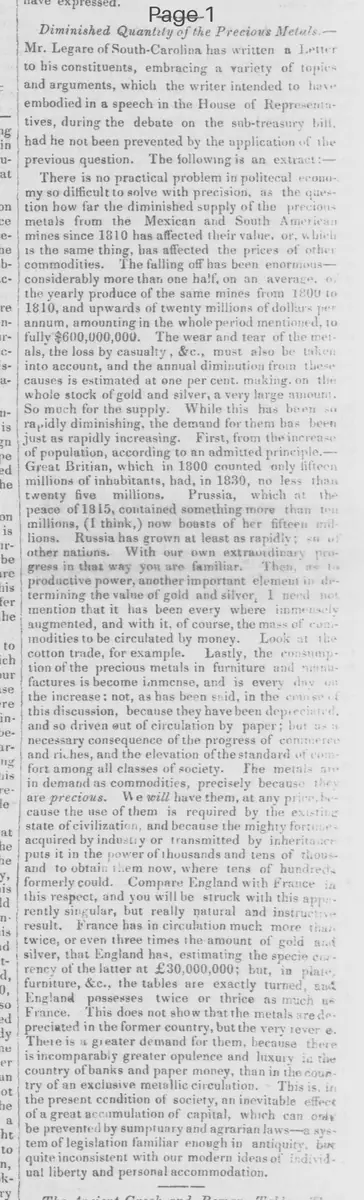
Mr. Legare of South-Carolina has written a letter to his constituents, embracing a variety of topics and arguments, which the writer intended to have embodied in a speech in the House of Representatives, during the debate on the sub-treasury bill, had he not been prevented by the application of the previous question. The following is an extract:-
There is no practical problem in political economy so difficult to solve with precision, as the question how far the diminished supply of the precious metals from the Mexican and South American mines since 1810 has affected their value, or, which is the same thing, has affected the prices of other commodities. The falling off has been enormous- considerably more than one half, on an average, the yearly produce of the same mines from 1800 to 1810, and upwards of twenty millions of dollars per annum, amounting in the whole period mentioned, to fully $600,000,000. The wear and tear of the metals, the loss by casualty, &c., must also be taken into account, and the annual diminution from these causes is estimated at one per cent., making, on the whole stock of gold and silver, a very large amount.
So much for the supply. While this has been rapidly diminishing, the demand for them has been just as rapidly increasing. First, from the increase of population, according to an admitted principle.- Great Britain, which in 1800 counted only fifteen millions of inhabitants, had, in 1830, no less than twenty five millions. Prussia, which at the peace of 1815, contained something more than ten millions, (I think,) now boasts of her fifteen millions. Russia has grown at least as rapidly;- other nations. With our own extraordinary progress in that way you are familiar. Then, as to productive power, another important element in determining the value of gold and silver, I need no mention that it has been every where immensely augmented, and with it, of course, the mass of commodities to be circulated by money. Look at the cotton trade, for example. Lastly, the consumption of the precious metals in furniture and manufactures is become immense, and is ever daily on the increase; not, as has been said, in the course of this discussion, because they have been depreciated, and so driven out of circulation by paper; but as a necessary consequence of the progress of commerce and riches, and the elevation of the standard of comfort among all classes of society. The metals are in demand as commodities, precisely because they are precious. We will have them, at any price, because the use of them is required by the existing state of civilization, and because the mighty fortune acquired by industry or transmitted by inheritance puts it in the power of thousands and tens of thousands to obtain them now, where tens of hundreds formerly could. Compare England with France in this respect, and you will be struck with this apparently singular, but really natural and instructive result. France has in circulation much more than twice, or even three times the amount of gold and silver, that England has, estimating the specie currency of the latter at 30,000,000; but, in plate, furniture, &c., the tables are exactly turned, and England possesses twice or thrice as much as France. This does not show that the metals are depreciated in the former country, but the very reverse. There is a greater demand for them, because there is incomparably greater opulence and luxury in the country of banks and paper money, than in the country of an exclusive metallic circulation. Thus it is, in the present condition of society, an inevitable effect of a great accumulation of capital, which can only be prevented by sumptuary and agrarian laws-a system of legislation familiar enough in antiquity, but quite inconsistent with our modern ideas of individual liberty and personal accommodation.
What sub-type of article is it?
What keywords are associated?
What entities or persons were involved?
Where did it happen?
Domestic News Details
Primary Location
South Carolina
Key Persons
Event Details
Mr. Legare of South-Carolina has written a letter to his constituents on topics including the diminished supply of precious metals from Mexican and South American mines since 1810, its effect on value and prices, increasing demand due to population growth, productive power, and consumption in furniture and manufactures. The letter was intended for a speech in the House of Representatives during the debate on the sub-treasury bill but was prevented by the previous question.