Thank you for visiting SNEWPapers!
Sign up free
Southern Christian Advocate
Charleston, Charleston County, South Carolina
What is this article about?
Editorial defends the Methodist Episcopal Church's moderate episcopacy against High-Church claims of apostolic succession from Oxford Tracts. Discusses Rev. Smyth's lectures on prelacy vs. presbytery, critiques Church of England reforms, quotes Edinburgh Review (1836), and urges adherence to scriptural church authority. Signed by W.T. Harrison, Bennettsville, S.C., Jan. 1, 1841.
Merged-components note: Continuation of the editorial 'CLERICAL AUTHORITY. ITS PREROGATIVES AND ITS BOUNDS.' across pages; the second part was incorrectly labeled as 'story'.
Clippings
1 of 2
OCR Quality
Full Text
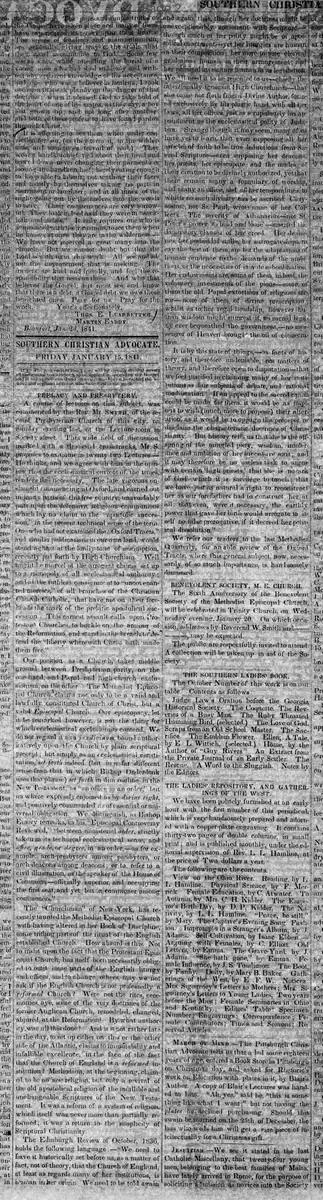
A course of lectures on this subject, was commenced by the Rev. Mr. Smyth, of the Second Presbyterian Church of this city, on Sunday evening last, at the Lecture-room in Society-street. This wide field of discussion marked with a thousand cross-tracks Mr. S. proposes to examine in twenty-two Lectures. He thinks, and we agree with him in the opinion, that the ecclesiastical current of the times, renders this necessary. The late vigorous onslaught commencing at Oxford, and carried out in many parts of this free country, unavoidably puts upon the defensive, religious communions which lay no claim to the "apostolic succession," in the present technical sense of the term. One who had not examined the 'Oxford Tracts,' and similar publications in our own land, would stand aghast at the lofty tone of assumption, recently put forth by High-Churchism. Well might he marvel at the arrogant claims set up to a monopoly of all ecclesiastical authority; and at the ruthless consignment to "uncovenanted mercies," of all branches of the Christian Church Catholic, that have not on their foreheads the mark of the prelatic apostolical succession. This earnest assault calls upon Protestant Churches, to buckle on the armour of the Reformation, and stand in the breach to defend the "liberty wherewith Christ hath made them free."
Our position as a Church, takes middle ground between Presbyterian parity, on the one hand, and Papal and high-church exclusivism, on the other. The Methodist Episcopal Church, claims not only to be a valid and lawfully constituted Church of Christ, but a valid Episcopal Church. Our episcopacy, let it be remarked however, is not the thing for which ecclesiastical exclusionists contend. We do not regard it as a jus divinum, bound authoritatively upon the Church by plain scriptural precept; but simply as an ecclesiastical constitution, set forth indeed (but in a far different sense from that in which Bishop Onderdonk uses that phrase) set forth in dim outline in the New Testament, as "an office in an order," but nowhere expressly enjoined as by divine right, and positively commanded as of essential or universal obligation. We distinguish, as Bishop Emory remarks, in his "Episcopal Controversy Reviewed," "between ministerial order, strictly taken in its technical ecclesiastical sense, and office, grade, or degree, in an order,—as for example, arch-presbyters among presbyters, or arch-deacons among deacons; or to refer to a civil illustration, as the speaker of the House of Commons—officially superior, and occupying the first seat, and yet but a commoner among commoners."
The "Churchman" of New York, has recently taunted the Methodist Episcopal Church with having altered in her Book of Discipline, some trifling parts of the ritual of the English established Church. How absurd is this. Not to insist upon the fact that the Protestant Episcopal Church, has itself been necessarily obliged to omit some parts of the English liturgy and offices, and to change others, may we not ask if the English Church is not professedly a reformed Church? Were not the rites, ceremonies, aye, some of the very doctrines of the former Anglican Church, remodelled, changed, abjured, at the Reformation? By what authority was all this done? And is it not rather late in the day, to set up either on this or the other side of the Atlantic, claims to immutability and infallible excellence, in the face of the fact that the Church of England is a reformed institution? Methodism, at the beginning, claimed to be no new religion, but only a revival of the old apostolical religion of the infallible and unchangeable Scriptures of the New Testament. It was a reform of a system of religion, which itself was never more than partially reformed; it was a return to the simplicity of Scriptural Christianity.
The Edinburgh Review of October, 1836, holds the following language :—"We need to have it historically set before us, as a matter of fact, not of theory, that the Church of England, at least as regards many of her institutions, is human in her origin We need to be told again and again, that though her doctrines might be unexceptionably consonant with Scripture, though much of her polity might be of apostolical enactment yet her liturgies are human in their composition: her more minute Clerical gradations human in their arrangement; and her political investiture human in its legislation. We all need it to be repeated to us—chiefly those intentionally ignorant High Churchman that she came not forth from a Divine Author, formed exclusively by his plastic hand, with all her laws, all her offices, just as scrupulously his appointment as the ecclesiastical polity of Judaism. Strange though it may seem, many of us have yet to learn, that even supposing all her articles of faith to be true deductions from Sacred Scripture—even supposing her deacons, her priests, her episcopate and the modes of their creation to be divinely authorized, yet that there remain many a formulary of worship, and many an office, and all her temporalities, to which no such divinity can be ascribed. Chrysostom, not St. Paul, wrote some of her Collects. The severity of Athanasius—not St. Peter's power to bind and loose—inserted anathematory clauses of her creed. Her deaneries, her prebendal stalls, her surrogateships, to say the best of them, are but the adaptations of human prudence to the demands of the ambitious, or the necessities of minute subordination. Her endowments are, some of them, indeed, the voluntary investments of the pious—some of them the old Papal extortions of religious terror—none of them of divine prescription; whilst as to her regal headship, however human wisdom might suggest it no sacred legacy ever bequeathed the government. no messenger of Heaven brought the oil of consecration. It is by this state of things,—as acts of history, and therefore undeniable, not matters of theory, and therefore open to disputation—that we feel justified in claiming many of her institutions as fair subjects of debate, and rational modification." If our appeal to the sacred canon could be made for them, it would be as impious to wish (much more to propose) their alteration, as it would be to oppugn the precepts, or disclaim the characteristic doctrines of Christianity. But history tells us that she is the offspring of the mingled piety, wisdom, intolerance and ambition of her successive sons: and it may therefore be no useless task to argue with certain high priests, that she is no ark of God which it is sacrilege to touch; that we have just as natural a right to reconstruct her as our forefathers had to construct her at all: that even, were it necessary, the earthly power that gave her birth would arrogate to itself no false prerogative, if it decreed her political dissolution."
We refer our readers to the last Methodist Quarterly, for an able review of the Oxford Tracts, where this general subject, now necessarily of so much importance, is handsomely discussed.
On the premises, that ministers should love and care for their flocks, such being their spiritual children really, or by adoption; otherwise they would be unworthy of their office. Here then we see established the authority of the clergy and the duty of the laity. From this ground it may be deduced, that ministers have the right of priority in all dubious matters pertaining to the church, yet so as to use no despotism, nor sovereignty; rather the acme of perfection is to act in concert with the whole voice.
How this may be done, without the surrender of scriptural ministerial authority on one hand, or an improper use of it on the other requires much of the grace of wisdom. To blend a sufficient firmness with suitable mildness, demands continual self-distrust, an earnest searching of the Scriptures, and unceasing prayer. If ministers and members were, practically possessed of the above principles, peace would abide in Jerusalem, and prosperity in her palaces. But, for the lack of these things, discord in the administration of Church Discipline, forms an entering wedge for the revolution of churches; which is succeeded by the neglect of Discipline all round; thence a total stagnation of the spiritual stream; backslidings and apostasies follow; a simony-seeking ministry; a general stupefaction is the end: and thus a sordid church differs but little from "the world that lieth in the wicked one." Let brethren of independent and congregational principles, do as they please; I hope that the Methodists, the world over, will faithfully and fearlessly stand by the scriptural constitution of the Church of Christ.
W. T. HARRISON.
Bennettsville, S. C., Jan. 1, 1841.
What sub-type of article is it?
What keywords are associated?
What entities or persons were involved?
Editorial Details
Primary Topic
Defense Of Methodist Episcopacy Against High Church Claims
Stance / Tone
Supportive Of Methodist Position, Critical Of High Churchism
Key Figures
Key Arguments