Thank you for visiting SNEWPapers!
Sign up free
Editorial
December 10, 1812
The Enquirer
Richmond, Henrico County, Virginia
What is this article about?
Editorial argues for equitable remission of U.S. merchants' bonds forfeited due to unintentional violations of non-importation law amid War of 1812, citing lack of criminal intent, advisory errors, and administrative burdens of partial enforcement; critiques Gallatin's partial remission plan.
Clipping
OCR Quality
95%
Excellent
Full Text
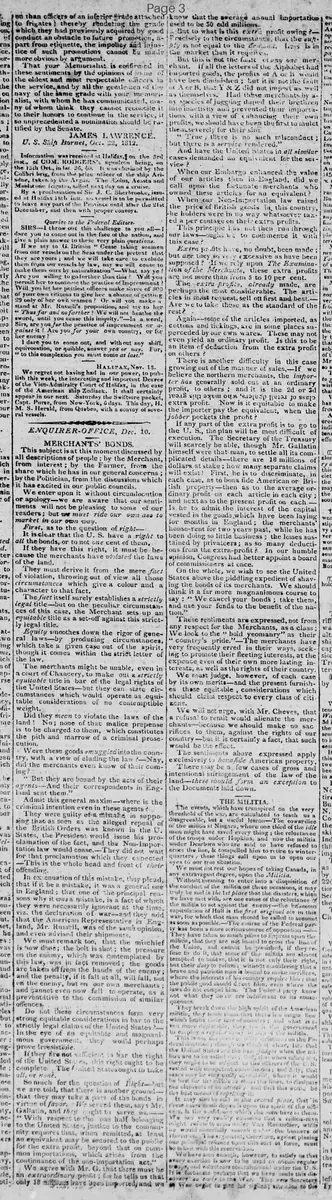
ENQUIRER-OFFICE, Dec. 10.
MERCHANTS' BONDS.
This subject is at this moment discussed by all descriptions of people; by the Merchant, from interest; by the Farmer, from the share which he has in our general concerns; by the Politician, from the discussions which it has excited in our public councils.
We enter upon it without circumlocution or apology—we are aware that our sentiments will not be pleasing to some of our readers; but we must ride our own ass to market in our own way.
First, as to the question of right—It is clear that the U. S. have a right to all the bonds, or to not one cent of them. If they have this right, it must be because the merchants have violated the laws of the land. They must derive it from the mere fact of violation, throwing out of view all those circumstances which give a colour and a character to that fact. The fact itself surely establishes a strictly legal title—but on the peculiar circumstances of this case, the Merchant sets up an equitable title as a set-off against this strictly legal title. Equity smoothes down the rigor of general laws—by producing circumstances, which take a given case out of the spirit, though it comes within the strict letter of the law. The merchants might be unable, even in a court of Chancery, to make out a strictly equitable title in bar of the legal rights of the United States—but they can state circumstances which would operate as equitable considerations of no contemptible weight.
Did they mean to violate the laws of the land! No; none of that malice prepense is to be charged to them, which constitutes the pith and marrow of a criminal prosecution. Were these goods smuggled into the country, with a view of eluding the law?—Nay, did the merchants even know of their coming?
'But they are bound by the acts of their agents—And their correspondents in England sent them.'
Admit this general maxim—where is the criminal intention even in these agents?... They were guilty of a mistake in supposing that as soon as the alleged repeal of the British Orders was known in the U. States, the President would issue his proclamation of the fact, and the Non-Importation law would cease.—They did not wait for that proclamation which they expected—This is the whole head and front of their offending,
In extenuation of this mistake, they plead, that if it be a mistake, it was a general one in England; that one of the principal reasons why it was a mistake, is a fact of which they were necessarily ignorant at the time, viz. the declaration of war—and they add that the American Representative in England, Mr. Russell, was of the same opinion, and even advised their shipments.
We must remark too, that the mischief is now done; the bolt is shot; the pressure on the enemy, which was contemplated by this law, was in fact removed; the goods are taken off from the hands of the enemy; and the penalty, if it fall at all, will fall, not on the enemy, but on our own merchants; and cannot even now fail to operate, as a preventative to the commission of similar offences,
Do not these circumstances form very strong equitable considerations in bar to the strictly legal claims of the United States—In the eye of an equitable and magnanimous government, they would perhaps prove irresistible.
If they are not sufficient to bar the right of the United States, this right ought to be complete. The United States ought to take all, or none.
So much for the question of Right—but we are told, that there is another ground—that they may take a part of the bonds in virtue of favor. We served them, says Mr. Gallatin, and they ought to serve us.—
'With respect to the one half belonging to the United States, justice to the community requires that, when remitted, at least an equivalent may be secured to the public for the extra profit, beyond that on common importations, which arises from the continuance of the non-importation act.'
We agree with Mr. G. that there must be an extraordinary profit; for he tells us that only 18 millions have been imported/and we know that the average annual importation used to be 50 odd millions.
But to what is this extra profit owing?—Precisely to the circumstance, that the supply is not equal to the demand. Less is in the market than it requires.
But this is not the fault of any one merchant. If all the letters of the Alphabet had imported goods, the profits of A or B would have been diminished; but it is not the fault of A or B, that Y & Z did not import as well as themselves. Had these merchants by any species of juggling duped their brethren into inactivity and prevented their importations with a view of enhancing their own profits, we should have been the first to mulct them severely for their sins.
'True, there is no such misconduct; but there is a service rendered.'
And have the United States in all similar cases demanded an equivalent for the service?
When our Embargo enhanced the value of our articles then in England, did we call upon the fortunate merchants who owned these articles for an equivalent?
When our Non-Importation law raised the price of British goods in this country, the holders were in no way whatsoever taxed a percentage on their extra profits.
This principle has not yet run through our laws—ought we to commence it with this case?
Extra profits have, no doubt, been made: but are they so very excessive as have been supposed? If we rely upon The Examination of the Merchants, these extra profits are not more than from 5 to 10 per cent.
The extra profits, already made, are perhaps the most considerable. The articles in most request, sell off first and best.
Are we to take these as the standard of the rest?
Again—some of the articles imported, as cottons and tickings, are in some places superceded by our own wares. These may not even yield an ordinary profit. Is this to be an item of deduction from the extra profit on others?
There is another difficulty in this case growing out of the manner of sales,—If we believe the northern merchants, the importer has generally sold out at an ordinary profit, to others; and it is the 2d or 3d extra profit. Now is it equitable to make the importer pay the equivalent, when the jobber pockets the profit?
If any part of the extra profit is to go to the U. S., the plan will be most difficult of execution. The Secretary of the Treasury will scarcely be able, though Mr. Gallatin himself were that man, to settle all its complicated details—there are 18 millions of dollars at stake; how many separate claims will exist! First, he is to discriminate, in each case, as to bona fide American or British property—then as to the average ordinary profit on each article in each city; and next as to the present profit on each.—Is he to admit the interest of the capital vested in the goods which have been laying for months in England; the merchants house-rent for two years past; while he has been doing so little business; the losses sustained by privateers; as so many deductions from the extra-profit? In our humble opinion, Congress had better appoint a board of commissioners at once.
On the whole, we wish to see the United States above the piddling expedient of shaving the bonds of its merchants. We should think it a far more magnanimous course to say: 'We cancel your bonds; take them, and use your funds to the benefit of the nation.'
These sentiments are expressed, not from any respect for the Merchants, as a class; We look to the "bold yeomanry" as their "country's pride."—The merchants have very frequently erred in their ways, seeking to promote their fleeting interests, at the expense even of their own more lasting interests, as well as the rights of their country.
We must judge, however, of each case by its own merits—and the present furnishes those equitable, considerations which should claim respect to every class of citizens.
We will not urge, with Mr. Cheves, that a refusal to remit would alienate the merchants—because we should make no sacrifices to them, against the rights of our country—but it is certainly a fact, that such would be the effect.
The sentiments above expressed apply exclusively to bona fide American property,
There may be a few cases of gross and intentional infringement of the law of the land—these should form an exception to the Doctrines laid down.
MERCHANTS' BONDS.
This subject is at this moment discussed by all descriptions of people; by the Merchant, from interest; by the Farmer, from the share which he has in our general concerns; by the Politician, from the discussions which it has excited in our public councils.
We enter upon it without circumlocution or apology—we are aware that our sentiments will not be pleasing to some of our readers; but we must ride our own ass to market in our own way.
First, as to the question of right—It is clear that the U. S. have a right to all the bonds, or to not one cent of them. If they have this right, it must be because the merchants have violated the laws of the land. They must derive it from the mere fact of violation, throwing out of view all those circumstances which give a colour and a character to that fact. The fact itself surely establishes a strictly legal title—but on the peculiar circumstances of this case, the Merchant sets up an equitable title as a set-off against this strictly legal title. Equity smoothes down the rigor of general laws—by producing circumstances, which take a given case out of the spirit, though it comes within the strict letter of the law. The merchants might be unable, even in a court of Chancery, to make out a strictly equitable title in bar of the legal rights of the United States—but they can state circumstances which would operate as equitable considerations of no contemptible weight.
Did they mean to violate the laws of the land! No; none of that malice prepense is to be charged to them, which constitutes the pith and marrow of a criminal prosecution. Were these goods smuggled into the country, with a view of eluding the law?—Nay, did the merchants even know of their coming?
'But they are bound by the acts of their agents—And their correspondents in England sent them.'
Admit this general maxim—where is the criminal intention even in these agents?... They were guilty of a mistake in supposing that as soon as the alleged repeal of the British Orders was known in the U. States, the President would issue his proclamation of the fact, and the Non-Importation law would cease.—They did not wait for that proclamation which they expected—This is the whole head and front of their offending,
In extenuation of this mistake, they plead, that if it be a mistake, it was a general one in England; that one of the principal reasons why it was a mistake, is a fact of which they were necessarily ignorant at the time, viz. the declaration of war—and they add that the American Representative in England, Mr. Russell, was of the same opinion, and even advised their shipments.
We must remark too, that the mischief is now done; the bolt is shot; the pressure on the enemy, which was contemplated by this law, was in fact removed; the goods are taken off from the hands of the enemy; and the penalty, if it fall at all, will fall, not on the enemy, but on our own merchants; and cannot even now fail to operate, as a preventative to the commission of similar offences,
Do not these circumstances form very strong equitable considerations in bar to the strictly legal claims of the United States—In the eye of an equitable and magnanimous government, they would perhaps prove irresistible.
If they are not sufficient to bar the right of the United States, this right ought to be complete. The United States ought to take all, or none.
So much for the question of Right—but we are told, that there is another ground—that they may take a part of the bonds in virtue of favor. We served them, says Mr. Gallatin, and they ought to serve us.—
'With respect to the one half belonging to the United States, justice to the community requires that, when remitted, at least an equivalent may be secured to the public for the extra profit, beyond that on common importations, which arises from the continuance of the non-importation act.'
We agree with Mr. G. that there must be an extraordinary profit; for he tells us that only 18 millions have been imported/and we know that the average annual importation used to be 50 odd millions.
But to what is this extra profit owing?—Precisely to the circumstance, that the supply is not equal to the demand. Less is in the market than it requires.
But this is not the fault of any one merchant. If all the letters of the Alphabet had imported goods, the profits of A or B would have been diminished; but it is not the fault of A or B, that Y & Z did not import as well as themselves. Had these merchants by any species of juggling duped their brethren into inactivity and prevented their importations with a view of enhancing their own profits, we should have been the first to mulct them severely for their sins.
'True, there is no such misconduct; but there is a service rendered.'
And have the United States in all similar cases demanded an equivalent for the service?
When our Embargo enhanced the value of our articles then in England, did we call upon the fortunate merchants who owned these articles for an equivalent?
When our Non-Importation law raised the price of British goods in this country, the holders were in no way whatsoever taxed a percentage on their extra profits.
This principle has not yet run through our laws—ought we to commence it with this case?
Extra profits have, no doubt, been made: but are they so very excessive as have been supposed? If we rely upon The Examination of the Merchants, these extra profits are not more than from 5 to 10 per cent.
The extra profits, already made, are perhaps the most considerable. The articles in most request, sell off first and best.
Are we to take these as the standard of the rest?
Again—some of the articles imported, as cottons and tickings, are in some places superceded by our own wares. These may not even yield an ordinary profit. Is this to be an item of deduction from the extra profit on others?
There is another difficulty in this case growing out of the manner of sales,—If we believe the northern merchants, the importer has generally sold out at an ordinary profit, to others; and it is the 2d or 3d extra profit. Now is it equitable to make the importer pay the equivalent, when the jobber pockets the profit?
If any part of the extra profit is to go to the U. S., the plan will be most difficult of execution. The Secretary of the Treasury will scarcely be able, though Mr. Gallatin himself were that man, to settle all its complicated details—there are 18 millions of dollars at stake; how many separate claims will exist! First, he is to discriminate, in each case, as to bona fide American or British property—then as to the average ordinary profit on each article in each city; and next as to the present profit on each.—Is he to admit the interest of the capital vested in the goods which have been laying for months in England; the merchants house-rent for two years past; while he has been doing so little business; the losses sustained by privateers; as so many deductions from the extra-profit? In our humble opinion, Congress had better appoint a board of commissioners at once.
On the whole, we wish to see the United States above the piddling expedient of shaving the bonds of its merchants. We should think it a far more magnanimous course to say: 'We cancel your bonds; take them, and use your funds to the benefit of the nation.'
These sentiments are expressed, not from any respect for the Merchants, as a class; We look to the "bold yeomanry" as their "country's pride."—The merchants have very frequently erred in their ways, seeking to promote their fleeting interests, at the expense even of their own more lasting interests, as well as the rights of their country.
We must judge, however, of each case by its own merits—and the present furnishes those equitable, considerations which should claim respect to every class of citizens.
We will not urge, with Mr. Cheves, that a refusal to remit would alienate the merchants—because we should make no sacrifices to them, against the rights of our country—but it is certainly a fact, that such would be the effect.
The sentiments above expressed apply exclusively to bona fide American property,
There may be a few cases of gross and intentional infringement of the law of the land—these should form an exception to the Doctrines laid down.
What sub-type of article is it?
Economic Policy
Legal Reform
War Or Peace
What keywords are associated?
Merchants Bonds
Non Importation Law
Equitable Considerations
Extra Profits
War Declaration
British Orders
Gallatin Proposal
Bond Remission
What entities or persons were involved?
United States
Merchants
Mr. Gallatin
Mr. Russell
Mr. Cheves
President
Editorial Details
Primary Topic
Remission Of Merchants' Bonds For Non Importation Law Violations
Stance / Tone
Advocates Equitable Remission Of Bonds Over Strict Enforcement
Key Figures
United States
Merchants
Mr. Gallatin
Mr. Russell
Mr. Cheves
President
Key Arguments
U.S. Has Strict Legal Right To Bonds If Laws Violated, But Equitable Considerations Mitigate Due To Lack Of Intent
Merchants' Agents Mistook Repeal Of British Orders And Expected Presidential Proclamation Ending Non Importation
War Declaration Unknown To Agents; Mr. Russell Advised Shipments
Mischief Done; Penalty Would Harm U.S. Merchants, Not Enemy
U.S. Should Take All Bonds Or None; Partial Remission For 'Service' Unfair
Extra Profits Due To Market Scarcity, Not Merchant Fault; Past Policies Didn't Tax Similar Gains
Administrative Complexity In Calculating Extra Profits Makes Partial Remission Impractical
Recommend Full Cancellation Of Bonds For National Benefit
Applies Only To Bona Fide American Property; Exceptions For Intentional Violations