Thank you for visiting SNEWPapers!
Sign up free
Story
February 16, 1795
Gazette Of The United States And Daily Evening Advertiser
Philadelphia, Philadelphia County, Pennsylvania
What is this article about?
Transcript of a debate in the U.S. House of Representatives on February 6, where Mr. Findley argues against extending excise revenue laws from two to six years without sufficient practical data on their effectiveness and impact on manufacturers and public debt repayment.
Clipping
OCR Quality
95%
Excellent
Full Text
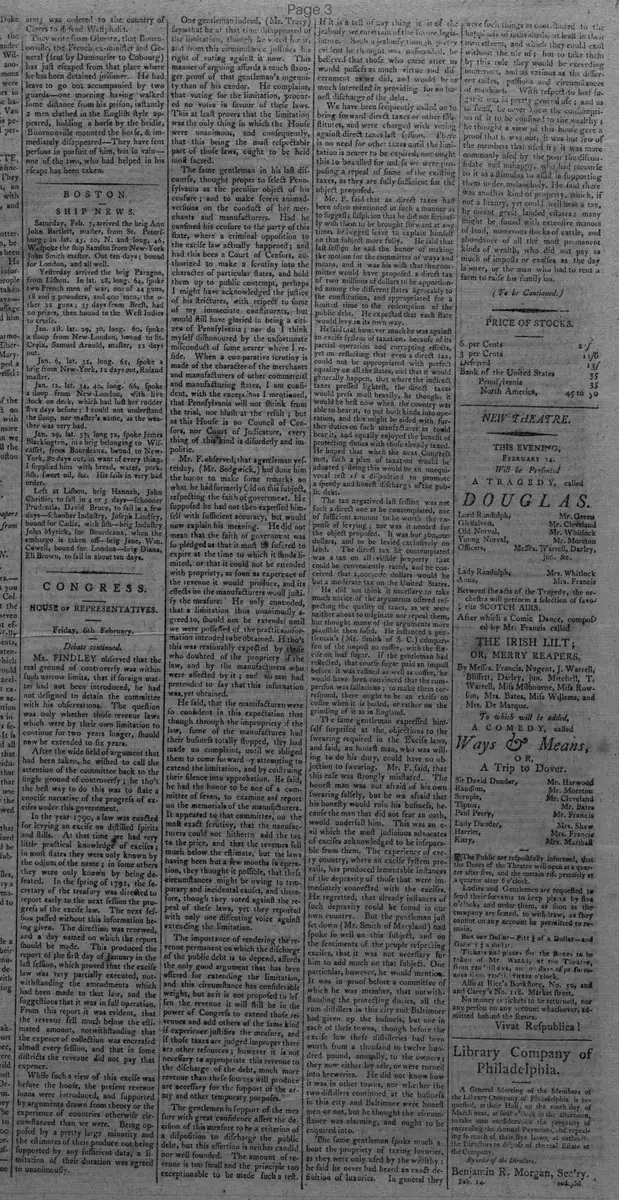
CONGRESS.
HOUSE OF REPRESENTATIVES.
Friday, 6th February.
Debate continued
MR. FINDLEY observed that the real ground of controversy was within such narrow limits, that if foreign matter had not been introduced, he had not deigned to detain the committee with his observations. The question was only whether those revenue laws which were by their own limitation to continue for two years longer, should now be extended to six years.
After the wide field of argument that had been taken, he wished to call the attention of the committee back to the single ground of controversy; he thought the best way to do this was to state a concise narrative of the progress of excises under this government.
In the year 1790, a law was enacted for levying an excise on distilled spirits and stills. At that time we had very little practical knowledge of excises; in most states they were only known by the odium of the name; in some others they were only known by being defeated. In the spring of 1791, the Secretary of the Treasury was directed to report early to the next session the progress of the excise law. The next session passed without this information being given. The direction was renewed, and a day named on which the report should be made. This produced the report of the first day of January in the last session, which proved that the excise law was very partially executed, notwithstanding the amendments which had been made to that law, and the suggestions that it was in full operation.
From this report it was evident, that the revenue fell much below the estimated amount, notwithstanding that the expense of collection was increased almost every session, and that in some districts the revenue did not pay that expense.
While such a view of this excise was before the house, the present revenue loans were introduced, and supported by arguments drawn from theory or the experience of countries otherwise circumstanced than we were. Being opposed by a pretty large minority and the estimates of their produce not being supported by any sufficient data, a limitation of their duration was agreed to unanimously.
One gentleman indeed, (Mr. Tracy) says that he at that time disapproved of the limitation, though he voted for it, and from this circumstance justifies his right of voting against it now. This manner of arguing affords a much stronger proof of that gentleman's ingenuity than of his candor. He complains, that voting for the limitation, procured no votes in favour of these laws. This at least proves that the limitation was the only thing in which the House were unanimous, and consequently, that this being the most respectable part of those laws, ought to be held most sacred.
The same gentleman in his last discourse, thought proper to select Pennsylvania as the peculiar object of his censure; and to make severe animadversions on the conduct of her merchants and manufacturers. Had he confined his censure to the party of this state, where a criminal opposition to the excise law actually happened; and had this been a Court of Censors, authorized to make a scrutiny into the character of particular states, and hold them up to public contempt, perhaps I might have acknowledged the justice of his strictures, with respect to some of my immediate constituents, but would still have gloried in being a citizen of Pennsylvania; nor do I think myself dishonoured by the unfortunate misconduct of some nearer where I reside, When a comparative scrutiny is made of the character of the merchants and manufacturers of other commercial and manufacturing states, I am confident, with the exceptions I mentioned, that Pennsylvania will not shrink from the trial, nor blush at the result; but as this House is no Council of Censors, nor Court of Judicature, every thing of this kind is disorderly and impolitic.
Mr. F. observed; that a gentleman yesterday, (Mr. Sedgwick,) had done him the honor to make some remarks on what he had formerly said on this subject, respecting the faith of government. He supposed he had not then expressed himself with sufficient accuracy, but would now explain his meaning. He did not mean that the faith of government was so pledged as that it must be suffered to expire at the time to which it stands limited, or that it could not be extended with propriety, as soon as experience of the revenue it would produce, and its effects on the manufacturers would justify the measure: He only contended, that a limitation thus unanimously agreed to, should not be extended until we were possessed of the practical information intended to be obtained. He thought this was reasonably expected by those who doubted of the propriety of the law, and by the manufacturers who were affected by it; and no man had pretended to say that this information was yet obtained.
He said, that the manufacturers were so confident in this expectation that though through the impropriety of the law, some of the manufacturers had their business totally stopped, they had made no complaint, until we obliged them to come forward by attempting to extend the limitation, and by construing their silence into approbation. He said, he had the honor to be one of a committee of seven, to examine and report on the memorials of the manufacturers. It appeared to that committee, on the most exact scrutiny, that the manufacturers could not hitherto add the tax to the price, and that the revenues fell much below the estimate, but the laws having been but a few months in operation, they thought it possible, that these circumstances might be owing to temporary and incidental causes, and therefore, though they voted against the repeal of these laws, yet they reported with only one dissenting voice against extending the limitation.
The importance of rendering the revenue permanent on which the discharge of the public debt is to depend, affords the only good argument that has been offered for extending the limitation, and this circumstance has considerable weight, but as it is not proposed to lessen the revenue it will still be in the power of Congress to extend those revenues and add others of the same kind if experience justifies the measure, and if those taxes are judged improper there are other resources; however it is not necessary to appropriate this revenue to the discharge of the debt, much more revenue than these sources will produce are necessary for the support of the army and other temporary purposes.
The gentlemen in support of the measure with great confidence assert the decision of this measure to be a criterion of a disposition to discharge the public debt, but this assertion is neither candid nor well founded. The amount of revenue is too small and the principle too exceptionable to be made such a test.
If it is a test of any thing it is of the jealousy we entertain of the future legislature. Such a jealousy though pretty evident he thought was unfounded, he believed that those who came after us would possess as much virtue and discernment as we did, and would be as much interested in providing for an honest discharge of the debt.
We have been frequently called on to bring forward direct taxes or other substitutes, and were charged with voting against direct taxes last session. There is no need for other taxes until the limitation is nearer to be expired, nor ought this to be called for unless we were proposing a repeal of some of the existing taxes, as they are fully sufficient for the object proposed.
Mr. F. said that as direct taxes had been often mentioned in such a manner as to suggest suspicion that he did not seriously wish them to be brought forward at any time, he begged leave to explain himself on that subject more fully. He said that last session he had the honor of making the motion for the committee of ways and means, and it was his wish that the committee would have proposed a direct tax of two millions of dollars to be apportioned among the different states agreeably to the constitution, and appropriated for a limited time to the redemption of the public debt. He expected that each state would levy in its own way.
He said that however much he was against an excise system of taxation, because of its partial operation and corrupting effects, yet on reflecting that even a direct tax, could not be appropriated with perfect equality on all the states, and that it would generally happen, that where the indirect taxes pressed lightest, the direct taxes would press most heavily, he thought it would be best now when the country was able to bear it, to put both kinds into operation, and this might be aided with further duties on such manufactures as could bear it, and equally enjoyed the benefit of protecting duties with those already taxed.
He hoped that when the next Congress met, such a plan of taxation would be adopted; doing this would be an unequivocal test of a disposition to promote a speedy and honest discharge of the public debt.
The tax negatived last session was not such a direct one as he contemplated, nor of sufficient amount to be worth the expense of levying; nor was it needed for the object proposed. It was but 50,000 dollars, and to be levied exclusively on land. The direct tax he contemplated was a tax on all visible property that could be conveniently rated, and he conceived that 2,000,000 dollars would be but a moderate tax on the United States.
He did not think it necessary to take much notice of the arguments offered respecting the quality of taxes, as we were neither about to originate nor repeal them, but thought many of the arguments more plausible than solid. He instanced a gentleman's (Mr. Smith of S. C.) comparison of the impost on coffee, with the Excise on loaf sugar. If the gentleman had reflected, that coarse sugar paid an impost before it was refined as well as coffee, he would have been convinced that the comparison was fallacious; to make them correspond, there ought to be an excise on coffee when it is boiled, or rather on the grinding of it as in England.
The same gentleman expressed himself surprised at the objections to the swearing required in the Excise laws, and said, an honest man, who was willing to do his duty, could have no objection to swearing. Mr. F. said, that this case was strongly misstated. The honest man was not afraid of his own swearing falsely, but he was afraid that his honesty would ruin his business, because the man that did not fear an oath, would undersell him. This was an evil which the most judicious advocates of excises acknowledged to be inseparable from them. The experience of every country, where an excise system prevails, has produced lamentable instances of the depravity of those that were immediately connected with the excises.
He regretted, that already instances of such depravity could be found in our own country. But the gentleman just set down (Mr. Smith of Maryland) had spoken so well on this subject, and on the sentiments of the people respecting excises, that it was not necessary for him to add much on that subject. One particular, however, he would mention. It was in proof before a committee of which he was member, that notwithstanding the protecting duties, all the rum distillers in this city and Baltimore had given up the business, but one in each of these towns, though before the excise law these distilleries had been worth from a thousand to twelve hundred pounds, annually, to the owners; they now either lay idle, or were turned into breweries. He did not know how it was in other towns, nor whether the two distillers continued at the business in this city and Baltimore were honest men or not, but he thought the circumstance was alarming, and ought to be enquired into.
The same gentleman spoke much about the propriety of taxing luxuries, as they were only used by the wealthy: he said he never had heard an exact definition of luxuries. In general they were such things as contributed to the happiness of individuals, at least in their own esteem, and which they could exist without the title of; but to take them by this rule they would be exceedingly numerous, and as various as the different tastes, passions and circumstances of mankind. With respect to loaf sugar it was in pretty general use; and as to its use, he never knew the consumption of it to be confined to the wealthy; he thought a view of this house gave a proof that it was not; it was but few of the members that used it; it was more commonly used by the poor the disconsolate and unhappy, who had recourse to it as a stimulus to aid in supporting them under melancholy. He said there was another kind of property, which, if not a luxury, yet could well bear a tax, he meant great landed estates: many might be found with extensive manors of land, numerous stocks of cattle, and abundance of all the most permanent kinds of wealth, who did not pay as much of imposts or excises as the day labourer, or the man who had to rent a farm to raise his family on.
(To be Continued.)
HOUSE OF REPRESENTATIVES.
Friday, 6th February.
Debate continued
MR. FINDLEY observed that the real ground of controversy was within such narrow limits, that if foreign matter had not been introduced, he had not deigned to detain the committee with his observations. The question was only whether those revenue laws which were by their own limitation to continue for two years longer, should now be extended to six years.
After the wide field of argument that had been taken, he wished to call the attention of the committee back to the single ground of controversy; he thought the best way to do this was to state a concise narrative of the progress of excises under this government.
In the year 1790, a law was enacted for levying an excise on distilled spirits and stills. At that time we had very little practical knowledge of excises; in most states they were only known by the odium of the name; in some others they were only known by being defeated. In the spring of 1791, the Secretary of the Treasury was directed to report early to the next session the progress of the excise law. The next session passed without this information being given. The direction was renewed, and a day named on which the report should be made. This produced the report of the first day of January in the last session, which proved that the excise law was very partially executed, notwithstanding the amendments which had been made to that law, and the suggestions that it was in full operation.
From this report it was evident, that the revenue fell much below the estimated amount, notwithstanding that the expense of collection was increased almost every session, and that in some districts the revenue did not pay that expense.
While such a view of this excise was before the house, the present revenue loans were introduced, and supported by arguments drawn from theory or the experience of countries otherwise circumstanced than we were. Being opposed by a pretty large minority and the estimates of their produce not being supported by any sufficient data, a limitation of their duration was agreed to unanimously.
One gentleman indeed, (Mr. Tracy) says that he at that time disapproved of the limitation, though he voted for it, and from this circumstance justifies his right of voting against it now. This manner of arguing affords a much stronger proof of that gentleman's ingenuity than of his candor. He complains, that voting for the limitation, procured no votes in favour of these laws. This at least proves that the limitation was the only thing in which the House were unanimous, and consequently, that this being the most respectable part of those laws, ought to be held most sacred.
The same gentleman in his last discourse, thought proper to select Pennsylvania as the peculiar object of his censure; and to make severe animadversions on the conduct of her merchants and manufacturers. Had he confined his censure to the party of this state, where a criminal opposition to the excise law actually happened; and had this been a Court of Censors, authorized to make a scrutiny into the character of particular states, and hold them up to public contempt, perhaps I might have acknowledged the justice of his strictures, with respect to some of my immediate constituents, but would still have gloried in being a citizen of Pennsylvania; nor do I think myself dishonoured by the unfortunate misconduct of some nearer where I reside, When a comparative scrutiny is made of the character of the merchants and manufacturers of other commercial and manufacturing states, I am confident, with the exceptions I mentioned, that Pennsylvania will not shrink from the trial, nor blush at the result; but as this House is no Council of Censors, nor Court of Judicature, every thing of this kind is disorderly and impolitic.
Mr. F. observed; that a gentleman yesterday, (Mr. Sedgwick,) had done him the honor to make some remarks on what he had formerly said on this subject, respecting the faith of government. He supposed he had not then expressed himself with sufficient accuracy, but would now explain his meaning. He did not mean that the faith of government was so pledged as that it must be suffered to expire at the time to which it stands limited, or that it could not be extended with propriety, as soon as experience of the revenue it would produce, and its effects on the manufacturers would justify the measure: He only contended, that a limitation thus unanimously agreed to, should not be extended until we were possessed of the practical information intended to be obtained. He thought this was reasonably expected by those who doubted of the propriety of the law, and by the manufacturers who were affected by it; and no man had pretended to say that this information was yet obtained.
He said, that the manufacturers were so confident in this expectation that though through the impropriety of the law, some of the manufacturers had their business totally stopped, they had made no complaint, until we obliged them to come forward by attempting to extend the limitation, and by construing their silence into approbation. He said, he had the honor to be one of a committee of seven, to examine and report on the memorials of the manufacturers. It appeared to that committee, on the most exact scrutiny, that the manufacturers could not hitherto add the tax to the price, and that the revenues fell much below the estimate, but the laws having been but a few months in operation, they thought it possible, that these circumstances might be owing to temporary and incidental causes, and therefore, though they voted against the repeal of these laws, yet they reported with only one dissenting voice against extending the limitation.
The importance of rendering the revenue permanent on which the discharge of the public debt is to depend, affords the only good argument that has been offered for extending the limitation, and this circumstance has considerable weight, but as it is not proposed to lessen the revenue it will still be in the power of Congress to extend those revenues and add others of the same kind if experience justifies the measure, and if those taxes are judged improper there are other resources; however it is not necessary to appropriate this revenue to the discharge of the debt, much more revenue than these sources will produce are necessary for the support of the army and other temporary purposes.
The gentlemen in support of the measure with great confidence assert the decision of this measure to be a criterion of a disposition to discharge the public debt, but this assertion is neither candid nor well founded. The amount of revenue is too small and the principle too exceptionable to be made such a test.
If it is a test of any thing it is of the jealousy we entertain of the future legislature. Such a jealousy though pretty evident he thought was unfounded, he believed that those who came after us would possess as much virtue and discernment as we did, and would be as much interested in providing for an honest discharge of the debt.
We have been frequently called on to bring forward direct taxes or other substitutes, and were charged with voting against direct taxes last session. There is no need for other taxes until the limitation is nearer to be expired, nor ought this to be called for unless we were proposing a repeal of some of the existing taxes, as they are fully sufficient for the object proposed.
Mr. F. said that as direct taxes had been often mentioned in such a manner as to suggest suspicion that he did not seriously wish them to be brought forward at any time, he begged leave to explain himself on that subject more fully. He said that last session he had the honor of making the motion for the committee of ways and means, and it was his wish that the committee would have proposed a direct tax of two millions of dollars to be apportioned among the different states agreeably to the constitution, and appropriated for a limited time to the redemption of the public debt. He expected that each state would levy in its own way.
He said that however much he was against an excise system of taxation, because of its partial operation and corrupting effects, yet on reflecting that even a direct tax, could not be appropriated with perfect equality on all the states, and that it would generally happen, that where the indirect taxes pressed lightest, the direct taxes would press most heavily, he thought it would be best now when the country was able to bear it, to put both kinds into operation, and this might be aided with further duties on such manufactures as could bear it, and equally enjoyed the benefit of protecting duties with those already taxed.
He hoped that when the next Congress met, such a plan of taxation would be adopted; doing this would be an unequivocal test of a disposition to promote a speedy and honest discharge of the public debt.
The tax negatived last session was not such a direct one as he contemplated, nor of sufficient amount to be worth the expense of levying; nor was it needed for the object proposed. It was but 50,000 dollars, and to be levied exclusively on land. The direct tax he contemplated was a tax on all visible property that could be conveniently rated, and he conceived that 2,000,000 dollars would be but a moderate tax on the United States.
He did not think it necessary to take much notice of the arguments offered respecting the quality of taxes, as we were neither about to originate nor repeal them, but thought many of the arguments more plausible than solid. He instanced a gentleman's (Mr. Smith of S. C.) comparison of the impost on coffee, with the Excise on loaf sugar. If the gentleman had reflected, that coarse sugar paid an impost before it was refined as well as coffee, he would have been convinced that the comparison was fallacious; to make them correspond, there ought to be an excise on coffee when it is boiled, or rather on the grinding of it as in England.
The same gentleman expressed himself surprised at the objections to the swearing required in the Excise laws, and said, an honest man, who was willing to do his duty, could have no objection to swearing. Mr. F. said, that this case was strongly misstated. The honest man was not afraid of his own swearing falsely, but he was afraid that his honesty would ruin his business, because the man that did not fear an oath, would undersell him. This was an evil which the most judicious advocates of excises acknowledged to be inseparable from them. The experience of every country, where an excise system prevails, has produced lamentable instances of the depravity of those that were immediately connected with the excises.
He regretted, that already instances of such depravity could be found in our own country. But the gentleman just set down (Mr. Smith of Maryland) had spoken so well on this subject, and on the sentiments of the people respecting excises, that it was not necessary for him to add much on that subject. One particular, however, he would mention. It was in proof before a committee of which he was member, that notwithstanding the protecting duties, all the rum distillers in this city and Baltimore had given up the business, but one in each of these towns, though before the excise law these distilleries had been worth from a thousand to twelve hundred pounds, annually, to the owners; they now either lay idle, or were turned into breweries. He did not know how it was in other towns, nor whether the two distillers continued at the business in this city and Baltimore were honest men or not, but he thought the circumstance was alarming, and ought to be enquired into.
The same gentleman spoke much about the propriety of taxing luxuries, as they were only used by the wealthy: he said he never had heard an exact definition of luxuries. In general they were such things as contributed to the happiness of individuals, at least in their own esteem, and which they could exist without the title of; but to take them by this rule they would be exceedingly numerous, and as various as the different tastes, passions and circumstances of mankind. With respect to loaf sugar it was in pretty general use; and as to its use, he never knew the consumption of it to be confined to the wealthy; he thought a view of this house gave a proof that it was not; it was but few of the members that used it; it was more commonly used by the poor the disconsolate and unhappy, who had recourse to it as a stimulus to aid in supporting them under melancholy. He said there was another kind of property, which, if not a luxury, yet could well bear a tax, he meant great landed estates: many might be found with extensive manors of land, numerous stocks of cattle, and abundance of all the most permanent kinds of wealth, who did not pay as much of imposts or excises as the day labourer, or the man who had to rent a farm to raise his family on.
(To be Continued.)
What sub-type of article is it?
Congressional Debate
Legislative Speech
What keywords are associated?
Excise Law
Revenue Extension
Public Debt
Direct Taxes
Congressional Debate
Manufacturers Impact
Taxation Policy
What entities or persons were involved?
Mr. Findley
Mr. Tracy
Mr. Sedgwick
Mr. Smith Of S. C.
Mr. Smith Of Maryland
Where did it happen?
House Of Representatives
Story Details
Key Persons
Mr. Findley
Mr. Tracy
Mr. Sedgwick
Mr. Smith Of S. C.
Mr. Smith Of Maryland
Location
House Of Representatives
Event Date
Friday, 6th February
Story Details
Mr. Findley delivers a speech opposing the extension of excise revenue laws, reviewing their history since 1790, criticizing their partial execution and impact on manufacturers, defending Pennsylvania, advocating for direct taxes instead, and refuting arguments on tax equity and luxuries.