Thank you for visiting SNEWPapers!
Sign up free
The Holly Chieftain
Holly, Prowers County, Colorado
What is this article about?
Germany's May 30, 1915, diplomatic reply to the US note on submarine attacks defends actions against Lusitania, Cushing, and Gulflight, claiming self-defense due to armament and ammunition aboard, expresses regret for neutral losses, and proposes investigation, disappointing US officials who seek reparation and guarantees.
Clipping
OCR Quality
Full Text
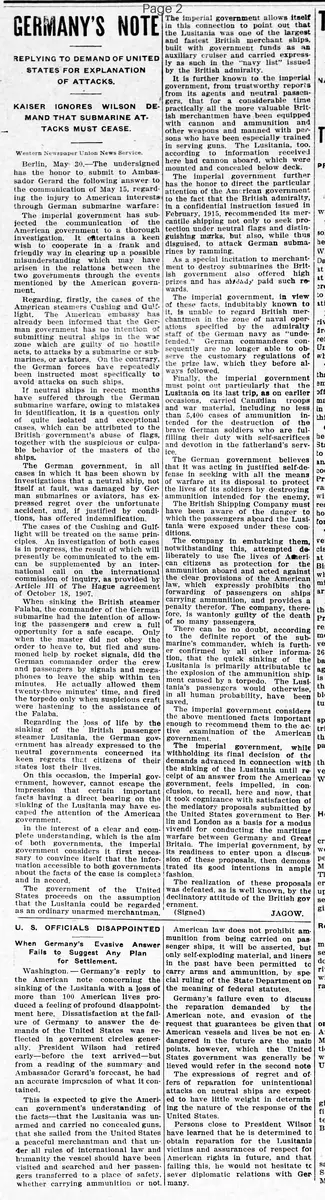
REPLYING TO DEMAND OF UNITED STATES FOR EXPLANATION OF ATTACKS.
KAISER IGNORES WILSON DEMAND THAT SUBMARINE ATTACKS MUST CEASE.
Western Newspaper Union News Service.
Berlin, May 30.-The undersigned has the honor to submit to Ambassador Gerard the following answer to the communication of May 15, regarding the injury to American interests through German submarine warfare:
The imperial government has subjected the communication of the American government to a thorough investigation. It entertains a keen wish to cooperate in a frank and friendly way in clearing up a possible misunderstanding which may have arisen in the relations between the two governments through the events mentioned by the American government.
Regarding, firstly, the cases of the American steamers Cushing and Gulflight. The American embassy has already been informed that the German government has no intention of submitting neutral ships in the war zone which are guilty of no hostile acts, to attacks by a submarine or submarines, or aviators. On the contrary, the German forces have repeatedly been instructed most specifically to avoid attacks on such ships.
If neutral ships in recent months have suffered through the German submarine warfare, owing to mistakes in identification, it is a question only of quite isolated and exceptional cases, which can be attributed to the British government's abuse of flags, together with the suspicious or culpable behavior of the masters of the ships.
The German government, in all cases in which it has been shown by investigations that a neutral ship, not itself at fault, was damaged by German submarines or aviators, has expressed regret over the unfortunate accident, and, if justified by conditions, has offered indemnification.
The cases of the Cushing and Gulflight will be treated on the same principles. An investigation of both cases is in progress, the result of which will presently be communicated to the embassy. This can be supplemented by an international commission, the international commission of inquiry, as provided by Article III of The Hague agreement of October 18, 1907.
When sinking the British steamer Falaba, the commander of the German submarine had the intention of allowing the passengers and crew a full opportunity for a safe escape. Only when the master did not obey the order to heave to, but fled and summoned help by rocket signals, did the German commander order the crew and passengers by signals and megaphones to leave the ship within ten minutes. He actually allowed them twenty-three minutes' time, and fired the torpedo only when suspicious craft were hastening to the assistance of the Falaba.
Regarding the loss of life by the sinking of the British passenger steamer Lusitania, the German government has already expressed to the neutral governments concerned its keen regrets that citizens of their states lost their lives.
On this occasion, the imperial government, however, cannot escape the impression that certain important facts having a direct bearing on the sinking of the Lusitania may have escaped the attention of the American government.
In the interest of a clear and complete understanding, which is the aim of both governments, the imperial government considers it first necessary to convince itself that the information accessible to both governments about the facts of the case is complete and in accord.
The government of the United States proceeds on the assumption that the Lusitania could be regarded as an ordinary unarmed merchantman.
U. S. OFFICIALS DISAPPOINTED
When Germany's Evasive Answer Fails to Suggest Any Plan for Settlement.
Washington.-Germany's reply to the American note concerning the sinking of the Lusitania with a loss of more than 100 American lives produced a feeling of profound disappointment here. Dissatisfaction at the failure of Germany to answer the demands of the United States was reflected in government circles generally. President Wilson had retired early-before the text arrived-but from a reading of the summary and Ambassador Gerard's forecast, he had an accurate impression of what it contained.
This is expected to give the American government's understanding of the facts-that the Lusitania was unarmed and carried no concealed guns, that she sailed from the United States a peaceful merchantman and that under all rules of international law and humanity the vessel should have been visited and searched and her passengers transferred to a place of safety, whether carrying ammunition or not.
The imperial government allows itself in this connection to point out that the Lusitania was one of the largest and fastest British merchant ships, built with government funds as an auxiliary cruiser and carried expressly as such in the "navy list" issued by the British admiralty.
It is further known to the imperial government, from trustworthy reports from its agents and neutral passengers, that for a considerable time practically all the more valuable British merchantmen have been equipped with cannon and ammunition and other weapons and manned with persons who have been especially trained in serving guns. The Lusitania, too, according to information received here had cannon aboard, which were mounted and concealed below deck.
The imperial government further has the honor to direct the particular attention of the American government to the fact that the British admiralty, in a confidential instruction issued in February, 1915, recommended its mercantile shipping not only to seek protection under neutral flags and distinguishing marks, but also, while thus disguised, to attack German submarines by ramming.
As a special incitation to merchantmen to destroy submarines the British government also offered high prizes and has already paid such rewards.
The imperial government, in view of these facts, indubitably known to it, is unable to regard British merchantmen in the zone of naval operations specified by the admiralty staff of the German navy as "undefended." German commanders consequently are no longer able to observe the customary regulations of the prize law, which they before always followed.
Finally, the imperial government must point out particularly that the Lusitania on its last trip, as on earlier occasions, carried Canadian troops and war material, including no less than 5,400 cases of ammunition intended for the destruction of the brave German soldiers who are fulfilling their duty with self-sacrifices and devotion in the fatherland's service.
The German government believes that it was acting in justified self-defense in seeking with all the means of warfare at its disposal to protect the lives of its soldiers by destroying ammunition intended for the enemy.
The British Shipping Company must have been aware of the danger to which the passengers aboard the Lusitania were exposed under these conditions. The company in embarking them, notwithstanding this, attempted deliberately to use the lives of American citizens as protection for the ammunition aboard and acted against the clear provisions of the American law, which expressly prohibits the forwarding of passengers on ships carrying ammunition, and provides a penalty therefor. The company, therefore, is wantonly guilty of the death of so many passengers.
There can be no doubt, according to the definite report of the submarine's commander, which is further confirmed by all other information, that the quick sinking of the Lusitania is primarily attributable to the explosion of the ammunition shipment caused by a torpedo. The Lusitania's passengers would otherwise, in all human probability, have been saved.
The imperial government considers the above mentioned facts important enough to recommend them to the active examination of the American government.
The imperial government, while withholding its final decision of the demands advanced in connection with the sinking of the Lusitania until receipt of an answer from the American government, feels impelled, in conclusion, to recall, here and now, that it took cognizance with satisfaction of the mediatory proposals submitted by the United States government to Berlin and London as a basis for a modus vivendi for conducting the maritime warfare between Germany and Great Britain. The imperial government, by its readiness to enter upon a discussion of these proposals, then demonstrated its good intentions in ample fashion.
The realization of these proposals was defeated, as is well known, by the declinatory attitude of the British government.
(Signed) JAGOW.
American law does not prohibit ammunition from being carried on passenger ships, it will be asserted, but only self-exploding material, and liners in the past have been permitted to carry arms and ammunition, by special ruling of the State Department on the meaning of federal statutes.
Germany's failure even to discuss the reparation demanded by the American note, and evasion of the request that guarantees be given that American vessels and lives be not endangered in the future are the main points, however, which the United States government was generally believed would refer in the second note.
The expressions of regret and offers of reparation for unintentional attacks on neutral ships are expected to have little weight in determining the nature of the response of the United States.
Persons close to President Wilson have learned that he is determined to obtain reparation for the Lusitania victims and assurances of respect for American rights in future, and that failing this, he would not hesitate to sever diplomatic relations with Germany.
What sub-type of article is it?
What keywords are associated?
What entities or persons were involved?
Where did it happen?
Foreign News Details
Primary Location
Berlin
Event Date
May 30
Key Persons
Outcome
sinking of lusitania with loss of more than 100 american lives; germany's evasive reply offers investigations and regrets but no guarantees or reparations, leading to us disappointment and potential severance of diplomatic relations.
Event Details
Germany's note to the US defends submarine attacks on Lusitania, claiming it carried ammunition and was armed, justifying self-defense; expresses regret for neutral losses on Cushing, Gulflight, and Falaba; proposes investigations and possible indemnification; US officials disappointed by lack of settlement plan.