Thank you for visiting SNEWPapers!
Sign up free
Kentucky Gazette
Lexington, Fayette County, Kentucky
What is this article about?
In the U.S. House of Representatives on January 9, 1837, John Quincy Adams presented multiple petitions from women urging abolition of slavery in the District of Columbia. Debates ensued over their reception, with objections from Southern members citing agitation and alarm. Votes resulted in some petitions being received but tabled.
Merged-components note: Merged sequential components reporting on House of Representatives proceedings regarding abolition petitions; relabeled to domestic_news as it covers US political news.
Clipping
OCR Quality
Full Text
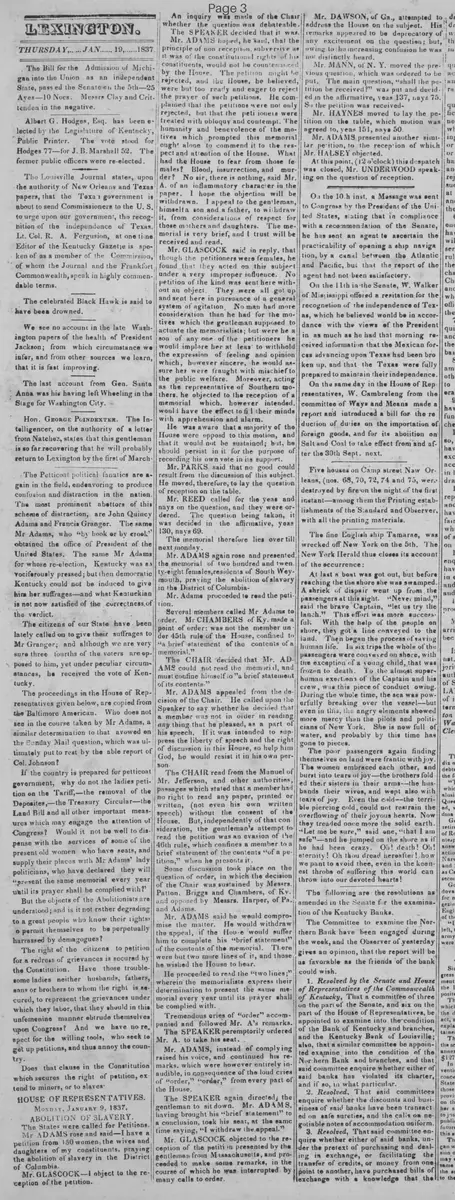
Monday, January 9, 1837.
ABOLITION OF SLAVERY.
The States were called for Petitions.
Mr. ADAMS rose and said—I have a petition from 150 women, the wives and daughters of my constituents, praying the abolition of slavery in the District of Columbia.
Mr. GLASCOCK—I object to the reception of the petition.
An inquiry was made of the Chair whether the question was debatable.
The SPEAKER decided that it was.
Mr. ADAMS hoped, he said, that the principle of non-reception, subversive as it was of the constitutional rights of his constituents, would not be countenanced by the House. The petition might be rejected, and the House, he believed, were but too ready and eager to reject the prayer of such petitions. He complained that the petitions were not only rejected, but that the petitioners were treated with obloquy and contempt. The humanity and benevolence of the motives which prompted this memorial ought alone to commend it to the respect and attention of the House. What had the House to fear from those females? Blood, insurrection, and murder? No sir, there is nothing, said Mr. A. of an inflammatory character in the paper. I hope the objection will be withdrawn. I appeal to the gentleman, himself a son and a father, to withdraw it, from considerations of respect for those mothers and daughters. The memorial is very brief, and I trust will be received and read.
Mr. GLASCOCK said in reply, that though the petitioners were females, he found that they acted on this subject under a very improper influence. No petition of the kind was sent here without an object. They were all got up and sent here in pursuance of a general system of agitation. No man had more consideration than he had for the motives which the gentleman supposed to actuate the memorialists: but were he a son of any one of the petitioners he would implore her at least to withhold the expression of feeling and opinion which, however sincere, he would assure her were fraught with mischief to the public welfare. Moreover, acting as the representative of Southern mothers, he objected to the reception of a memorial which, however intended, would have the effect to fill their minds with apprehension and alarm.
He was aware that a majority of the House were opposed to this motion, and that it would not be sustained; but, he should persist in it for the purpose of recording his own vote in its support.
Mr. PARKS said that no good could result from the discussion of this subject. He moved, therefore, to lay the question of reception on the table.
Mr. REED called for the yeas and nays on the question, and they were ordered. The question being taken, it was decided in the affirmative, yeas 130, nays 69.
The memorial therefore lies over till next Monday.
Mr. ADAMS again rose and presented the memorial of two hundred and twenty-eight females, residents of South Weymouth, praying the abolition of slavery in the District of Columbia—
Mr. Adams proceeded to read the petition.
Several members called Mr. Adams to order. Mr. CHAMBERS of Ky. made a point of order: was not the member under 45th rule of the House, confined to "a brief statement of the contents of a memorial."
The CHAIR decided that Mr. ADAMS could not read the memorial, and must confine himself to "a brief statement of its contents."
Mr. ADAMS appealed from the decision of the Chair. He called upon the Speaker to say whether he decided that a member was not in order in reading anything that he pleased, as a part of his speech. If it was intended to suppress the liberty of speech and the right of discussion in this House, so help him God, he would resist it in his own person.
The CHAIR read from the Manual of Mr. Jefferson, and other authorities, passages which stated that a member had no right to read any paper, printed or written, (not even his own written speech) without the consent of the House. But, independently of that consideration, the gentleman's attempt to read the petition was an evasion of the 46th rule, which confines a member to a brief statement of the contents "of a petition," when he presents it.
Some discussion took place on the question of order, in which the decision of the Chair was sustained by Messrs. Patton, Briggs and Chambers, of Ky. and opposed by Messrs. Harper, of Pa. and Adams.
Mr. ADAMS said he would compromise the matter. He would withdraw the appeal, if the House would suffer him to complete his "brief statement" of the contents of the memorial. There were but two more lines of it, and those he wished the House to hear.
He proceeded to read the "two lines;" wherein the memorialists express their determination to present the same memorial every year until its prayer shall be complied with.
Tremendous cries of "order" accompanied and followed Mr. A's remarks.
The SPEAKER peremptorily ordered Mr. A. to take his seat.
Mr. ADAMS, instead of complying raised his voice, and continued his remarks, which were however entirely inaudible, in consequence of the loud cries of "order," "order," from every part of the House.
The SPEAKER again directed the gentleman to sit down. Mr. ADAMS, having brought his "brief statement" to a conclusion, took his seat, at the same time saying, "I withdraw the appeal."
Mr. GLASCOCK objected to the reception of the petition presented by the gentleman from Massachusetts, and proceeded to make some remarks, in the course of which he was interrupted by many calls to order.
Mr. DAWSON, of Ga., attempted to address the House on the subject. His remarks appeared to be deprecatory of any excitement on the question; but, owing to the increasing confusion he was not distinctly heard.
Mr. MANN, of N. Y. moved the previous question, which was ordered to be put. The main question, "shall the petition be received?" was put and decided in the affirmative, yeas 137, nays 75.
So the petition was received—
Mr. HAYNES moved to lay the petition on the table, which motion was agreed to, yeas 151, nays 50.
Mr. ADAMS presented another similar petition, to the reception of which Mr. HALSEY objected.
At this point, (12 o'clock) this despatch was closed, Mr. UNDERWOOD speaking on the question of reception.
What sub-type of article is it?
What keywords are associated?
What entities or persons were involved?
Where did it happen?
Domestic News Details
Primary Location
Washington, D.C.
Event Date
Monday, January 9, 1837
Key Persons
Outcome
first petition laid on the table (yeas 130, nays 69); second petition received (yeas 137, nays 75) then tabled (yeas 151, nays 50); third petition's reception under debate at close.
Event Details
During the calling of states for petitions, Mr. Adams presented anti-slavery petitions from women constituents. Objections led to debates on reception, points of order regarding reading the petitions, and votes on tabling or receiving them amid heated exchanges and calls for order.