Thank you for visiting SNEWPapers!
Sign up free
New Hampshire Statesman
Concord, Merrimack County, New Hampshire
What is this article about?
Extract from Mr. Tallmadge's speech in the New-York House of Assembly on January 26, opposing caucus nominations for the 1824 presidential election that favor William H. Crawford over rivals John Quincy Adams, John C. Calhoun, Henry Clay, and Andrew Jackson. He argues caucuses undermine democracy and free elections. Followed by an article from the National Intelligencer critiquing caucuses as unnecessary and divisive among Republicans.
Clipping
OCR Quality
Full Text
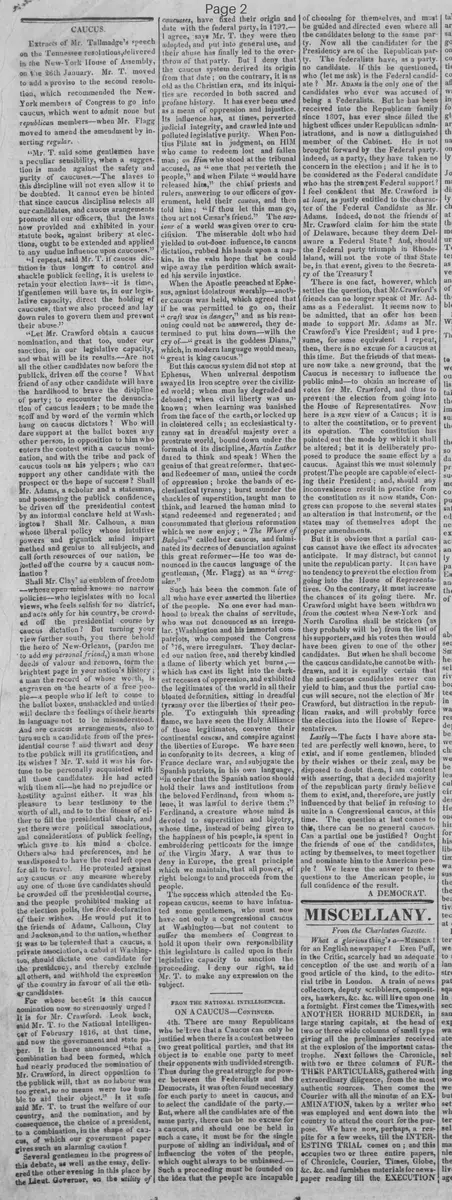
Extracts of Mr. Tallmadge's speech on the Tennessee resolutions, delivered in the New-York House of Assembly, on the 26th January. Mr. T. moved to add a proviso to the second resolution, which recommended the New York members of Congress to go into caucus, which went to admit none but republican members—when Mr. Flagg moved to amend the amendment by inserting regular.
"Mr. T. said some gentlemen have a peculiar sensibility, when a suggestion is made against the safety and purity of caucuses.—The slaves to this discipline will not even allow it to be doubted. It cannot even be hinted that since caucus discipline selects all our candidates, and caucus arrangements promote all our officers, that the laws now provided and exhibited in your statute book, against bribery at elections, ought to be extended and applied to any undue influence upon caucuses."
"I repeat, said Mr. T. if caucus dictation is thus longer to control and shackle publick feeling, it is useless to retain your election laws—it is time, if gentlemen will have us, in our legislative capacity, direct the holding of caucuses, that we also proceed and lay down rules to govern them and prevent their abuse."
"Let Mr. Crawford obtain a caucus nomination, and that too, under our sanction, in our legislative capacity, and what will be its results.—Are not all the other candidates now before the publick, driven off the course? What friend of any other candidate will have the hardihood to brave the discipline of party; to encounter the denunciation of caucus leaders; to be made the scoff and by-word of the vermin which hang on caucus dictators? Who will dare support at the ballot boxes any other person, in opposition to him who enters the contest with a caucus nomination, and with the tribe and pack of caucus tools as his yelpers; who can support any other candidate with the prospect or the hope of success? Shall Mr. Adams, a scholar and a statesman, and possessing the publick confidence, be driven off the presidential contest by an informal conclave held at Washington? Shall Mr. Calhoun, a man whose liberal policy, whose intuitive powers and gigantick mind impart method and genius to all subjects, and call forth resources of our nation, be jostled off the course by a caucus nomination? Shall Mr. Clay, an emblem of freedom—whose open mind knows no narrow policies—who legislates with no local views, who feels selfish for no district, and acts only for his country, be crowded off the presidential course by caucus dictation? But turning your view further south, you there behold the hero of New-Orleans, (pardon me to add my personal friend,) a man whose deeds of valour and renown, form the brightest page in your nation's history; a man the record of whose worth, is engraven on the hearts of a free people—a people who if left to come to the ballot boxes, unshackled and untied will declare the feelings of their hearts in language not to be misunderstood. And are caucus arrangements, also to turn such a candidate from off the presidential course? and thwart and deny to the publick will its gratification, and its wishes? Mr. T. said it was his fortune to be personally acquainted with all those candidates. He had acted with them all—he had no prejudice or hostility against either. It was his pleasure to bear testimony to the worth of all, and to the fitness of either to fill the presidential chair, and yet there were political associations, and considerations of publick feeling, which gave to his mind a choice. Others also had preferences, and he was disposed to have the road left open for all to travel. He protested against any caucus or any measure whereby any one of those five candidates should be crowded off the presidential course, and the people prohibited making at the election polls, the free declaration of their wishes. He would put it to the friends of Adams, Calhoun, Clay and Jackson, and to the nation, whether it was to be tolerated that a caucus, a private association, a cabal at Washington, should dictate one candidate for the presidency, and thereby exclude all others, and withhold the expression of the country in favour of all the other candidates.
For whose benefit is this caucus nomination now so strenuously urged? It is for Mr. Crawford. Look back, said Mr. T. to the National Intelligencer of February 1816, at that time, and now the government and state paper. It is there announced "that a combination had been formed, which had nearly produced the nomination of Mr. Crawford, in direct opposition to the publick will, that as no labour was too great, so no means were too humble to aid their object." Is it safe, said Mr. T. to trust the welfare of our country, and the nomination, and by consequence, the choice of a president, to a combination, in the shape of caucus, of which our government paper gives such an alarming caution? Several gentlemen in the progress of this debate, as well as the essay, delivered the other evening in this place by the Lieut. Governor, on the utility of caucuses, have fixed their origin and date with the federal party, in 1797.—I agree, says Mr. T. they were then adopted, and put into general use, and their abuse has finally led to the overthrow of that party. But I deny that the caucus system derived its origin from that date; on the contrary, it is as old as the Christian era, and its iniquities are recorded in both sacred and profane history. It has ever been used as a mean of oppression and injustice. Its influence has, at times, perverted judicial integrity, and crawled into and polluted legislative purity. When Pontius Pilate sat in judgment, on Him who came to redeem lost and fallen man; on Him who stood at the tribunal accused, as "one that perverteth the people," and when Pilate "would have released him," the chief priests and rulers, answering to our officers of government, held their caucus, and then told him; "If thou let this man go, thou art not Cæsar's friend." The Saviour of a world was given over to crucifixion. The miserable dolt who had yielded to out-door influence, to caucus dictation, rubbed his hands upon a napkin, in the vain hope that he could wipe away the perdition which awaited his servile injustice.
When the Apostle preached at Ephesus, against idolatrous worship—another caucus was held, which agreed that if he was permitted to go on, their "craft was in danger," and as his reasoning could not be answered, they determined to put him down—with the cry of "great is the goddess Diana," which, in modern language would mean, "great is king caucus."
But this caucus system did not stop at Ephesus. When universal despotism swayed its iron sceptre over the civilized world; when man lay degraded and debased; when civil liberty was unknown; when learning was banished from the face of the earth, or locked up in cloistered cells; an ecclesiastical tyranny sat in dreadful majesty over a prostrate world, bound down under the formula of its discipline, Martin Luther dared to think and speak! When the genius of that great reformer, that second Redeemer of man, untied the cords of oppression; broke the bands of ecclesiastical tyranny; burst asunder the shackles of superstition, taught man to think, and learned the human mind to stand redeemed and regenerated; and consummated that glorious reformation which we now enjoy; "The Whore of Babylon" called her caucus, and fulminated its decrees of denunciation against this great reformer—He too was denounced in the caucus language of the gentleman, (Mr. Flagg) as an "irregular."
Such has been the common fate of all who have ever asserted the liberties of the people. No one ever had manhood to break the chains of servitude, who was not denounced as an irregular. Washington and his immortal companions, who composed the Congress of 76, were irregulars. They declared our nation free, and thereby kindled a flame of liberty which yet burns,—which has cast its light into the darkest recesses of oppression, and exhibited the legitimates of the world in all their bloated deformities, sitting in dreadful tyranny over the liberties of their people. To extinguish this spreading flame, we have seen the Holy Alliance of those legitimates, convene their continental caucus, and conspire against the liberties of Europe. We have seen in conformity to its decrees, a king of France declare war, and subjugate the Spanish patriots, in his own language, "in order that the Spanish nation should hold their laws and institutions from the beloved Ferdinand, from whom alone, it was lawful to derive them;" Ferdinand, a creature whose mind is devoted to superstition and bigotry, whose time, instead of being given to the happiness of his people, is spent in embroidering petticoats for the image of the Virgin Mary. A war thus to deny in Europe, the great principle which we maintain, that all power, of right belongs to and proceeds from the people.
The success which attended the European caucus, seems to have infatuated some gentlemen, who must now have not only a congressional caucus at Washington—but not content to suffer the members of Congress to hold it upon their own responsibility this legislature is called upon in their legislative capacity to sanction the proceeding. I deny our right, said Mr. T. to make any expression on the subject.
FROM THE NATIONAL INTELLIGENCER.
ON A CAUCUS—Continued.
4th. There are many Republicans who believe that a Caucus can only be justified when there is a contest between two great political parties, and that its object is to enable one party to meet their opponents with undivided strength. Thus during the great struggle for power between the Federalists and the Democrats, it was often found necessary for each party to meet in caucus, and to select the candidate of the party.—But, where all the candidates are of the same party, there can be no excuse for a caucus, and should one be held in such a case, it must be for the single purpose of aiding an individual, and of influencing the votes of the people, which ought always to be unbiassed.—Such a proceeding must be founded on the idea that the people are incapable of choosing for themselves, and must be guided and directed even where all the candidates belong to the same party. Now all the candidates for the Presidency are of the Republican party. The federalists have, as a party, no candidate. If this be questioned, who (let me ask) is the Federal candidate? Mr. Adams is the only one of the candidates who ever was accused of being a Federalist. But he has been received into the Republican family since 1807, has ever since filled the highest offices under Republican administrations, and is now a distinguished member of the Cabinet. He is not brought forward by the Federal party. Indeed, as a party, they have taken no concern in the election; and if he is to be considered as the Federal candidate who has the strongest Federal support? I feel confident that Mr. Crawford is at least, as justly entitled to the character of the Federal Candidate as Mr. Adams. Indeed, do not the friends of Mr. Crawford claim for him the state of Delaware, because they deem Delaware a Federal State? And, should the Federal party triumph in Rhode Island, will not the vote of that State be, in that event, given to the Secretary of the Treasury?
There is one fact, however, which settles the question, that Mr. Crawford's friends can no longer speak of Mr. Adams as a Federalist. It seems now to be admitted, that an offer has been made to support Mr. Adams as Mr. Crawford's Vice President; and I presume, for some equivalent I repeat, then, there is no excuse for a caucus at this time. But the friends of that measure now take a new ground, that the Caucus is necessary to influence the public mind—to obtain an increase of votes for Mr. Crawford, and thus to prevent the election from going into the House of Representatives. Now here is a New view of a Caucus; it is to alter the constitution, or to prevent its operation. The constitution has pointed out the mode by which it shall be altered; but it is deliberately proposed to produce the same effect by a caucus. Against this we must solemnly protest. The people are capable of electing their President; and, should any inconvenience result in practice from the constitution as it now stands, Congress can propose to the several states an alteration in that instrument, or the states may of themselves adopt the proper amendments.
But it is obvious that a partial caucus cannot have the effect its advocates anticipate. It may distract, but cannot unite the republican party. It can have no tendency to prevent the election from going into the House of Representatives. On the contrary, it must increase the chances of its going there. Mr. Crawford might have been withdrawn from the contest when New-York and North Carolina shall be stricken (as they probably will be) from the list of his supporters, and his votes then would have been given to one of the other Candidates. But when he shall become the caucus candidate, he cannot be withdrawn, and it is equally certain that the anti-caucus candidates never can yield to him, and thus the partial caucus will secure, not the election of Mr. Crawford, but distraction in the republican ranks, and will probably force the election into the House of Representatives.
Lastly—The facts I have above stated are perfectly well known, here, to exist, and if some gentlemen, blinded by their wishes or their zeal, may be disposed to doubt them, I am content with asserting, that a decided majority of the republican party firmly believe them to exist, and, therefore, are justly influenced by that belief in refusing to unite in a Congressional caucus, at this time. The question at last comes to this, there can be no general caucus. Can a partial one be justified? Ought the friends of one of the candidates, acting by themselves, to meet together and nominate him to the American people? We leave the answer to these questions to the American people, in full confidence of the result.
A DEMOCRAT.
What sub-type of article is it?
What themes does it cover?
What keywords are associated?
What entities or persons were involved?
Where did it happen?
Story Details
Key Persons
Location
New York House Of Assembly, Washington
Event Date
26th January
Story Details
Mr. Tallmadge delivers a speech opposing caucus nominations that favor Mr. Crawford, arguing they suppress public will and exclude worthy candidates like Adams, Calhoun, Clay, and Jackson. He traces caucuses' oppressive history from biblical times to the Reformation and modern politics, advocating for free elections. An accompanying article from the National Intelligencer argues caucuses are unjustified among Republicans and would divide the party.