Thank you for visiting SNEWPapers!
Sign up free
Story
February 24, 1851
Portage Sentinel
Ravenna, Portage County, Ohio
What is this article about?
In a Senate speech, Mr. Benton advocates for a St. Louis-San Francisco road by highlighting how buffalo and other animals' instinctive paths have historically guided human routes across America, from trails to modern roads.
Clipping
OCR Quality
95%
Excellent
Full Text
Nature's Engineers.
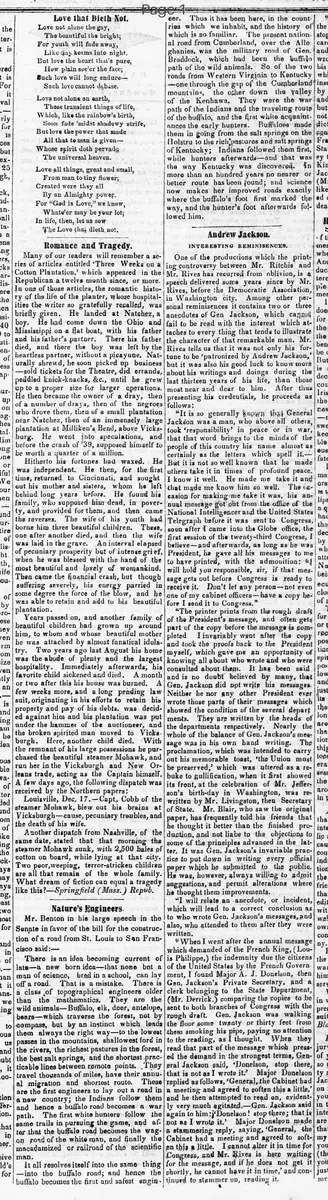
Mr. Benton in his large speech in the Senate in favor of the bill or the construction of a road from St. Louis to San Francisco said:-
There is an idea becoming current of late-a new born idea--that none but a man of science, bred in a school, can lay off a road. That is a mistake. There is a class of topographical engineers older than the mathematics. They are the wild animals-Buffalo, elk, deer, antelope, bears-which traverse the forest, not by compass, but by an instinct which leads them always the right way-to the lowest passes in the mountains, shallowest ford in the rivers, the richest pastures in the forest, the best salt springs, and the shortest practicable lines between remote points. They travel thousands of miles, have their annual migration and shortest route. These are the first engineers to lay out a road in a new country; the Indians follow them and hence a buffalo road becomes a war path. The first white hunters follow the same trails in pursuing the game, and after that the buffalo road becomes the wagon road of the white man, and finally the macadamized or railroad of the scientific man.
It all resolves itself into the same thing -into the buffalo road; and hence the buffalo becomes the first and safest engineer.
Thus it has been here, in the countries which we inhabit, and the history of which is so familiar. 'The present national road from Cumberland, over the Alleghanies, was the military road of Gen. Braddock, which had been the buffalo path of the wild animals. So of the two roads from Western Virginia to Kentucky --one through the gap of the Cumberland mountains, the other down the valley of the Kenhawa. They were the war path of the Indians and the traveling route of the buffalo, and the first white acquaintances the early hunters. Buffaloes made them in going from the salt springs on the Holston to the rich pastures and salt springs of Kentucky; Indians followed them first, while hunters afterwards--and that was the way Kentucky was discovered. In more than an hundred years no nearer or better route has been found; and science now makes her improved roads exactly where the buffalo's foot first marked the way, and the hunter's foot afterwards followed him.
Mr. Benton in his large speech in the Senate in favor of the bill or the construction of a road from St. Louis to San Francisco said:-
There is an idea becoming current of late-a new born idea--that none but a man of science, bred in a school, can lay off a road. That is a mistake. There is a class of topographical engineers older than the mathematics. They are the wild animals-Buffalo, elk, deer, antelope, bears-which traverse the forest, not by compass, but by an instinct which leads them always the right way-to the lowest passes in the mountains, shallowest ford in the rivers, the richest pastures in the forest, the best salt springs, and the shortest practicable lines between remote points. They travel thousands of miles, have their annual migration and shortest route. These are the first engineers to lay out a road in a new country; the Indians follow them and hence a buffalo road becomes a war path. The first white hunters follow the same trails in pursuing the game, and after that the buffalo road becomes the wagon road of the white man, and finally the macadamized or railroad of the scientific man.
It all resolves itself into the same thing -into the buffalo road; and hence the buffalo becomes the first and safest engineer.
Thus it has been here, in the countries which we inhabit, and the history of which is so familiar. 'The present national road from Cumberland, over the Alleghanies, was the military road of Gen. Braddock, which had been the buffalo path of the wild animals. So of the two roads from Western Virginia to Kentucky --one through the gap of the Cumberland mountains, the other down the valley of the Kenhawa. They were the war path of the Indians and the traveling route of the buffalo, and the first white acquaintances the early hunters. Buffaloes made them in going from the salt springs on the Holston to the rich pastures and salt springs of Kentucky; Indians followed them first, while hunters afterwards--and that was the way Kentucky was discovered. In more than an hundred years no nearer or better route has been found; and science now makes her improved roads exactly where the buffalo's foot first marked the way, and the hunter's foot afterwards followed him.
What sub-type of article is it?
Curiosity
Historical Event
What themes does it cover?
Nature
Exploration
What keywords are associated?
Buffalo Paths
Animal Engineers
Road Construction
Frontier Exploration
Historical Routes
What entities or persons were involved?
Mr. Benton
Gen. Braddock
Where did it happen?
United States (St. Louis To San Francisco, Alleghanies, Kentucky)
Story Details
Key Persons
Mr. Benton
Gen. Braddock
Location
United States (St. Louis To San Francisco, Alleghanies, Kentucky)
Story Details
Mr. Benton argues in a Senate speech that wild animals like buffalo instinctively create the best paths for roads in new territories, which humans then follow—from buffalo trails to Indian war paths, hunter routes, wagon roads, and finally scientific roads. He cites historical examples like the national road and paths to Kentucky.