Thank you for visiting SNEWPapers!
Sign up free
Richmond Enquirer
Richmond, Richmond County, Virginia
What is this article about?
Editorial response clarifying the US-British dispute over the Northeast boundary from the 1783 Treaty of Peace, unresolved per the Treaty of Ghent. Negotiations in London by Rush and Gallatin led to a convention for arbitration. Emphasizes mutual forbearance; condemns unauthorized acts like Gen. Baker's on disputed territory.
Clipping
OCR Quality
Full Text
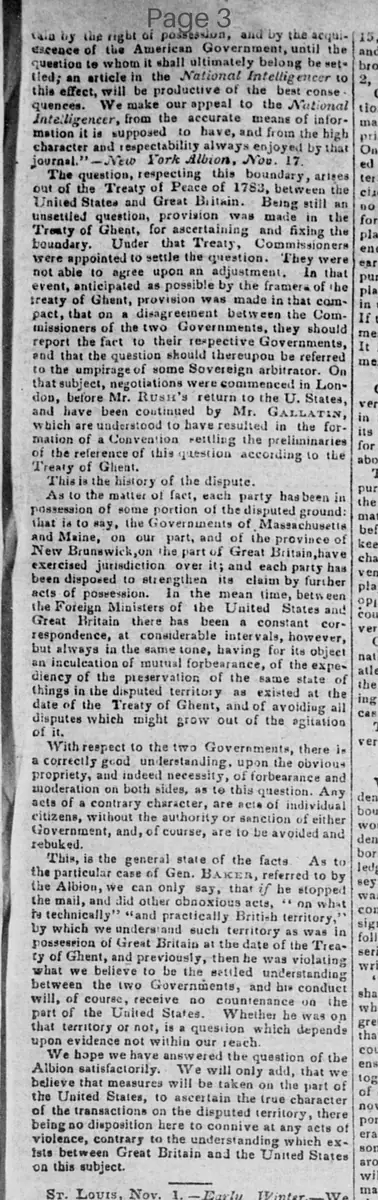
The question, respecting this boundary, arises out of the Treaty of Peace of 1783, between the United States and Great Britain. Being still an unsettled question, provision was made in the Treaty of Ghent, for ascertaining and fixing the boundary. Under that Treaty, Commissioners were appointed to settle the question. They were not able to agree upon an adjustment. In that event, anticipated as possible by the framers of the treaty of Ghent, provision was made in that compact, that on a disagreement between the Commissioners of the two Governments, they should report the fact to their respective Governments, and that the question should thereupon be referred to the umpirage of some Sovereign arbitrator. On that subject, negotiations were commenced in London, before Mr. Rush's return to the U. States, and have been continued by Mr. Gallatin, which are understood to have resulted in the formation of a Convention settling the preliminaries of the reference of this question according to the Treaty of Ghent.
This is the history of the dispute.
As to the matter of fact, each party has been in possession of some portion of the disputed ground: that is to say, the Governments of Massachusetts and Maine, on our part, and of the province of New Brunswick, on the part of Great Britain, have exercised jurisdiction over it; and each party has been disposed to strengthen its claim by further acts of possession. In the mean time, between the Foreign Ministers of the United States and Great Britain there has been a constant correspondence, at considerable intervals, however, but always in the same tone, having for its object an inculcation of mutual forbearance, of the expediency of the preservation of the same state of things in the disputed territory as existed at the date of the Treaty of Ghent, and of avoiding all disputes which might grow out of the agitation of it.
With respect to the two Governments, there is a perfectly good understanding, upon the obvious propriety, and indeed necessity, of forbearance and moderation on both sides, as to this question. Any acts of a contrary character, are acts of individual citizens, without the authority or sanction of either Government, and, of course, are to be avoided and rebuked.
This, is the general state of the facts. As to the particular case of Gen. Baker, referred to by the Albion, we can only say, that if he stopped the mail, and did other obnoxious acts, "on what is technically" "and practically British territory," by which we understand such territory as was in possession of Great Britain at the date of the Treaty of Ghent, and previously, then he was violating what we believe to be the settled understanding between the two Governments, and his conduct will, of course, receive no countenance on the part of the United States. Whether he was on that territory or not, is a question which depends upon evidence not within our reach.
We hope we have answered the question of the Albion satisfactorily. We will only add, that we believe that measures will be taken on the part of the United States, to ascertain the true character of the transactions on the disputed territory, there being no disposition here to connive at any acts of violence, contrary to the understanding which exists between Great Britain and the United States on this subject.
What sub-type of article is it?
What keywords are associated?
What entities or persons were involved?
Where did it happen?
Foreign News Details
Primary Location
Province Of New Brunswick
Key Persons
Outcome
negotiations resulted in a convention settling preliminaries for reference to a sovereign arbitrator per treaty of ghent; mutual forbearance urged, unauthorized acts to be rebuked.
Event Details
The boundary dispute arises from the 1783 Treaty of Peace between US and Great Britain. Unsettled, the Treaty of Ghent provided for commissioners, who disagreed, leading to proposed arbitration. Negotiations in London by Mr. Rush and continued by Mr. Gallatin formed a convention for this reference. Both sides have exercised jurisdiction over portions; foreign ministers correspond for forbearance to preserve status quo from Ghent. Good understanding exists between governments; individual acts like Gen. Baker's potential mail stoppage on British-held territory violate this and lack US sanction.