Thank you for visiting SNEWPapers!
Sign up free
Portland Gazette, And Maine Advertiser
Portland, Cumberland County, Maine
What is this article about?
Reports from June 1815 detail the Battle of Waterloo where Wellington's forces defeated Napoleon on June 18, with heavy casualties on both sides, French retreat in disorder, thousands of prisoners taken, and ongoing pursuits by Allied forces. Additional updates on French legislature, Swiss neutrality, and royal marriages.
Merged-components note: These components continue the foreign news summary on the aftermath of the Battle of Waterloo; the first includes a brief publication schedule note at the top but is predominantly foreign news.
Clipping
OCR Quality
Full Text
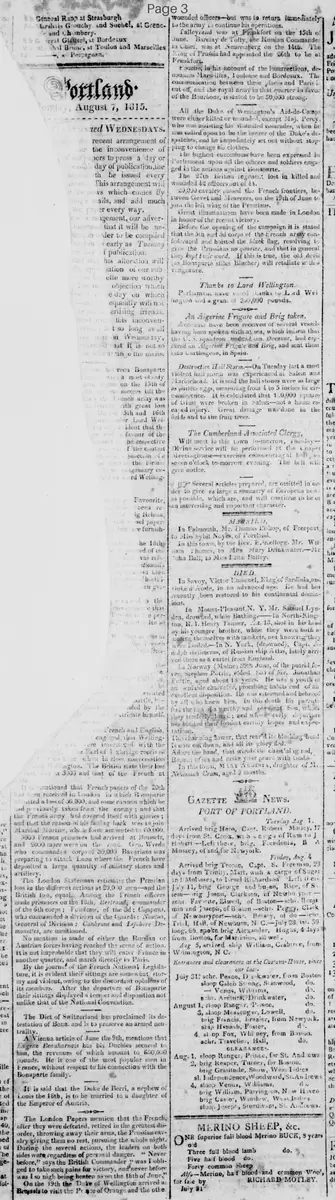
By a recent arrangement of the mails, to prevent the inconvenience of persons to press a day or day of publication, the Gazette will be issued every Wednesday.
This arrangement will enable us which comes by mails, and add much to the paper every way.
By this arrangement, our advertisers that it will be necessary to be compiled early as Tuesday of publication.
This alteration will give more time to the preparation of our sub- scription list, and make the Gazette more worthy of the patronage of our friends.
We trust our advertising friends will not consider this inconvenience as long as all mails arrive on Wednesday, it is not so with the mails.
The French army on the 15th of July suffered great loss on the 15th and 16th: our advanced Lord Wel- lington so violent that the in favour of the respective armies in the contest junction of the former s, assigning cr: third Wellington ii Favourite .) : ceei rc- .i ' , . ig ifvlena, , , sel super: .. ya a.e furnish- he 13th " p'ed of thr was rfi:- . , 'llionuily .14 been. .hotii , ck go: l.3 thi :etat Trt..:'eper- {.,".ite the French .. thoa- L{ :'h. ' , n, tr esruted ," slle, hr- aided by the rstrieate himself erench and English, engaged, tint Welling- ere inteeh xed with the e Earl of Uxbridge received whea in close conversation agtod. The British state their loss t 3100 and that of the French at entioned that French papers of the 20th en received in London in which Bonaparte atted a loss of 50,000, and some cannon which he ad previously taken from the enemy : and that the French army had covered itself with glories; and that the reason of his falling back was to join Marshal Mortier, whose force amounted to 60,000. 5000 French prisoners had arrived at Brussels, and 2000 more were on the road. Gen. Wrede who commands a corps of 50,000 Bavarians was preparing to attack Laon where the French have deposited a large quantity of military stores and artillery. The London Statesman estimates the Prussian loss in the different actions at 20,000 men—and the British loss, equal. Among the French officers made prisoners on the 18th, Bertrand, commander of the 6th corps; Vandamme, of the 3d; Compans, who commanded a division of the Guards: Norton, General of Division; Cambronne and Lefebvre Desnouettes, are mentioned. No mention is made of either the Russian or Austrian forces having reached the scene of action. It is not improbable that they will enter France in another quarter, and march directly to Paris. By the journals of the French National Legislature, it is evident their sittings are somewhat stormy and violent, owing to the discordant opinions of its members. After the departure of Bonaparte their sittings displayed a temper and disposition not unlike that of the National Convention. The Diet of Switzerland has proclaimed its detestation of Bona. and is to preserve an armed neutrality. A Vienna article of June the 9th, mentions that Eugene Beauharnais has his Duchies secured to him, the revenues of which amount to 600,000 pounds. He is one of the most popular men in France, without respect to his connection with the Bonaparte family. It is said that the Duke de Berri, a nephew of Louis the 18th, is to be married to a daughter of the Emperor of Austria, The London Papers mention that the French, after they were defeated, retired in the greatest disorder, throwing away their arms, the Prussian cavalry giving them no rest, pursuing the whole night. During the several actions, the leaders on both sides were regardless of personal danger. "Never before," says the British Commander "was I obliged to take such pains for victory, and never before was I so nigh being beaten as on the 16th of June." On the 19th the Duke of Wellington arrived at
wounded officers—but was to return immediately to the army to continue his operations.
Talleyrand was at Frankfort on the 15th of June. Barclay de Tolly, the Russian Commander in Chief, was at Neureintberg on the 14th. The King of Prussia had appointed the 26th to be at Frankfort.
Fouche, in his account of the insurrections, denounces Marseilles, Toulouse and Bordeaux. The communication between these places and Paris is cut off, and the royal army in that quarter in favor of the Bourbons, is stated to be 50,000 strong.
All the Duke of Wellington's Aid-de-Camps were either killed or wounded, except Maj. Percy, who was assisting his wounded comrades, when he was called upon to be the bearer of the Duke's despatches, and he immediately set out without stopping to change his clothes.
The highest encomiums have been expressed in Parliament upon all the officers and soldiers engaged in the actions against Bonaparte.
The 27th British regiment lost in killed and wounded 42 officers out of 44.
20,000 cavalry passed the French frontiers, between Ghent and Lisle, on the 19th of June to join the left wing of the Prussians.
Great illuminations have been made in London in honor of the recent victory.
Before the opening of the campaign it is stated that the 5th and 3d corps of the French army confederated and hoisted the black flag, resolving to give the Prussians no quarter, and that in general they kept their word. If this is true, the old devil (as Bonaparte styles Blucher) will retaliate with vengeance.
What sub-type of article is it?
What keywords are associated?
What entities or persons were involved?
Where did it happen?
Foreign News Details
Primary Location
Waterloo
Event Date
June 16 18, 1815
Key Persons
Outcome
british loss 3100; french loss claimed 50,000 by bonaparte; prussian loss 20,000; british equal; 5000 french prisoners at brussels, 2000 more en route; french officers captured including bertrand, vandamme, compans, norton, cambronne, lefebvre desnouettes; 27th british regiment lost 42 of 44 officers; french retreat in disorder, pursued by prussians.
Event Details
The French army suffered great loss in battles on June 15-16 and 18, 1815, against Wellington's forces at Waterloo. Intense fighting occurred, with Wellington noting close calls on the 16th. French retreated in disorder after defeat, pursued by Prussian cavalry. Bonaparte claimed 50,000 French losses but glory; actually fell back to join Mortier. 5000 prisoners arrived in Brussels. Wrede's Bavarians prepare to attack Laon. No Russian or Austrian involvement yet. French legislature stormy; Switzerland detests Bonaparte, armed neutrality. Eugene Beauharnais secures duchies. Duke de Berri to marry Austrian princess. Wellington visited wounded on 19th. Insurrections in Marseilles, Toulouse, Bordeaux; royal army 50,000 strong. All Wellington's aides killed or wounded except Maj. Percy who carried despatches. Parliament praises forces. 20,000 cavalry crossed to join Prussians. London illuminations. French 3rd and 5th corps hoisted black flag, no quarter to Prussians.