Thank you for visiting SNEWPapers!
Sign up free
Story
July 9, 1841
The Liberator
Boston, Suffolk County, Massachusetts
What is this article about?
Editorial from Plymouth Rock critiques the Memorial editor's view on the right of petition for abolition causes, arguing it is sacred and must be exercised despite risks of agitation, contrasting with pro-slavery positions and referencing J.Q. Adams.
Clipping
OCR Quality
98%
Excellent
Full Text
From the Plymouth Rock.
The Memorial and the Right of Petition.
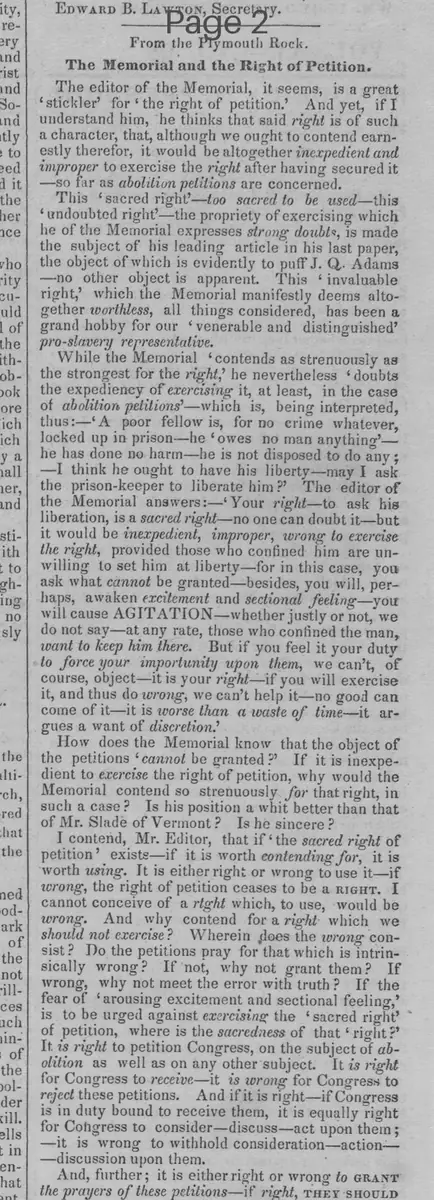
The editor of the Memorial, it seems, is a great 'stickler' for 'the right of petition.' And yet, if I understand him, he thinks that said right is of such a character, that, although we ought to contend earnestly therefor, it would be altogether inexpedient and improper to exercise the right after having secured it—so far as abolition petitions are concerned. This 'sacred right'—too sacred to be used—this 'undoubted right'—the propriety of exercising which he of the Memorial expresses strong doubts, is made the subject of his leading article in his last paper, the object of which is evidently to puff J. Q. Adams—no other object is apparent. This invaluable right,' which the Memorial manifestly deems altogether worthless, all things considered, has been a grand hobby for our 'venerable and distinguished' pro-slavery representative. While the Memorial 'contends as strenuously as the strongest for the right,' he nevertheless 'doubts the expediency of exercising it, at least, in the case of abolition petitions'—which is, being interpreted, thus:—'A poor fellow is, for no crime whatever, locked up in prison—he 'owes no man anything'—he has done no harm—he is not disposed to do any; —I think he ought to have his liberty—may I ask the prison-keeper to liberate him?' The editor of the Memorial answers:—'Your right—to ask his liberation, is a sacred right—no one can doubt it—but it would be inexpedient, improper, wrong to exercise the right, provided those who confined him are unwilling to set him at liberty—for in this case, you ask what cannot be granted—besides, you will, perhaps, awaken excitement and sectional feeling—you will cause AGITATION—whether justly or not, we do not say—at any rate, those who confined the man, want to keep him there. But if you feel it your duty to force your importunity upon them, we can't, of course, object—it is your right—if you will exercise it, and thus do wrong, we can't help it—no good can come of it—it is worse than a waste of time—it argues a want of discretion.' How does the Memorial know that the object of the petitions 'cannot be granted?' If it is inexpedient to exercise the right of petition, why would the Memorial contend so strenuously for that right, in such a case? Is his position a whit better than that of Mr. Slade of Vermont? Is he sincere? I contend, Mr. Editor, that if 'the sacred right of petition' exists—if it is worth contending for, it is worth using. It is either right or wrong to use it—if wrong, the right of petition ceases to be a Right. I cannot conceive of a right which, to use, would be wrong. And why contend for a right which we should not exercise? Wherein does the wrong consist? Do the petitions pray for that which is intrinsically wrong? If not, why not grant them? If wrong, why not meet the error with truth? If the fear of arousing 'excitement and sectional feeling,' is to be urged against exercising the 'sacred right' of petition, where is the sacredness of that right? It is right to petition Congress, on the subject of abolition as well as on any other subject. It is right for Congress to receive—it is wrong for Congress to reject these petitions. And if it is right—if Congress is in duty bound to receive them, it is equally right for Congress to consider—discuss—act upon them; -it is wrong to withhold consideration—action—discussion upon them. And, further; it is either right or wrong to GRANT the prayers of these petitions—if right, THEY SHOULD BE GRANTED—if wrong, they should be denied;—but not until a free, full and fair discussion has been had upon them. The wrong in the case does not consist in the exercise of the right of petition—does not consist in the exercise of the right of discussion—it consists in the hellish determination of Southern slaveholders, and Northern slaves to turn a deaf ear to the voice of TRUTH, JUSTICE, HUMANITY.
The Memorial and the Right of Petition.
The editor of the Memorial, it seems, is a great 'stickler' for 'the right of petition.' And yet, if I understand him, he thinks that said right is of such a character, that, although we ought to contend earnestly therefor, it would be altogether inexpedient and improper to exercise the right after having secured it—so far as abolition petitions are concerned. This 'sacred right'—too sacred to be used—this 'undoubted right'—the propriety of exercising which he of the Memorial expresses strong doubts, is made the subject of his leading article in his last paper, the object of which is evidently to puff J. Q. Adams—no other object is apparent. This invaluable right,' which the Memorial manifestly deems altogether worthless, all things considered, has been a grand hobby for our 'venerable and distinguished' pro-slavery representative. While the Memorial 'contends as strenuously as the strongest for the right,' he nevertheless 'doubts the expediency of exercising it, at least, in the case of abolition petitions'—which is, being interpreted, thus:—'A poor fellow is, for no crime whatever, locked up in prison—he 'owes no man anything'—he has done no harm—he is not disposed to do any; —I think he ought to have his liberty—may I ask the prison-keeper to liberate him?' The editor of the Memorial answers:—'Your right—to ask his liberation, is a sacred right—no one can doubt it—but it would be inexpedient, improper, wrong to exercise the right, provided those who confined him are unwilling to set him at liberty—for in this case, you ask what cannot be granted—besides, you will, perhaps, awaken excitement and sectional feeling—you will cause AGITATION—whether justly or not, we do not say—at any rate, those who confined the man, want to keep him there. But if you feel it your duty to force your importunity upon them, we can't, of course, object—it is your right—if you will exercise it, and thus do wrong, we can't help it—no good can come of it—it is worse than a waste of time—it argues a want of discretion.' How does the Memorial know that the object of the petitions 'cannot be granted?' If it is inexpedient to exercise the right of petition, why would the Memorial contend so strenuously for that right, in such a case? Is his position a whit better than that of Mr. Slade of Vermont? Is he sincere? I contend, Mr. Editor, that if 'the sacred right of petition' exists—if it is worth contending for, it is worth using. It is either right or wrong to use it—if wrong, the right of petition ceases to be a Right. I cannot conceive of a right which, to use, would be wrong. And why contend for a right which we should not exercise? Wherein does the wrong consist? Do the petitions pray for that which is intrinsically wrong? If not, why not grant them? If wrong, why not meet the error with truth? If the fear of arousing 'excitement and sectional feeling,' is to be urged against exercising the 'sacred right' of petition, where is the sacredness of that right? It is right to petition Congress, on the subject of abolition as well as on any other subject. It is right for Congress to receive—it is wrong for Congress to reject these petitions. And if it is right—if Congress is in duty bound to receive them, it is equally right for Congress to consider—discuss—act upon them; -it is wrong to withhold consideration—action—discussion upon them. And, further; it is either right or wrong to GRANT the prayers of these petitions—if right, THEY SHOULD BE GRANTED—if wrong, they should be denied;—but not until a free, full and fair discussion has been had upon them. The wrong in the case does not consist in the exercise of the right of petition—does not consist in the exercise of the right of discussion—it consists in the hellish determination of Southern slaveholders, and Northern slaves to turn a deaf ear to the voice of TRUTH, JUSTICE, HUMANITY.
What sub-type of article is it?
Editorial Opinion
Political Argument
What themes does it cover?
Justice
Moral Virtue
Deception
What keywords are associated?
Right Of Petition
Abolition Petitions
J.Q. Adams
Slavery Agitation
Congressional Debate
What entities or persons were involved?
J. Q. Adams
Editor Of The Memorial
Mr. Slade Of Vermont
Where did it happen?
United States Congress
Story Details
Key Persons
J. Q. Adams
Editor Of The Memorial
Mr. Slade Of Vermont
Location
United States Congress
Story Details
Critique of the Memorial editor's reluctance to exercise the right of petition for abolition despite advocating for it, using analogy of a prisoner; argues petitions should be received, discussed, and acted upon by Congress, condemning slaveholders' refusal to heed truth and justice.