Thank you for visiting SNEWPapers!
Sign up free
Phenix Gazette
Alexandria, Virginia
What is this article about?
In Pittsburgh, July 1826, Jackson Democrat editor John M'Farland opposed public honors for Jefferson and Adams' memories, calling a meeting of naturalized Irishmen where his resolutions were rejected but falsely published as adopted, leading to public rebuke.
Clipping
OCR Quality
Full Text
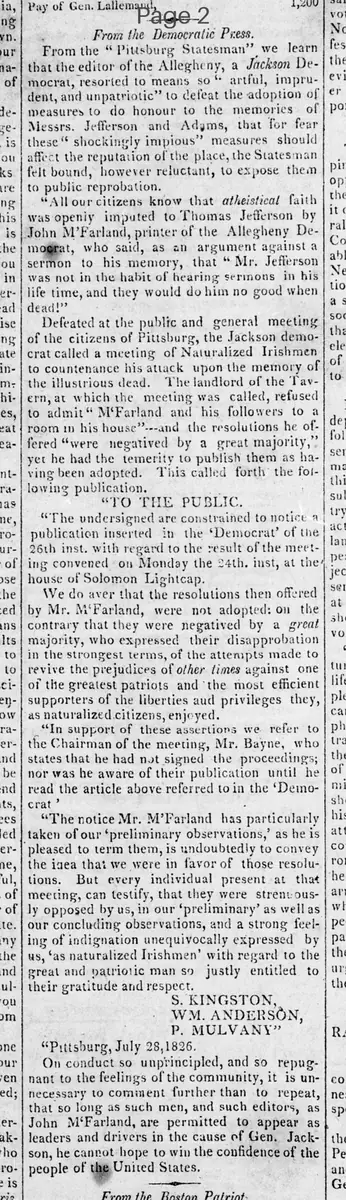
From the "Pittsburg Statesman" we learn that the editor of the Allegheny, a Jackson Democrat, resorted to means so "artful, imprudent, and unpatriotic" to defeat the adoption of measures to do honour to the memories of Messrs. Jefferson and Adams, that for fear these "shockingly impious" measures should affect the reputation of the place, the Statesman felt bound, however reluctant, to expose them to public reprobation.
"All our citizens know that atheistical faith was openly imputed to Thomas Jefferson by John M'Farland, printer of the Allegheny Democrat, who said, as an argument against a sermon to his memory, that "Mr. Jefferson was not in the habit of hearing sermons in his life time, and they would do him no good when dead!"
Defeated at the public and general meeting of the citizens of Pittsburg, the Jackson democrat called a meeting of Naturalized Irishmen to countenance his attack upon the memory of the illustrious dead. The landlord of the Tavern, at which the meeting was called, refused to admit "M'Farland and his followers to a room in his house".--and the resolutions he offered "were negatived by a great majority," yet he had the temerity to publish them as having been adopted. This called forth the following publication.
"TO THE PUBLIC.
"The undersigned are constrained to notice a publication inserted in the 'Democrat' of the 26th inst. with regard to the result of the meeting convened on Monday the 24th. inst, at the house of Solomon Lightcap.
We do aver that the resolutions then offered by Mr. M'Farland, were not adopted: on the contrary that they were negatived by a great majority, who expressed their disapprobation in the strongest terms, of the attempts made to revive the prejudices of other times against one of the greatest patriots and 'the most efficient supporters of the liberties and privileges they. as naturalized citizens, enjoyed.
"In support of these assertions we refer to the Chairman of the meeting, Mr. Bayne, who states that he had not signed the proceedings; nor was he aware of their publication until he read the article above referred to in the 'Democrat
"The notice Mr. M'Farland has particularly taken of our 'preliminary observations,' as he is pleased to term them, is undoubtedly to convey the idea that we were in favor of those resolutions. But every individual present at that meeting, can testify, that they were strenuously opposed by us, in our 'preliminary' as well as our concluding observations, and a strong feeling of indignation unequivocally expressed by us, 'as naturalized Irishmen' with regard to the great and patriotic man so justly entitled to their gratitude and respect.
S. KINGSTON
WM. ANDERSON,
P. MULVANY"
"Pittsburg, July 28,1826.
On conduct so unprincipled, and so repugnant to the feelings of the community, it is unnecessary to comment further than to repeat that so long as such men, and such editors, as John M'Farland, are permitted to appear as leaders and drivers in the cause of Gen. Jackson, he cannot hope to win the confidence of the people of the United States.
What sub-type of article is it?
What keywords are associated?
What entities or persons were involved?
Where did it happen?
Domestic News Details
Primary Location
Pittsburg
Event Date
July 24, 1826
Key Persons
Outcome
resolutions negatived by majority; falsely published as adopted; public exposure and reprobation of m'farland's conduct.
Event Details
John M'Farland, editor of Allegheny Democrat and Jackson Democrat, opposed measures honoring memories of Jefferson and Adams, imputing atheism to Jefferson and arguing against a sermon. Defeated at public meeting, he called naturalized Irishmen meeting at Solomon Lightcap's tavern on July 24, 1826, where resolutions were rejected but published as adopted, prompting rebuttal from S. Kingston, Wm. Anderson, P. Mulvany.