Thank you for visiting SNEWPapers!
Sign up free
The Enquirer
Richmond, Henrico County, Virginia
What is this article about?
On May 4, 1812, at the Palace of St. Cloud, Napoleon issued a decree regulating grain and flour circulation in the French Empire to prevent speculation, ensure market supply, and maintain economic stability until September 1, 1812.
Clipping
OCR Quality
Full Text
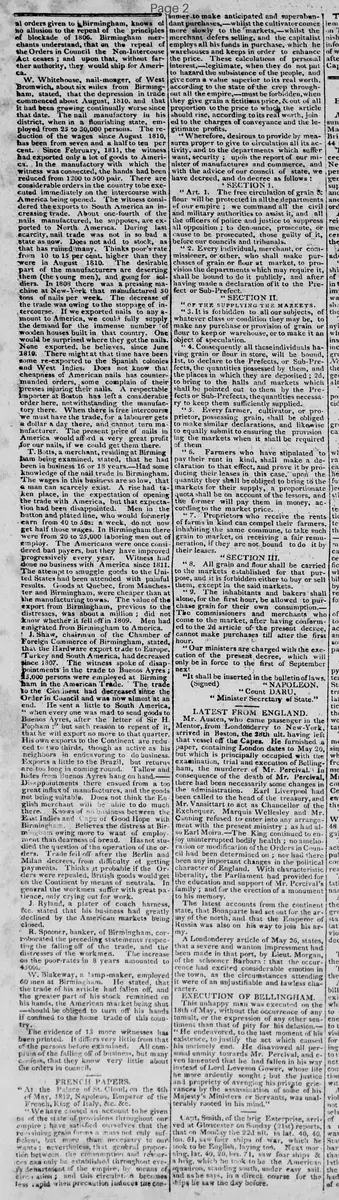
At the Palace of St. Cloud, on the 4th of May, 1812, Napoleon, Emperor of the French, King of Italy, &c. &c.
We have caused an account to be given us of the state of provisions throughout our empire; have satisfied ourselves that the remaining grain forms a mass not only sufficient, but more than necessary to our wants; nevertheless, that general proportion between the consumption and resources can only be established throughout every department of the empire, by means of circulation; and this circulation becomes less rapid when precaution induces the consumer to make anticipated and superabundant purchases, -- whilst the cultivator comes more slowly to the markets, -- whilst the merchant defers selling, and the capitalist employs all his funds in purchase, which he warehouses and keeps in order to enhance the price. These calculations of personal interest, -- legitimate, when they do not put to hazard the subsistence of the people, and give corn a value superior to its real worth, according to the state of the crop throughout all the empire, -- must be forbidden, when they give grain a fictitious price, & out of all proportion to the price to which the article should rise, according to its real worth, joined to the charges of conveyance and the legitimate profits.
Wherefore, desirous to provide by measures proper to give to circulation all its activity, and to the departments which suffer want, security; upon the report of our minister of manufactures and commerce, and with the advice of our council of state, we have decreed, and do decree as follows:
SECTION I.
Art. 1. The free circulation of grain & flour will be protected in all the departments of our empire; we command all the civil and military authorities to assist it, and all the officers of police and justice to suppress all opposition; to denounce, prosecute, or cause to be prosecuted, those guilty of it, before our councils and tribunals.
2. Every individual, merchant, or commissioner, or other, who shall make purchases of grain or flour at market, to provision the departments which may require it, shall be bound to do it publicly, and after having made a declaration of it to the Prefect or Sub-Prefect.
SECTION II.
OF THE SUPPLYING THE MARKETS.
3. It is forbidden to all our subjects, of whatever class or condition they may be, to make any purchase or provision of grain or flour to keep or warehouse, or to make it an object of speculation.
4. Consequently all those individuals having grain or flour in store, will be bound, 1st, to declare to the Prefects, or Sub-Prefects, the quantities possessed by them, and the places in which they are deposited; 2d, to bring to the halls and markets which shall be pointed out to them by the Prefects or Sub-Prefects, the quantities necessary to keep them sufficiently supplied.
5. Every farmer, cultivator, or proprietor, possessing grain, shall be obliged to make similar declarations, and likewise to equally submit to ensuring the provisioning the markets when it shall be required of them.
6. Farmers who have stipulated to pay their rent in kind, shall make a declaration to that effect, and prove it by producing their leases in this case, upon the quantity they shall be obliged to bring to the markets for their supply, a proportionate quota shall be on account of the lessors, and the former will pay them in money, according to the market price.
7. Proprietors who receive the rents of farms in kind can compel their farmers, inhabiting the same commune, to take such grain to market, on receiving a fair remuneration, if they are not bound to do it by their leases.
SECTION III.
8. All grain and flour shall be carried to the markets established for that purpose, and it is forbidden either to buy or sell them, except in the said markets.
9. The inhabitants and bakers shall alone, for the first hour, be allowed to purchase grain for their own consumption. The commissioners and merchants who come to the market, after having conformed to the 2d article of the present decree, cannot make purchases till after the first hour.
Our ministers are charged with the execution of the present decree, which will only be in force to the first of September next.
It shall be inserted in the bulletin of laws.
(Signed)
NAPOLEON.
Count DARU,
Minister Secretary of State.
What sub-type of article is it?
What keywords are associated?
What entities or persons were involved?
Where did it happen?
Foreign News Details
Primary Location
French Empire
Event Date
1812 05 04
Key Persons
Outcome
decree enforces grain circulation, bans speculation and hoarding, effective until september 1, 1812
Event Details
Napoleon decrees protection of free grain and flour circulation, requires public declarations for purchases, forbids hoarding and speculation, mandates declarations of stored quantities and supply to markets by owners, farmers, and proprietors, restricts sales to designated markets with priority for local consumers.