Thank you for visiting SNEWPapers!
Sign up free
Gazette Of The United States, & Philadelphia Daily Advertiser
Philadelphia, Philadelphia County, Pennsylvania
What is this article about?
Extract from Chief Justice M' Kean's charge to the Grand Jury in Philadelphia on Nov. 27, defining libel, its dangers to public peace and government, punishments under Pennsylvania law, and defending freedom of the press while condemning scurrilous publications amid U.S.-France tensions.
Clipping
OCR Quality
Full Text
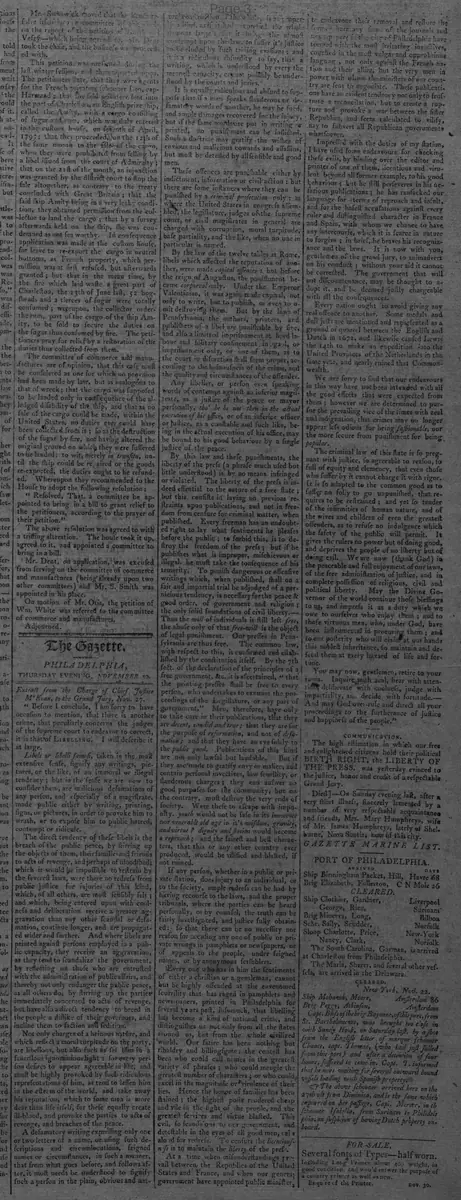
Extracts from the Charge of Chief Justice M' Kean, to the Grand Jury, Nov. 27.
"Before I conclude, I am sorry to have occasion to mention, that there is another crime, that peculiarly concerns the judges of the supreme court to endeavor to correct, it is that of LIBELLING. I will describe it at large.
Libels or libelli famosi, taken in the most extensive sense, signify any writings, pictures, or the like, of an immoral or illegal tendency; but in the sense we are now to consider them, are malicious defamations of any person, and especially of a magistrate, made public either by writing, printing, signs, or pictures, in order to provoke him to wrath, or to expose him to public hatred, contempt or ridicule.
The direct tendency of these libels is the breach of the public peace, by stirring up the objects of them, their families and friends to acts of revenge, and perhaps of bloodshed; which it would be impossible to restrain by the severest laws, were there no redress from public justice for injuries of this kind, which, of all others, are most sensibly felt; and which, being entered upon with coolness and deliberation receive a greater aggravation than any other scandal or defamation, continue longer, and are propagated wider and farther. And where libels are printed against persons employed in a public capacity, they receive an aggravation, as they tend to scandalize the government, by reflecting on those who are entrusted with the administration of public affairs, and thereby not only endanger the public peace, as all others do, by stirring up the parties immediately concerned to acts of revenge, but have also a direct tendency to breed in the people a dislike of their governors, and incline them to faction and sedition.
Not only charges of a heinous nature, and which reflect a moral turpitude on the party, are libellous, but also such as set him in a currilous ignominious light before every person desires to appear agreeable in life, and must be highly provoked by such ridiculous representations of him, as tend to lessen him in the esteem of the world, and take away his reputation, which to some men is more dear than life itself, for these equally create ill-blood, and provoke the parties to acts of revenge, and breaches of the peace.
A defamatory writing expressing only one or two letters of a name, or using such descriptions and circumlocutions, feigned names or circumstances, in such a manner, that from what goes before, and follows after, it must needs be understood to signify such a person in the plain, obvious and natural sense, is a proper subject of a libel, as if his name had been expressed at large: for it brings the utmost contempt upon the law, to suffer it's justice to be eluded by such trifling evasions; and it is a ridiculous absurdity to say, that a writing, which is understood by every the meanest capacity, cannot possibly be understood by the courts and juries.'
It is equally ridiculous and absurd to suppose that if a man speaks slanderous or defamatory words of another, he may be sued, and ample damages recovered for the injury, but if the same words are put in writing printed, no punishment can be inflicted. Such a doctrine may gratify the wishes of envious and malicious cowards and assassins, but must be detested by sensible and good men.
These offences are punishable either by indictment, information or civil action: but there are some instances where they can be punished by a criminal prosecution only; as where the United States in congress assembled, the legislature, judges of the supreme court, or civil magistrates in general are charged with corruption, moral turpitude, base partiality, and the like, when no one in particular is named.
By the law of the twelve tables at Rome, libels which affected the reputation of another, were made capital offences: but before the reign of Augustus, the punishment became corporeal only. Under the Emperor Valentinian, it was again made capital, not only to write, but to publish, or even to omit destroying them. But by the laws of Pennsylvania, the authors, printers, and publishers of a libel are punishable by fine, and also a limited imprisonment at hard labour and solitary confinement in gaol, or imprisonment only, or one of them, as to the court in discretion shall seem proper, according to the heinousness of the crime, and the quality and circumstances of the offender.
Any libeller, or person even speaking words of contempt against an inferior magistrate, as a justice of the peace or mayor personally, tho' he be not then in the actual execution of his office, or of an inferior officer or justice, as a constable and such like, being in the actual execution of his office, may be bound to his good behaviour by a single justice of the peace.
By this law and these punishments, the liberty of the press (a phrase much used but little understood) is by no means infringed or violated. The liberty of the press is indeed essential to the nature of a free state; but this consists in laying no previous restraints upon publications, and not in freedom from censure for criminal matter, when published. Every freeman has an undoubted right to lay what sentiments he pleases before the public; to forbid this, is to destroy the freedom of the press; but if he publishes what is improper, mischievous or illegal. he must take the consequence of his temerity. To punish dangerous or offensive writings which, when published, shall on a fair and impartial trial be adjudged of a pernicious tendency, is necessary for the peace & good order, of government and religion; the only solid foundations of civil liberty.
Thus the will of individuals is still left free, the abuse only of that free-will is the object of legal punishment. Our presses in Pennsylvania are thus free. The common law, with respect to this, is confirmed and established by the constitution itself. By the 7th sect. of the declaration of the principles of a free government, &c. it is ascertained, "that the printing press shall be free to every person, who undertakes to examine the proceedings of the Legislature, or any part of government." Men, therefore, have only to take care in their publications, that they are decent, candid and true; that they are for the purpose of reformation, and not of defamation; and that they have an eye solely to the public good. Publications of this Kind are not only lawful but laudable. But if they are made to gratify envy or malice, and contain personal invectives, low scurrility, or slanderous charges; they can answer no good purposes for the community, but on the contrary, must destroy the very ends of society. Were these to escape with impunity. youth would not be safe in its innocence nor venerable old age in it's wisdom, gravity, and virtue ? dignity and station would become a reproach; and the fairest and best characters, that this or any other country ever produced, would be vilified and blasted, if not ruined.
If any person, whether in a public or private station, does injury to an individual, or to the society, ample redress can be had by having recourse to the laws, and the proper tribunals, where the parties can be heard personally, or by counsel, the truth can be fairly investigated, and justice fully obtained: so that there can be no necessity nor reason for accusing any one of public or private wrongs in pamphlets or newspapers, or of appeals to the people, under feigned names, or by anonymous scribblers.
Every one who has in him the sentiments of either a christian or a gentleman, cannot but be highly offended at the envenomed scurrility that has raged in pamphlets and news-papers, printed in Philadelphia for several years past, insomuch, that libelling has become a kind of national crime, and distinguishes us not only from all the states around us, but from the whole civilized world. Our satire has been nothing but ribaldry and billingsgate: the contest has been who could call names in the greatest variety of phrases ; who could mangle the greatest number of characters ; or who could excel in the magnitude or virulence of their lies. Hence the honor of families has been stained; the highest posts rendered cheap and vile in the light of the people, and the greatest services and virtue blasted. This evil, so scandalous to our government, and detestable in the eyes of all good men, calls also for redress. To censure the licentiousness is to maintain the liberty of the press.
At a time when misunderstandings prevail between, the Republics of the United States and France, and when our general government have appointed public ministers to endeavour their removal and restore the former harmony some of the journals and daily papers in this city of Philadelphia have teemed with the most irritating invectives, couched in the most vulgar and opprobrious language , not only against the French nation and their allies, but the very men in power with whom the ministers of our country are sent to negotiate. These publications have an evident tendency not only to frustrate a reconciliation, but to create a rupture and provoke a war between the sister Republics, and seem calculated to vilify, nay to subvert all Republican governments whatsoever.
Impressed with the duties of my station, I have used some endeavours for checking these evils, by binding over the editor and printer of one of them, licentious and virulent beyond all former example, to his good behaviour; but he still perseveres in his nefarious publications; he has ransacked our language for terms of reproach and insult, and for the basest accusations against every ruler and distinguished character in France and Spain, with whom we chance to have any intercourse, which it is scarce in nature to forgive ; in brief, he braves his recognizance and the laws. It is now with you, gentlemen of the grand jury, to animadvert on his conduct ; without your aid it cannot be corrected. The government that will not discountenance, may be thought to adopt it, and be deemed justly chargeable with all the consequences.
Every nation ought to avoid giving any real offence to another. Some medals and dull jells are mentioned and represented as a ground of quarrel between the English and Dutch in 1672, and likewise caused Lewis the 14th to make an expedition into the United Provinces of the Netherlands in the same year, and nearly ruined that Commonwealth.
We are sorry to find that our endeavours in this way have not been attended with all the good effects that were expected from them ; however we are determined to pursue the prevailing vice of the times with zeal and indignation, that crimes may no longer appear less odious for being fashionable, nor the more secure from punishment for being popular.
The criminal law of this state is so pregnant with justice, so agreeable to reason, so full of equity and clemency, that even those who suffer by it cannot charge it with rigor. It is so adapted to the common good as to suffer no folly to go unpunished, that requires to be restrained; and yet so tender of the infirmities of human nature, and of the wives and children of even the greatest offenders, as to refuse no indulgence which the safety of the public will permit. It gives the rulers no power but of doing good, and deprives the people of no liberty but of doing evil. We are now (thank God) in the peaceable and full enjoyment of our laws, of the free administration of justice, and in complete possession of religious, civil and political liberty. May the Divine Governor of the world continue those blessings to us, and impress it as a duty which we owe to ourselves who enjoy them ; and to those virtuous men, who, under God, have been instrumental in procuring them ; and to our posterity who will claim at our hands this noblest inheritance, to maintain and defend them at every hazard of life and fortune.
You may now, gentlemen, retire to your room. Inquire with zeal, hear with attention deliberate with coolness, judge with impartiality, and decide with fortitude.—And may God over-rule and direct all your proceedings to the furtherance of justice and happiness of the people."
What sub-type of article is it?
What themes does it cover?
What keywords are associated?
What entities or persons were involved?
Where did it happen?
Story Details
Key Persons
Location
Philadelphia
Event Date
Nov. 27
Story Details
Chief Justice M' Kean charges the Grand Jury on the crime of libeling, defining it as malicious defamation, explaining its threats to peace and government, detailing punishments under Pennsylvania law, and upholding freedom of the press while urging action against scurrilous publications amid U.S.-France tensions.