Thank you for visiting SNEWPapers!
Sign up free
Editorial
December 29, 1936
The Daily Alaska Empire
Juneau, Juneau County, Alaska
What is this article about?
Editorial criticizes shipowners and maritime strikers for blaming the new Copeland shipping bill for delaying strike settlement, despite lobbying for it earlier; bill aims to revitalize U.S. merchant marine through subsidies and regulations.
Clipping
OCR Quality
95%
Excellent
Full Text
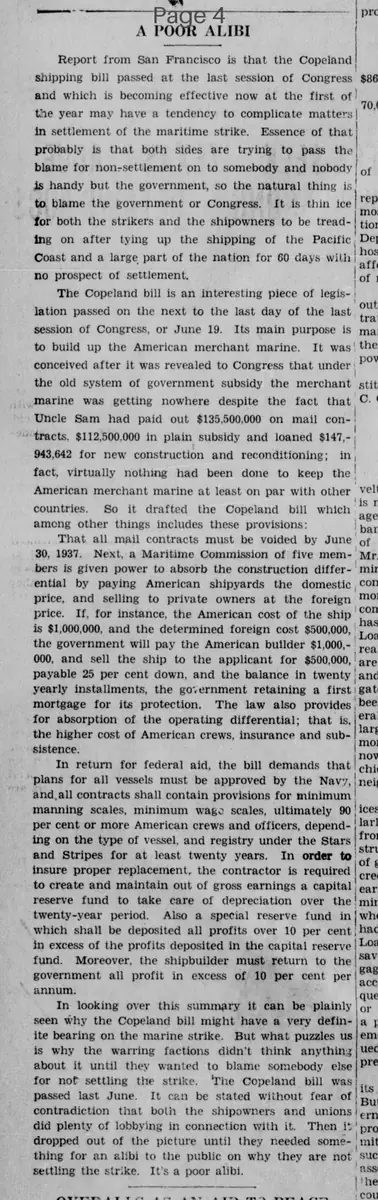
A POOR ALIBI
Report from San Francisco is that the Copeland
shipping bill passed at the last session of Congress
and which is becoming effective now at the first of
the year may have a tendency to complicate matters
in settlement of the maritime strike. Essence of that
probably is that both sides are trying to pass the
blame for non-settlement on to somebody and nobody
is handy but the government, so the natural thing is
to blame the government or Congress. It is thin ice
for both the strikers and the shipowners to be treading
on after tying up the shipping of the Pacific
Coast and a large part of the nation for 60 days with
no prospect of settlement.
The Copeland bill is an interesting piece of legislation
passed on the next to the last day of the last
session of Congress, or June 19. Its main purpose is
to build up the American merchant marine. It was
conceived after it was revealed to Congress that under
the old system of government subsidy the merchant
marine was getting nowhere despite the fact that
Uncle Sam had paid out $135,500,000 on mail contracts,
$112,500,000 in plain subsidy, and loaned $147,
943,642 for new construction and reconditioning; in
fact, virtually nothing had been done to keep the
American merchant marine at least on par with other
countries. So it drafted the Copeland bill which
among other things includes these provisions:
That all mail contracts must be voided by June
30, 1937. Next, a Maritime Commission of five members
is given power to absorb the construction differential
by paying American shipyards the domestic
price, and selling to private owners at the foreign
price. If, for instance, the American cost of the ship
is $1,000,000, and the determined foreign cost $500,000,
the government will pay the American builder $1,000,000,
and sell the ship to the applicant for $500,000,
payable 25 per cent down, and the balance in twenty
yearly installments, the government retaining a first
mortgage for its protection. The law also provides
for absorption of the operating differential; that is
the higher cost of American crews, insurance and subsistence.
In return for federal aid, the bill demands that
plans for all vessels must be approved by the Navy,
and all contracts shall contain provisions for minimum
manning scales, minimum wage scales, ultimately 90
per cent or more American crews and officers, depending
on the type of vessel, and registry under the Stars
and Stripes for at least twenty years. In order to
insure proper replacement, the contractor is required
to create and maintain out of gross earnings a capital
reserve fund to take care of depreciation over the
twenty-year period. Also a special reserve fund in
which shall be deposited all profits over 10 per cent
in excess of the profits deposited in the capital reserve
fund. Moreover, the shipbuilder must return to the
government all profit in excess of 10 per cent per
annum.
In looking over this summary it can be plainly
seen why the Copeland bill might have a very definite
bearing on the marine strike. But what puzzles us
is why the warring factions didn't think anything
about it until they wanted to blame somebody else
for not settling the strike. The Copeland bill was
passed last June. It can be stated without fear of
contradiction that both the shipowners and unions
did plenty of lobbying in connection with it. Then it
dropped out of the picture until they needed something
for an alibi to the public on why they are not
settling the strike. It's a poor alibi.
Report from San Francisco is that the Copeland
shipping bill passed at the last session of Congress
and which is becoming effective now at the first of
the year may have a tendency to complicate matters
in settlement of the maritime strike. Essence of that
probably is that both sides are trying to pass the
blame for non-settlement on to somebody and nobody
is handy but the government, so the natural thing is
to blame the government or Congress. It is thin ice
for both the strikers and the shipowners to be treading
on after tying up the shipping of the Pacific
Coast and a large part of the nation for 60 days with
no prospect of settlement.
The Copeland bill is an interesting piece of legislation
passed on the next to the last day of the last
session of Congress, or June 19. Its main purpose is
to build up the American merchant marine. It was
conceived after it was revealed to Congress that under
the old system of government subsidy the merchant
marine was getting nowhere despite the fact that
Uncle Sam had paid out $135,500,000 on mail contracts,
$112,500,000 in plain subsidy, and loaned $147,
943,642 for new construction and reconditioning; in
fact, virtually nothing had been done to keep the
American merchant marine at least on par with other
countries. So it drafted the Copeland bill which
among other things includes these provisions:
That all mail contracts must be voided by June
30, 1937. Next, a Maritime Commission of five members
is given power to absorb the construction differential
by paying American shipyards the domestic
price, and selling to private owners at the foreign
price. If, for instance, the American cost of the ship
is $1,000,000, and the determined foreign cost $500,000,
the government will pay the American builder $1,000,000,
and sell the ship to the applicant for $500,000,
payable 25 per cent down, and the balance in twenty
yearly installments, the government retaining a first
mortgage for its protection. The law also provides
for absorption of the operating differential; that is
the higher cost of American crews, insurance and subsistence.
In return for federal aid, the bill demands that
plans for all vessels must be approved by the Navy,
and all contracts shall contain provisions for minimum
manning scales, minimum wage scales, ultimately 90
per cent or more American crews and officers, depending
on the type of vessel, and registry under the Stars
and Stripes for at least twenty years. In order to
insure proper replacement, the contractor is required
to create and maintain out of gross earnings a capital
reserve fund to take care of depreciation over the
twenty-year period. Also a special reserve fund in
which shall be deposited all profits over 10 per cent
in excess of the profits deposited in the capital reserve
fund. Moreover, the shipbuilder must return to the
government all profit in excess of 10 per cent per
annum.
In looking over this summary it can be plainly
seen why the Copeland bill might have a very definite
bearing on the marine strike. But what puzzles us
is why the warring factions didn't think anything
about it until they wanted to blame somebody else
for not settling the strike. The Copeland bill was
passed last June. It can be stated without fear of
contradiction that both the shipowners and unions
did plenty of lobbying in connection with it. Then it
dropped out of the picture until they needed something
for an alibi to the public on why they are not
settling the strike. It's a poor alibi.
What sub-type of article is it?
Economic Policy
Labor
Trade Or Commerce
What keywords are associated?
Copeland Bill
Maritime Strike
Shipping Subsidies
American Merchant Marine
Labor Unions
Congress Legislation
What entities or persons were involved?
Congress
Maritime Commission
Shipowners
Unions
Editorial Details
Primary Topic
Critique Of Using Copeland Shipping Bill As Alibi For Maritime Strike
Stance / Tone
Critical Of Shipowners And Unions For Blaming Government
Key Figures
Congress
Maritime Commission
Shipowners
Unions
Key Arguments
Copeland Bill Passed June 19 To Build Up American Merchant Marine Via Subsidies And Regulations
Old Subsidy System Ineffective Despite Large Expenditures
Bill Voids Mail Contracts By June 30 1937 And Absorbs Construction And Operating Differentials
Requires Navy Approval Minimum Wages American Crews And Registry
Demands Reserve Funds And Return Of Excess Profits To Government
Both Sides Lobbied For Bill But Now Use It As Excuse For Strike Delay