Thank you for visiting SNEWPapers!
Sign up free
St. Paul Recorder
Saint Paul, Ramsey County, Minnesota
What is this article about?
Robert Durr views the Southern press's strong reaction to the President's Committee on Civil Rights report as a hopeful sign, despite unfavorable comments, highlighting the Southern Regional Council's support and efforts to promote the report's goals of ending prejudice and segregation in the South.
Clipping
OCR Quality
Full Text
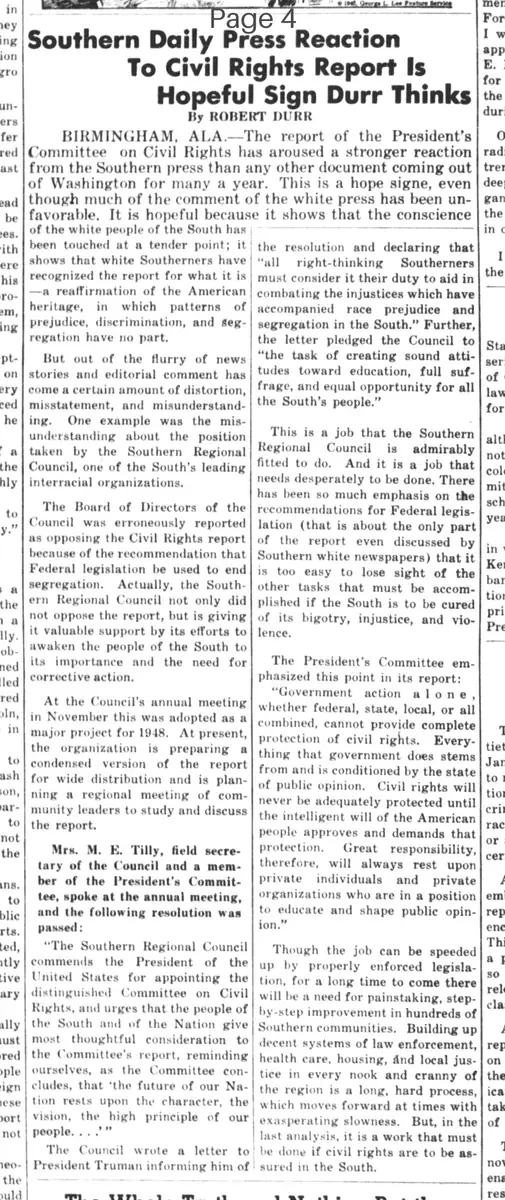
By ROBERT DURR
BIRMINGHAM, ALA.—The report of the President's Committee on Civil Rights has aroused a stronger reaction from the Southern press than any other document coming out of Washington for many a year. This is a hopeful sign, even though much of the comment of the white press has been unfavorable. It is hopeful because it shows that the conscience of the white people of the South has been touched at a tender point: it shows that white Southerners have recognized the report for what it is—a reaffirmation of the American heritage, in which patterns of prejudice, discrimination, and segregation have no part.
But out of the flurry of news stories and editorial comment has come a certain amount of distortion, misstatement, and misunderstanding. One example was the misunderstanding about the position taken by the Southern Regional Council, one of the South's leading interracial organizations.
The Board of Directors of the Council was erroneously reported as opposing the Civil Rights report because of the recommendation that Federal legislation be used to end segregation. Actually, the Southern Regional Council not only did not oppose the report, but is giving it valuable support by its efforts to awaken the people of the South to its importance and the need for corrective action.
At the Council's annual meeting in November this was adopted as a major project for 1948. At present, the organization is preparing a condensed version of the report for wide distribution and is planning a regional meeting of community leaders to study and discuss the report.
Mrs. M. E. Tilly, field secretary of the Council and a member of the President's Committee, spoke at the annual meeting, and the following resolution was passed:
"The Southern Regional Council commends the President of the United States for appointing the distinguished Committee on Civil Rights, and urges that the people of the South and of the Nation give most thoughtful consideration to the Committee's report, reminding ourselves, as the Committee concludes, that 'the future of our Nation rests upon the character, the vision, the high principle of our people. . . .' "
In a letter to the press following the adoption of the resolution and declaring that "all right-thinking Southerners must consider it their duty to aid in combating the injustices which have accompanied race prejudice and segregation in the South." Further, the letter pledged the Council to "the task of creating sound attitudes toward education, full suffrage, and equal opportunity for all the South's people."
This is a job that the Southern Regional Council is admirably fitted to do. And it is a job that needs desperately to be done. There has been so much emphasis on the recommendations for Federal legislation (that is about the only part of the report even discussed by Southern white newspapers) that it is too easy to lose sight of the other tasks that must be accomplished if the South is to be cured of its bigotry, injustice, and violence.
The President's Committee emphasized this point in its report:
"Government action alone, whether federal, state, local, or all combined, cannot provide complete protection of civil rights. Everything that government does stems from and is conditioned by the state of public opinion. Civil rights will never be adequately protected until the intelligent will of the American people approves and demands that protection. Great responsibility, therefore, will always rest upon private individuals and private organizations who are in a position to educate and shape public opinion."
Though the job can be speeded up by properly enforced legislation, for a long time to come there will be a need for painstaking, step-by-step improvement in hundreds of Southern communities. Building up decent systems of law enforcement, health care, housing, and local justice in every nook and cranny of the region is a long, hard process, which moves forward at times with exasperating slowness. But, in the last analysis, it is a work that must be done if civil rights are to be assured in the South.
What sub-type of article is it?
What keywords are associated?
What entities or persons were involved?
Where did it happen?
Domestic News Details
Primary Location
Birmingham, Ala.
Event Date
In November
Key Persons
Outcome
hopeful sign of touched conscience among white southerners; southern regional council adopts support as major project for 1948, prepares condensed version for distribution, plans regional meeting; resolution commends president and urges consideration of report; letter pledges aid in combating injustices and promoting education, suffrage, equal opportunity.
Event Details
The President's Committee on Civil Rights report arouses strong reaction from Southern press, mostly unfavorable but hopeful as it touches white Southern conscience; misunderstandings include erroneous report of Southern Regional Council's opposition; Council supports report, adopted at November annual meeting as 1948 project; Mrs. M. E. Tilly spoke; resolution passed commending President; letter to press declares duty to combat injustices from race prejudice and segregation, pledges to create sound attitudes; emphasis needed on public opinion and local improvements beyond federal legislation.