Thank you for visiting SNEWPapers!
Sign up free
Gazette Of The United States, & Philadelphia Daily Advertiser
Philadelphia, Philadelphia County, Pennsylvania
What is this article about?
Committee address defending James Ross for Pennsylvania governor against Thomas McKean, refuting charges of slander, pro-French sympathies, and deism; includes certificates affirming Ross's piety and criticizing McKean's views on France and immigration. Dated around August 1799.
Merged-components note: Continuation across pages of the address to the freemen of Pennsylvania supporting James Ross, including the appended certificates refuting charges of deism
Clippings
1 of 2
OCR Quality
Full Text
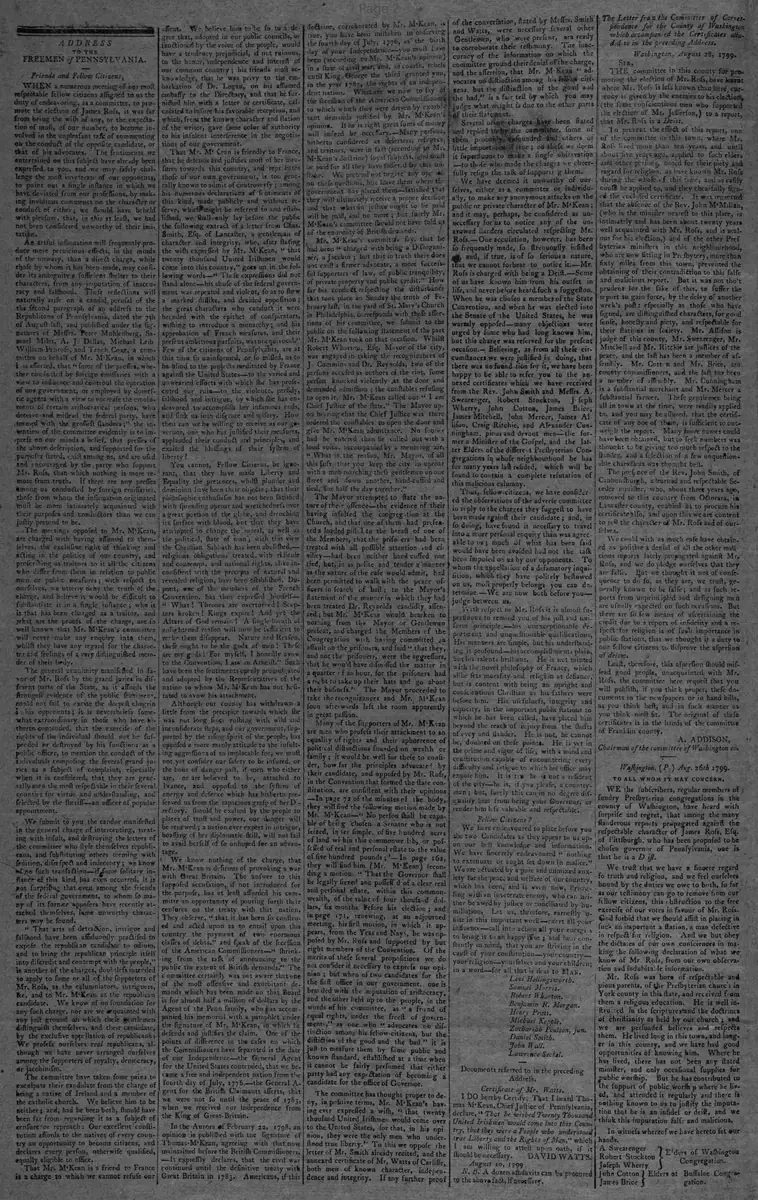
TO THE
FREEMEN OF PENNSYLVANIA.
Friends and Fellow Citizens,
WHEN a numerous meeting of our most respectable fellow citizens assigned to us the duty of endeavoring, as a committee, to promote the election of James Ross, it was far from being the wish of any, or the expectation of most, of our number, to become involved in the unpleasant task of commenting on the conduct of the opposite candidate, or that of his advocates. The sentiments we entertained on this subject have already been expressed to you, and we may safely challenge the most inveterate of our opponents, to point out a single instance in which we have deviated from our professions, by making invidious comments on the character or conduct of either: we should have beheld with pleasure, that, in this at least, we had not been considered unworthy of their imitation.
An artful insinuation will frequently produce more pernicious effects, in the minds of the unwary, than a direct charge, while those by whom it has been made, may consider its ambiguity a sufficient shelter to their characters, from any imputation of inaccuracy and falsehood. These reflections will naturally arise on a candid perusal of the second paragraph of an address to the Republicans of Pennsylvania, dated the 7th of August last, and published under the signatures of Messrs. Peter Muhlenberg, Samuel Miles, A. J. Dallas, Michael Leib, William Penrose, and Tench Coxe, as a committee on behalf of Mr. M'Kean, in which it is asserted, that "some of the presses, whether conducted by foreign emissaries with a view to influence and control the operation of our government, or employed by domestic agents with a view to increase the emoluments of certain aristocratical persons, who deceive and mislead the federal party, have teemed with the grossest slanders;" the intention of the committee evidently is to impress on our minds a belief, that presses of the above description, and supported for the purposes stated, exist among us, and are used and encouraged by the party who support Mr. Ross, than which nothing is more remote from truth. If there are any presses among us conducted by foreign emissaries, those from whom the insinuation originated must be more intimately acquainted with their purposes and conductors than we can justly pretend to be.
...The meetings opposed to Mr. M'Kean, are charged with having assumed to themselves, the exclusive right of thinking and acting in the politics of our country, and proscribing as traitors to it all the citizens who differ from them in relation to public men or public measures; with respect to ourselves, we utterly deny the truth of the charge, and believe it would be difficult to substantiate it in a single instance; who it is that has been charged as a traitor, and what are the proofs of the charge, are well known that Mr. M'Kean's committee will never make any enquiry into them, whilst they have any regard for the character and feelings of a very distinguished member of their body.
The general unanimity manifested in favor of Mr. Ross by the grand juries in different parts of the State, as it affords the strongest evidence of the public sentiment, could not fail to excite the deepest chagrin in his opponents; it is nevertheless somewhat extraordinary, in those who have hitherto contended, that the exercise of the rights of the individual should not be suspended or destroyed by his functions as a public officer, to mention the conduct of the individuals composing the several grand juries as a subject of complaint, especially when it is considered, that they are generally men the most respectable in their several counties for virtue and understanding, and elected by the sheriff an officer of popular appointment.
We submit to you, the candor manifested in the general charge of intercepting, treating with insult, and destroying the letters of the committee who style themselves republicans, and substituting others teeming with sedition, disrespect and indecency; we know no such transaction—if some solitary instance of this kind, has even occurred, it is not surprising. that even among the friends of the federal government, to whom so many of its former opposers have recently attached themselves, some unworthy characters may be found.
"That arts of detraction, intrigue and falsehood have been assiduously practiced to expose. the republican candidate to odium, and to bring the republican principle itself into discredit and contempt with the people," is another of the charges, doubtless intended to apply to some or all of the supporters of Mr. Ross,, as the calumniators, intriguers, &c. and to Mr. M Kean as the republican candidate. We know of no foundation for any such charge, nor are we acquainted with any just ground on which these gentlemen distinguish themselves, and their candidate, by the exclusive appellation of republicans: We profess ourselves real republicans, although we have never arranged ourselves among the supporters of royalty, democracy, or jacobinis.
The committee have taken some pains to exculpate their candidate from the charge of being a native of Ireland and a member of the catholic church. We believe him to be neither : and, had he been both, should have been far from regarding it as a subject of censure or reproach: Our excellent constitution affords to the natives of every country an opportunity to become citizens, and declares every person, otherwise qualified, equally eligible to office.
That Mr. M'Kean is a friend to France is a charge to which we cannot refuse our assent.' We believe him to be so to a degree that, adopted in our public councils, or sanctioned by the voice of the people, would have a tendency prejudicial, if not ruinous, to the honor, independence and interest of our common country; his friends must acknowledge, that he was privy to the embarkation of Dr. Logan, on his assumed embassy to the Directory, and that he furnished him with a letter or certificate, calculated to insure his favorable reception, and which, from the known character and station of the writer, gave some color of authority to his insolent interference in the negotiations of our government.
That Mr. M' Kean is friendly to France, that he defends and justifies most of her measures towards this country, and reprehends those of our own government, is too generally known to admit of controversy ; among his numerous declarations of sentiments of this kind, made publicly and without reserve, which might be referred to and established, we shall only lay before the public the following extract of a letter from Chas. Smith, Esq. of Lancaster, a gentleman of character and integrity, who, after stating the wish expressed by Mr. M'Kean, " that twenty thousand United Irishmen would come into this country," goes on in the following words—“ These expressions did not stand alone his abuse of the federal government was repeated and violent, so as to show a marked dislike, and decided opposition; the great characters who conduct it were branded with the epithet of conspirators, wishing to introduce a monarchy; and his approbation of French measures, and their present ambitious pursuits, was unequivocal."
Few of the citizens of Pennsylvania, are at this time so uninformed, or so misled, as to be blind to the projects meditated by France against the United States—to the varied and unwearied efforts with which she has prosecuted our ruin—to the violence, perfidy, falsehood and intrigue, by which she has endeavored to accomplish her infamous ends, and sink us into disgrace and misery. How then can we be willing to receive as our governor, one who has justified their measures, applauded their conduct and principles, and extolled the blessings of their system of liberty?
You cannot, Fellow Citizens, be ignorant, that they have made Liberty and Equality the pretences, whilst plunder and dominion have been their objects; that their philosophic enthusiasm has not been satisfied with spreading uproar and wretchedness over a great portion of the globe, and drenching its surface with blood, but that they have attempted to change the moral, as well as the political, state of man; with this view the Christian Sabbath has been abolished,— religious obligations treated with ridicule and contempt, and national rights, alike inconsistent with the precepts of natural and revealed religion, have been established. Dupont, one of the members of the French Convention, has thus expressed himself " What! Thrones are overturned! Scepters broken! Kings expire! And yet the Altars of God remain ! A single breath of enlightened reason will now be sufficient to make them disappear. Nature and Reason, these ought to be the gods of men! These are my gods! For myself, I honestly avow to the Convention, I am an Atheist." Such have been the sentiments openly promulgated and adopted by the Representatives of the nation to whom Mr. M·Kean has not hesitated to avow his attachment.
Although our country has withdrawn a little from the precipice towards which she was not long since rushing with wild and inconsiderate steps, and our government, supported by the rising spirit of the people, has opposed a more manly attitude to the insulting aggressions of an implacable foe, we must not yet consider our safety to be insured, or the hour of danger past, if men who either are, or are believed to be, attached to France, and opposed to the system 'of energy and defence which has hitherto preserved us from the rapacious grasp of her Directory, should be exalted by the people to places of trust and power, our danger will be renewed ; a nation ever expert in intrigue, boasting of her diplomatic skill, will not fail to avail herself of so unhoped for an advantage.
We know nothing of the charge, that Mr. M'Kean is desirous of provoking a war with Great Britain. The answer to this supposed accusation, if not introduced for the purpose, has at least afforded his committee an opportunity of pouring forth their censures on the treaty with that nation. They observe, " that it has been so construed and acted upon as to entail upon this country the payment of two enormous classes of debts." and speak of the session of the American Commissioners—“ shrinking from the task of announcing to the public the extent of British demands." The committee certainly was not aware that one of the most offensive and exorbitant demands which has been made on that Board is for almost half a million of dollars by the Agent of the Penn family, who has accompanied his memorial with a pamphlet under the signature of Mr. M'Kean, in which he defends and justifies the claim. One of the points of difference in the cases on which the Commissioners have separated is the date of our Independence—the General Agent for the United States contended, that we became a free and independent nation from the fourth day of July, 1776,—the General Agent for the British Claimants asserts, that we were not so until the peace of 1783, when we received our independence from the King of Great-Britain.
In the Aurora of February 22, 1798, an opinion is published with the signature of Thomas M'Kean, agreeing with that now maintained before the British Commissioners —It expressly declares, that the civil war continued until the definitive treaty with Great Britain in 1783, Americans, if this doctrine, corroborated by Mr. M·Kean, is true, you have been mistaken in observing the fourth day of July, 1776, as the birth day of your Independence—you must have been (according to Mr. M Kean's opinion) in a state of civil war, and, of course, rebels until King George the third granted you, in the year 1783, the rights of an independent nation. What are we now to say of the session of the American Commissioners to which they were driven by exorbitant demands justified by Mr. M Kean's opinion. If he is right great sums of money will indeed be necessary.—Many persons, hitherto considered as deserters, refugees, and traitors, were in fact (according to Mr. M Kean's doctrine) loyal subjects, and must be paid for all they have suffered by this mistake. We pretend not to give any opinion on these questions, but leave them where the government has placed them satisfied that they will ultimately receive a proper decision and that what in justice ought to be paid will be paid, and no more ; but surely Mr. M'Kean's committee should not have told us of the enormity of British demands.
Mr. M'Kean's committee say, that he had been " charged with being a Disorganizer, a Jacobin ; but that in truth there does not exist a firmer advocate, a more successful supporter of law, of public tranquility, of private property and public credit." How far his conduct respecting the disturbance that took place on Sunday the tenth of February last, in the yard of St. Mary's Church in Philadelphia, corresponds with these assertions of his committee, we submit to the public on the following statement of the part Mr. M'Kean took on that occasion. Whilst Robert Wharton, Esq. Mayor of the city, was engaged in taking the recognizances of J. Cummins and Dr. Reynolds, two of the persons accused as authors of the riot, some person knocked violently at the door and demanded admission ; the constables refusing to open it, Mr. M·Kean called out " I am Chief Justice of the state." The Mayor upon hearing that the Chief Justice was there ordered the constables to open the door and give Mr. M'Kean admittance. No sooner had he entered than he called out with a loud voice, accompanied by a menacing air, " What is the reason, Mr. Mayor, of all this fuss that you keep the city in uproar with a mob marching the gentlemen up one street and down another, hand-cuffed and tied, for half the day together."
The Mayor attempted to state the nature of their offence—the evidence of their having insulted the congregation at the Church, and that one of them had pressed a loaded pistol to the breast of one of the Members, that the prisoners had been treated with all possible attention and civility—had been neither hand cuffed nor tied, but, in as polite and tender a manner as the nature of the case would admit, had been permitted to walk with the peace officers in search of bail; to the Mayor's statement of the manner in which they had been treated Dr. Reynolds candidly assented; but Mr. M Kean would hearken to nothing from the Mayor or Gentlemen present, and charged the Members of the Congregation with having committed an assault on the prisoners, and said " that they, and not the prisoners, were the aggressors, that he would have dismissed the matter in a quarter of an hour, for the prisoners had a right to take up their hats and go about their business." The Mayor proceeded to take the recognizances and Mr. M Kean soon afterwards left the room apparently in great passion.
Many of the supporters of Mr. M·Kean are men who profess their attachment to an equality of rights and their abhorrence of political distinctions founded on wealth or family : it would be well for these to consider, how far the principles advocated by their candidate, and opposed by Mr. Ross, in the Convention that formed the state constitution. are consistent with their opinions —In page 72 of the minutes of the body, they will find the following motion made by Mr. M Kean—“ No person Shall be capable of being chosen a Senator who is not sized, in fee simple, of five hundred acres of land within this commonwealth, or possessed of real and personal estate to the value of five hundred pounds; In page 162, they will find him (Mr. M°Kean) seconding a motion. " That the Governor shall be legally seized and possessed of a clear real and personal estate, within this commonwealth, of the value of four thousand dollars, six months before his election ; and in page 171, renewing, at an adjourned meeting, his first motion, in which it appears, from the Yeas and Nays, he was opposed by Mr. Ross and supported by but eight members of the Convention. Of the merits of these several propositions we do not consider it necessary to express our opinion ; but when of two candidates for the first office in our government, one is branded with the imputation of aristocracy, and the other held up to the people, in the words of his committee, as " a friend of equal rights, under the freest of governments," as one who " advocates no distinction among his fellow-citizens, but the distinction of the good and the bad." it is just to measure them by some public and known standard, established at a time when it cannot be fairly presumed that either party had any expectation of becoming a candidate for the office of Governor.
The committee has thought proper to deny, in positive terms, Mr. M Kean's having ever expressed a wish, " that twenty thousand United Irishmen would come over to the United States, for that, in his opinion, they were the only men who understood true liberty." To this we oppose the letter of Mr. Smith already recited, and the annexed certificate of Mr, Watts of Carlisle, both men of known character, independence and integrity. If any further proof of the conversation, stated by Messrs. Smith and Watts, were necessary several other Gentlemen, who were present, are ready to corroborate their testimony. The inaccuracy of the information on which the committee ground their denial of the charge, and the assertion, that Mr. M·Kean " advocates no distinction among his fellow citizens, but the distinction of the good and the bad," is a fair test by which you may judge what weight is due to the other parts of their statement.
Several other charges have been stated and replied to by the committee, some of them probably unfounded and others of little importance if true; on these we deem it superfluous to make a single observation —to those who made the charges we cheerfully resign the task of supporting them. We have deemed it unworthy of ourselves, either as a committee or individually, to make any anonymous attacks on the public or private character of Mr. M'Kean; and it may, perhaps, be considered as unnecessary for us to notice any of the unavowed slanders circulated respecting Mr. Ross.—One accusation, however, has been so frequently made, so strenuously insisted on, and, if true, is of so serious a nature, that we cannot forbear to notice it.—Mr. Ross is charged with being a Deist.—Some of us have known him from his outset in life, and never before heard such a suggestion. When he was chosen a member of the State Convention, and when he was elected into the Senate of the United States, he was warmly opposed—many objections were urged by some who had long known him, but this charge was reserved for this present occasion.— Believing, as from all these circumstances we were justified in doing, that there was no foundation for it, we have been happy to be able to refer you to the annexed certificates which we have received from the Rev. John Smith and Messrs. A. Swearenger, Robert Stockton, Joseph Wherry, John Cotton, James Brice, James Mitchell, John Mercer, James Allison, Craig Ritchie, and Alexander Cunningham, pious and devout men—the former a Minister of the Gospel, and the latter Elders of the different Presbyterian Congregations in whose neighbourhood he has for many years last resided, which will be found to contain a complete refutation of this malicious calumny.
Thus, fellow citizens, we have considered the observations of the adverse committee in reply to the charges they suggest to have been made against their candidate; and, in so doing, have found it necessary to travel into a more personal enquiry than was agreeable to us; much of what has been said would have been avoided had not the task been imposed on us by our opponents. To whom the appellation of a defamatory inquisition, which they have politely bestowed on us, most properly belongs you can determine.—We are now both before you— judge between us.
With respect to Mr. Ross it is almost superfluous to remind you of his just and uniform principle,—his unexceptionable deportment and unquestionable qualifications, His manners are simple, but his understanding is profound—his accomplishments plain, but his talents brilliant. He is not tainted with the novel philosophy of France, which alike sets morality and religion at defiance, but is content with being an upright and conscientious Christian as his fathers were before him. His usefulness, integrity and capacity, in the important public stations to which he has been called, have placed him beyond the reach of injury from the shafts of envy and slander. He is not, he cannot be, doubted on these points. He is yet in the prime and vigor of life, with a mind and constitution capable of encountering every difficulty and fatigue to which his office may expose him. It is true he is not a resident of the city—he is, if you please, a countryman; but, surely this can in no degree disqualify him from being your Governor, or render him less valuable and respectable.
Fellow Citizens?
We have endeavoured to place before you the two Candidates as they appear to us upon our best knowledge and information. We have sincerely endeavoured " nothing to extenuate or aught set down in malice." We are actuated by a pure and unmixed anxiety for the peace and welfare of our country, which has been, and is even now, struggling with an inveterate enemy, who can neither be awed by justice or conciliated by humiliation, Let us, therefore, earnestly unite in this important work—exert all your influence—call into action all your energies to bring it to an happy issue ; and bear constantly in mind, that you are striving in the cause of your constitution—your country— your religion—yourselves and your children; in a word—for all that is dear to MAN.
Levi Hollingsworth.
Samuel Morris.
Robert Wharton.
Benjamin R. Morgan.
Henry Pratt.
Michael Kepple.
Zacariah Poulson, jun.
Daniel Smith.
John Wall.
Lawrence Seckel.
Documents referred to in the preceding Address.
Certificate of Mr. Watts.
I DO hereby Certify, That I heard Thomas M Kean, Chief Justice of Pennsylvania, declare, " That he wished Twenty Thousand United Irishmen would come into this Country, that they were a People who understood true Liberty and the Rights of Man," which I am willing to attest upon oath, if it should be necessary.
DAVID WATTS.
August 10, 1799
N. B. A dozen affidavits can be procured to the above fact, if necessary.
The Letter from the Committee of Correspondence for the County of Washington which accompanied the Certificates alluded to in the preceding Address.
Washington, August 28, 1799.
Sir,
THE committee in this county for promoting the election of Mr. Ross, have learnt where Mr. Ross is less known than here, currency is given by the enemies to his election (the same conscientious men who supported the election of Mr. Jefferson,) to a report, that Mr. Ross is a Deist.
To prevent the effect of. this report, one of the committee in this town, where Mr. Ross lived more than ten years, and until about five years ago, applied to such elders and other persons, noted for their piety and regard for religion, as have known Mr. Ross during the whole of this time, and as easily could be applied to, and they cheerfully signed the enclosed certificate. It was regretted that the absence of the Rev. John M Millan, (who is the minister nearest to this place, is intimately and has been about twenty years well acquainted with Mr. Ross, and is zealous for his election,) and of the other Presbyterian ministers in this neighbourhood, who are now sitting in Presbytery, more than fifty miles from this town, prevented the obtaining of their contradiction to this false and malicious report. But it was not thought prudent for the sake of this, to suffer the report to gain force, by the delay of another week's post: especially as those who have signed, are distinguished characters, for good sense, honesty and piety, and respectable for their stations in society. Mr. Allison is judge of this county, Mr. Swearenger, Mr. Mitchell and Mr. Ritchie are justices of the peace, and the last has been a member of assembly. Mr. Cotton and Mr. Brice, are county commissioners, and the last has been a member of assembly. Mr. Cunningham is a substantial merchant and Mr. Mercer a substantial farmer. These gentlemen being all in town at the time, were readily applied to, and you may be assured, that the certificate of any one of them, is sufficient to outweigh the report. Many more names could have been obtained, but to seek numbers was thought to be giving too much respect to the slander, and a selection of a few unquestionable characters was thought best.
The presence of the Rev. John Smith, of Canonsburgh, a learned and respectable Seceder minister, who, about three years ago, removed to this country from Octorara, in Lancaster county, enabled us to procure his certificate also, and upon this we are content to rest the character of Mr. Ross and of ourselves.
We could with as much ease have obtained as positive a denial of all the other malicious reports lately propagated against Mr. Ross, and we do pledge ourselves that they are false. But we thought it not of consequence to do so, as they are, we trust, generally known to be false; and as such reports from unprincipled and designing men are usually expected on such occasions. But there are so few means of ascertaining the credit due to a report of infidelity and a respect for religion is of such importance in public stations, that we thought it a duty to our fellow citizens to disprove the aspersion of deism.
Lest, therefore, this aspersion should mislead good people, unacquainted, with Mr. Ross, the committee here request that you will publish, if you think proper, these documents in the newspapers or in hand bills, as you think best, and in such manner as you think most fit. The original of these certificates is in the hands of the committee of Franklin county.
A. ADDISON.
Chairman of the committee of Washington co.
Washington, (P.) Aug. 26th 1799.
TO ALL WHOM IT MAY CONCERN.
WE the subscribers, regular members of sundry Presbyterian congregations in the county of Washington, have heard with surprise and regret, that among the many slanderous reports propagated against the respectable character of James Ross, Esq. of Pittsburgh. who has been proposed to be chosen governor of Pennsylvania, one is that he is a D. i.
We trust that we have a sincere regard for truth and religion, and we feel ourselves bound by the duties we owe to both, so far as our testimony can go to remove from our fellow citizens, this obstruction to the free exercise of our votes in favour of Mr. Ross. God forbid that we should aid in placing in so' an important a station, a man defective in respect'for religion. 'And we but obey the dictates of our own consciences in making the following declaration of what we know of Mr. Ross, from our own observation and indubitable information.
Mr. Ross was born of respectable and pious parents, of the Presbyterian church i in York county in this state, and received from them a religious education. He is well instructed in the scriptures and the doctrines of christianity as held by our church ; and we are persuaded believes and respects them. He lived long in this town, and longer in this county, and we have had good opportunities of knowing him. Where he has lived, there has not been any stated minister, and only occasional supplies for public worship. But he has contributed to the support of public worship where he lived, and attended it regularly and there is nothing known to us to justify the imputation that he is an infidel or deist, and we think this imputation false and malicious.
In witness whereof we have hereto set our hands.
A Swearenger
'E'ders of Washington
Robert Stockton
Congregation.
Joseph Wherry
John Cotton) Elders of Buffalo Congre
James Brice
gation.
James Mitchell, Elder of Peters Congregation.
John Mercer
Elders of Chartiers
James Allison
Congregation.
Cage Richie
Alexander Cunningham.
Since I lived in Washington county, I have had opportunity of conversing and being well acquainted with James Ross, Esq. of Pittsburgh, and of knowing his character from serious and respectable persons well acquainted with his opinions and conversation, and I am well persuaded that he is sincerely respectful of the Christian Protestant Religion, and do verily believe that the report of his being an infidel or deist is altogether without foundation.
JOHN SMITH,
Minister of Associated Congregation Chartiers.
What sub-type of article is it?
What keywords are associated?
What entities or persons were involved?
Editorial Details
Primary Topic
Support For James Ross Against Thomas Mckean In Pennsylvania Gubernatorial Election
Stance / Tone
Strongly Pro Ross, Anti Mckean And Pro French Influences
Key Figures
Key Arguments