Thank you for visiting SNEWPapers!
Sign up free
The Daily Worker
Chicago, Cook County, Illinois
What is this article about?
The article criticizes the newly approved coal code under the NRA for recognizing company unions, maintaining low wages, and establishing strikebreaking mechanisms, betraying miners' demands for union recognition and better conditions. It highlights protests by UMWA leaders and calls for continued strikes and independent organization.
Merged-components note: Merged continuation of the article on the coal code and its impact on miners' strikes from page 1 to page 3, based on explicit 'Continued from Page One' indicator and matching topic.
Clippings
1 of 2
OCR Quality
Full Text
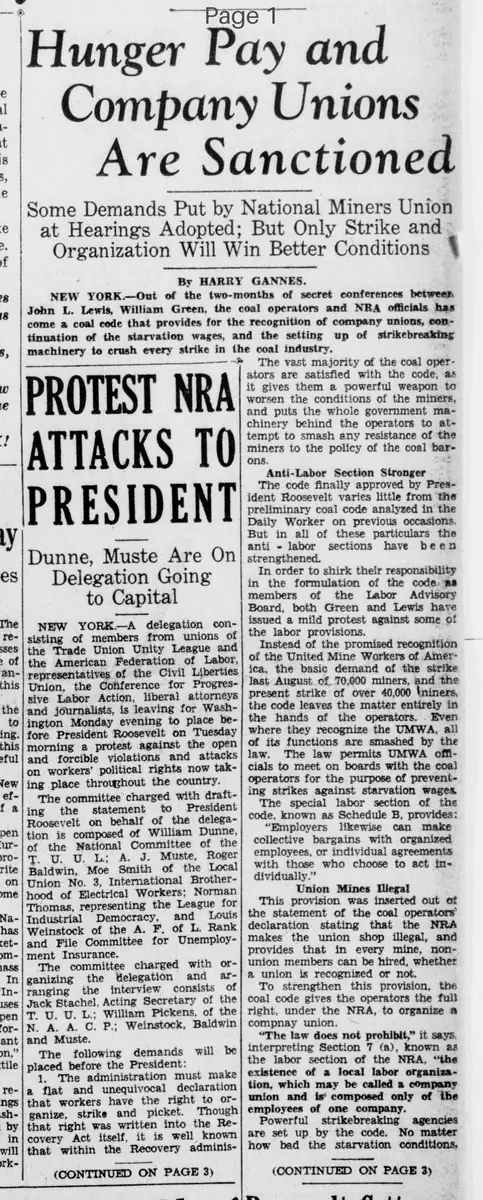
Pay
and
Company Unions
Are Sanctioned
Some Demands Put by National Miners Union
at Hearings Adopted; But Only Strike and
Organization Will Win Better Conditions
By HARRY GANNES.
NEW YORK.-Out of the two-months of secret conferences between
John L. Lewis, William Green, the coal operators and NRA officials has
come a coal code that provides for the recognition of company unions, con-
tinuation of the starvation wages, and the setting up of strikebreaking
machinery to crush every strike in the coal industry.
The vast majority of the coal oper-
ators are satisfied with the code, as
it gives them a powerful weapon to
worsen the conditions of the miners,
and puts the whole government ma-
chinery behind the operators to at-
tempt to smash any resistance of the
miners to the policy of the coal bar-
ons.
Anti-Labor Section Stronger
The code finally approved by Pres-
ident Roosevelt varies little from the
preliminary coal code analyzed in the
Daily Worker on previous occasions.
But in all of these particulars the
anti-labor sections have been
strengthened.
In order to shirk their responsibility
in the formulation of the code as
members of the Labor Advisory
Board, both Green and Lewis have
issued a mild protest against some of
the labor provisions.
Instead of the promised recognition
of the United Mine Workers of Amer-
ica, the basic demand of the strike
last August of 70,000 miners, and the
present strike of over 40,000 miners,
the code leaves the matter entirely in
the hands of the operators. Even
where they recognize the UMWA, all
of its functions are smashed by the
law. The law permits UMWA of-
cials to meet on boards with the coal
operators for the purpose of prevent-
ing strikes against starvation wages.
The special labor section of the
code, known as Schedule B, provides:
"Employers likewise can make
collective bargains with organized
employees, or individual agreements
with those who choose to act in-
dividually."
Union Mines Illegal
This provision was inserted out of
the statement of the coal operators'
declaration stating that the NRA
makes the union shop illegal, and
provides that in every mine, non-
union members can be hired, whether
a union is recognized or not.
To strengthen this provision, the
coal code gives the operators the full
right, under the NRA, to organize a
company union.
"The law does not prohibit," it says
interpreting Section 7 (a), known as
the labor section of the NRA, "the
existence of a local labor organiza-
tion, which may be called a company
union and is composed only of the
employees of one company."
Powerful strikebreaking agencies
are set up by the code. No matter
how bad the starvation conditions.
COAL CODE AIDS IN BREAKING STRIKES
(Continued from Page One)
the codes make it illegal for the workers to strike, but demands they stay on the job while a compulsory arbitration board, consisting of two representatives of the bosses, and one of the UMWA "discuss" the workers grievances. When these grievances are discussed, and a decision made, the workers must abide by it for a period of six months. At that time, they are not allowed to strike, according to the law, but must wait again for the compulsory arbitration.
While this appeared in the preliminary draft of the coal code, it has now been greatly strengthened.
Strikebreaking Provisions
All of these strikebreaking and compulsory arbitration methods appear in the code under Article VII, entitled "Administration," section 5, "labor relations."
Paragraph A of this section, provides that all controversies must be submitted to special bodies set up to handle them. Then Section B reads:
"Any such controversy which cannot be settled in the manner so provided and which threatens to interrupt or has interrupted or is impairing the efficient operation of any mine or mines to such an extent as to restrain interstate commerce in the products thereof shall be referred to the appropriate bituminous coal labor board, established as hereinafter provided, and the decision of said board shall be accepted by the parties to the controversy as effective for a provisional period of not longer than six months to be fixed by the board."
In plain English it means, the miners if their wages are cut, or if their union is attacked, or even if the provisions of the code are violated, are not allowed to strike but must submit to a board in which the operators and their government have the last word.
Section C, makes the anti-strike order even more oppressive. It says that while the board is discussing the controversy the miners must submit to existing conditions, saying "Neither party to the controversy shall change the conditions out of which the controversy arose or utilize any coercive or retaliatory measure to compel the other party to accede to its demands."
In short, the miners must continue to slave under existing conditions, without using their organization to win their demands. This is a complete outlawing of the right to strike and every other right of the workers, and strives to make entirely worthless any organization of the miners.
Finally, under this set-up, the code provides for a bituminous coal labor board to be set up in each district. They are to consist of three members chosen as follows: 1 By the coal operators. 2 By the President or the NRA. 3) By organization of the workers (in practice, officials of the UMWA, the very same betrayers who helped to write the code.)
Nothing could be more disastrous for the miners than to have their fate rest in the hands of such a clique in each district. Definitely, two of the members of the labor board in whose hands rests all decisions are bosses' men, and the third, the UMWA officials, are the very individuals who tried to break the last two strikes of the miners, and promised them that the code would give them all the demands.
The operators and the UMWA officials had very little conflict over wages and hours, as these are set low enough to continue the present starvation pay throughout the entire soft coal fields of the United States.
Whereas the preliminary code provided for the 36-hour week, the code finally adopted sets the 40-hour week, and eight-hour day rate, with plenty of loopholes for the operators to increase hours without increasing pay.
A special provision is made for individual agreements at separate mines, allowing the operators to fix hours as they wish, depending on the resistance of the workers. The code definitely states that the 40-hour week is "not the minimum."
Wages are ranged from $3.60 for so-called outside common labor, to $5.63 (for Montana alone) for inside skilled workers. Sixteen districts are set up in which the wages are arranged to suit the operators. In the largest district, known as district A, covering Pennsylvania, Ohio, Michigan, and the Panhandle of West Virginia, wages are set at $4.60 a day for "skilled" workers, and $3.60 for common outside laborers.
This means that the minimum wage is $3.60, and the operators designate, who is "skilled" and who "unskilled." An hourly rate is also set, so that by the stagger plan the present wages can be cut even lower than they are.
In many districts the present wages of the miners, won through strikes and organization, as those in the Utah and New Mexico coal fields through the National Miners' Union, are cut through the coal code.
The warning to the miners by the National Miners' Union that John L. Lewis and other U. M. W. A. officials, through the coal code negotiations, are preparing a drastic attack against the miners is fully borne out.
The demands presented by the National Miners' Union at the Washington hearings for a $6 a day scale as minimum for six hours' work, and a guarantee of 40 weeks' work for the year, were rejected.
Several of the demands of the N. M. U., however, were included in the code, but even these are endangered by the set up of compulsory arbitrating and the strikebreaking apparatus that goes with the code.
These provisions in the code are: Tonnage to be based on 2,000 to 2,400 pounds, though no scale is set for tonnage, the operators having the right to fix the rates on the basis of the starvation day rates; miners to be paid twice a month by cash or checks; miners do not have to live in company houses; nor are they required to trade at company stores.
The code provides that young workers under 17 shall not work underground, and those under 16 shall not work around the mines. But there are many ways to get around this.
The coal code is to be signed today by Roosevelt, and becomes effective the second Monday after its signature.
Besides dealing with wages and hours, the coal code provides a whole scheme of price raising to increase the profits of the coal operators.
The miners now on strike should not give up their rights, but continue the strike until an agreement is made directly with the companies and the strike committees.
It is clear now union recognition will come only through struggle. Throughout the past two strikes the U. M. W. A. officials have exposed their unity with the operators, and the immediate necessity of the miners is a powerful opposition against the Lewis machine which will wipe out these traitors.
Even where small concessions are granted, these will not be carried through unless forced by action of the miners.
At no time should the miners give up the right to strike, or leave their fate in the hands of the bituminous labor boards.
More than ever independent organization of the miners themselves, freed from the betraying grasp of the U. M. W. A. officials, is now necessary. The National Miners' Union from the very beginning of the strike exposed the betrayals of the Lewis machine, fought in Washington and on the picket lines in a united front struggle for the miners' demands. The N. M. U. is co-operating and fighting with the opposition forces in the U. M. W. A., in order to defeat the new slave law of Roosevelt, Lewis and the coal operators.
What sub-type of article is it?
What themes does it cover?
What keywords are associated?
What entities or persons were involved?
Where did it happen?
Story Details
Key Persons
Location
United States Coal Fields, Washington
Event Date
Last August, Present Strike, Signed Today
Story Details
The coal code, approved after secret conferences, sanctions company unions, low wages, and strikebreaking arbitration boards, betraying miners' demands for UMWA recognition and better conditions despite protests from Lewis and Green; National Miners Union calls for continued strikes and independent organization.