Thank you for visiting SNEWPapers!
Sign up free
The Indianapolis Journal
Indianapolis, Marion County, Indiana
What is this article about?
Coroner's investigation in Indianapolis into Ed Quinlan's shooting death features testimonies from witnesses, police, and an autopsy revealing a .32-calibre bullet. Eyewitness James N. Vickery testifies a civilian fired the fatal fourth shot, not police.
Clipping
OCR Quality
Full Text
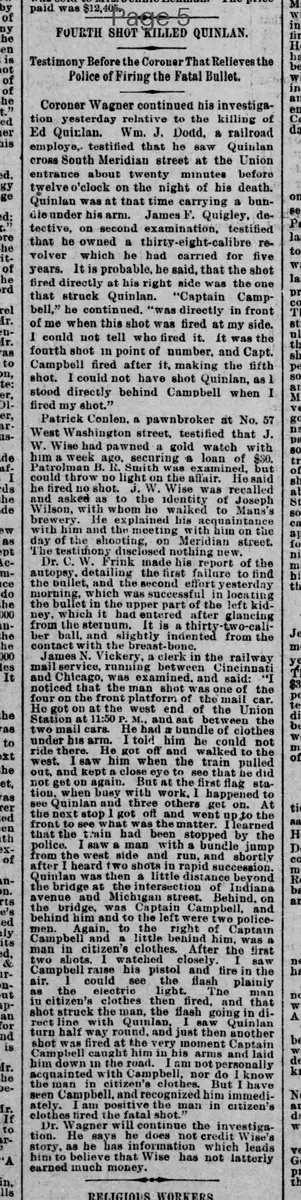
Testimony Before the Coroner That Relieves the Police of Firing the Fatal Bullet.
Coroner Wagner continued his investigation yesterday relative to the killing of Ed Quinlan. Wm. J. Dodd, a railroad employe, testified that he saw Quinlan cross South Meridian street at the Union entrance about twenty minutes before twelve o'clock on the night of his death. Quinlan was at that time carrying a bundle under his arm. James F. Quigley, detective, on second examination, testified that he owned a thirty-eight-calibre revolver which he had carried for five years. It is probable, he said, that the shot fired directly at his right side was the one that struck Quinlan. "Captain Campbell," he continued, "was directly in front of me when this shot was fired at my side. I could not tell who fired it. It was the fourth shot in point of number, and Capt. Campbell fired after it, making the fifth shot. I could not have shot Quinlan, as I stood directly behind Campbell when I fired my shot."
Patrick Conlen, a pawnbroker at No. 57 West Washington street, testified that J. W. Wise had pawned a gold watch with him a week ago, securing a loan of $30.
Patrolman B. R. Smith was examined, but could throw no light on the affair. He said he fired no shot. J. W. Wise was recalled and asked as to the identity of Joseph Wilson, with whom he walked to Maus's brewery. He explained his acquaintance with him and the meeting with him on the day of the shooting, on Meridian street.
The testimony disclosed nothing new.
Dr. C. W. Frink made his report of the autopsy, detailing the first failure to find the bullet, and the second effort yesterday morning, which was successful in locating the bullet in the upper part of the left kidney, which it had entered after glancing from the sternum. It is a thirty-two-calibre ball, and slightly indented from the contact with the breast-bone.
James N. Vickery, a clerk in the railway mail service, running between Cincinnati and Chicago, was examined, and said: I noticed that the man shot was one of the four on the front platform of the mail car. He got on at the west end of the Union Station at 11:50 P. M., and sat between the two mail cars. He had a bundle of clothes under his arm. I told him he could not ride there. He got off and walked to the west. I saw him when the train pulled out, and kept a close eye to see that he did not get on again. But at the first flag station, when busy with work, I happened to see Quinlan and three others get on. At the next stop I got off and went up to the front to see what was the matter. I learned that the train had been stopped by the police. I saw a man with a bundle jump from the west side and run, and shortly after I heard two shots in rapid succession. Quinlan was then a little distance beyond the bridge at the intersection of Indiana avenue and Michigan street. Behind, on the bridge, was Captain Campbell, and behind him and to the left were two policemen. Again, to the right of Captain Campbell and man in citizen's clothes. After the first two shots, I watched closely. I saw Campbell raise his pistol and fire in the air. I could see the flash plainly as the electric light. The man in citizen's clothes then fired, and that shot struck the man, the flash going in direct line with Quinlan. I saw Quinlan turn half way round, and just then another shot was fired at the very moment Captain Campbell caught him in his arms and laid him down in the road. I am not personally acquainted with Campbell, nor do I know the man in citizen's clothes. But I have seen Campbell, and recognized him immediately. I am positive the man in citizen's clothes fired the fatal shot.
Dr. Wagner will continue the investigation. He says he does not credit Wise's story, as he has information which leads him to believe that Wise has not latterly earned much money.
What sub-type of article is it?
What themes does it cover?
What keywords are associated?
What entities or persons were involved?
Where did it happen?
Story Details
Key Persons
Location
Indianapolis, Indiana (South Meridian Street, Union Station, Indiana Avenue And Michigan Street)
Event Date
Night Of His Death, Around 11:50 P.M.
Story Details
Coroner's inquest into the shooting death of Ed Quinlan includes testimonies from witnesses and police, autopsy report locating a .32-calibre bullet in his kidney, and an eyewitness identifying a civilian's shot as the fatal one, the fourth shot fired, relieving police of responsibility.