Thank you for visiting SNEWPapers!
Sign up free
Story
October 8, 1931
Western News And The Libby Times
Libby, Lincoln County, Montana
What is this article about?
Article on the late adoption of wood for paper making, proposed by Reaumur in 1719 inspired by wasps, with key advancements by Schaffer in 1765, as rags were traditionally used for durable paper.
Clipping
OCR Quality
98%
Excellent
Full Text
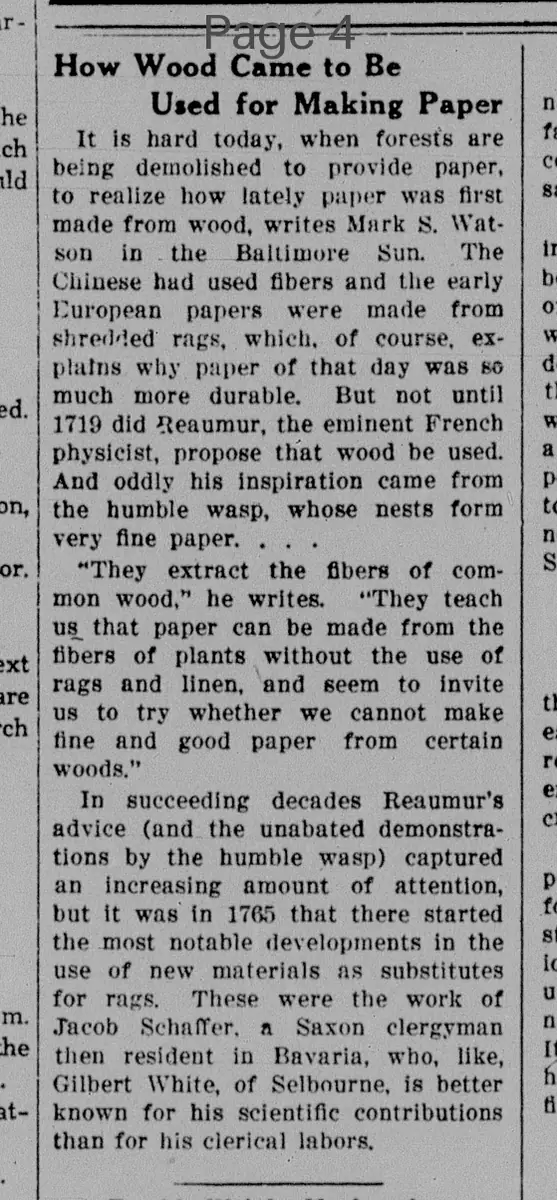
How Wood Came to Be Used for Making Paper
It is hard today, when forests are being demolished to provide paper, to realize how lately paper was first made from wood, writes Mark S. Watson in the Baltimore Sun. The Chinese had used fibers and the early European papers were made from shredded rags, which, of course, explains why paper of that day was so much more durable. But not until 1719 did Reaumur, the eminent French physicist, propose that wood be used. And oddly his inspiration came from the humble wasp, whose nests form very fine paper.
"They extract the fibers of common wood," he writes. "They teach us that paper can be made from the fibers of plants without the use of rags and linen, and seem to invite us to try whether we cannot make fine and good paper from certain woods."
In succeeding decades Reaumur's advice (and the unabated demonstrations by the humble wasp) captured an increasing amount of attention, but it was in 1765 that there started the most notable developments in the use of new materials as substitutes for rags. These were the work of Jacob Schaffer, a Saxon clergyman then resident in Bavaria, who, like Gilbert White, of Selbourne, is better known for his scientific contributions than for his clerical labors.
It is hard today, when forests are being demolished to provide paper, to realize how lately paper was first made from wood, writes Mark S. Watson in the Baltimore Sun. The Chinese had used fibers and the early European papers were made from shredded rags, which, of course, explains why paper of that day was so much more durable. But not until 1719 did Reaumur, the eminent French physicist, propose that wood be used. And oddly his inspiration came from the humble wasp, whose nests form very fine paper.
"They extract the fibers of common wood," he writes. "They teach us that paper can be made from the fibers of plants without the use of rags and linen, and seem to invite us to try whether we cannot make fine and good paper from certain woods."
In succeeding decades Reaumur's advice (and the unabated demonstrations by the humble wasp) captured an increasing amount of attention, but it was in 1765 that there started the most notable developments in the use of new materials as substitutes for rags. These were the work of Jacob Schaffer, a Saxon clergyman then resident in Bavaria, who, like Gilbert White, of Selbourne, is better known for his scientific contributions than for his clerical labors.
What sub-type of article is it?
Historical Event
Curiosity
What themes does it cover?
Exploration
What keywords are associated?
Paper Making
Wood Fibers
Wasp Inspiration
Reaumur Proposal
Schaffer Developments
What entities or persons were involved?
Mark S. Watson
Reaumur
Jacob Schaffer
Gilbert White
Where did it happen?
Europe
Story Details
Key Persons
Mark S. Watson
Reaumur
Jacob Schaffer
Gilbert White
Location
Europe
Event Date
1719 1765
Story Details
The history of using wood for paper, inspired by wasps in 1719 by French physicist Reaumur, with notable developments in 1765 by Saxon clergyman Jacob Schaffer using new materials as rag substitutes.