Thank you for visiting SNEWPapers!
Sign up free
The Morning News
Savannah, Chatham County, Georgia
What is this article about?
At the New York Democratic state convention in Albany on Feb. 22, 1892, a protest from the Grace-Anderson committee against the convention timing is tabled. The convention enthusiastically endorses Senator David B. Hill as a presidential candidate, with Hill delivering a speech on tariff reform and Democratic principles.
Merged-components note: These two components form a single continuous narrative article on the New York Democratic convention endorsing Senator Hill, with sequential reading orders and matching topic.
Clipping
OCR Quality
Full Text
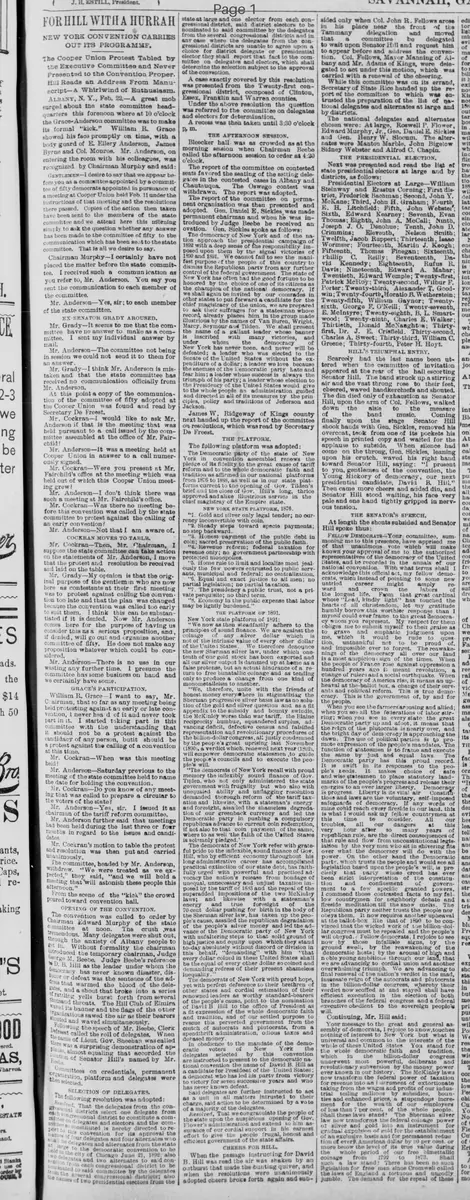
NEW YORK CONVENTION CARRIES OUT ITS PROGRAMME.
The Cooper Union Protest Tabled by the Executive Committee and Never Presented to the Convention Proper.
Hill Reads an Address From Manuscript—A Whirlwind of Enthusiasm.
ALBANY, N. Y., Feb. 22.—A great mob surged about the state committee headquarters this forenoon where at 10 o'clock the Grace-Anderson committee was to make its formal "kick."
William R. Grace showed his face promptly on time, with a body guard of E. Ellery Anderson, James Byrne and Col. Monroe. Mr. Anderson, on entering the room with his colleagues, was recognized by Chairman Murphy and said:
"GENTLEMEN—I desire to say that we appear before you as a committee appointed by a committee of fifty democrats appointed in pursuance of a meeting at Cooper Union held Feb. 11 under the instructions of that meeting and the resolutions there passed. Copies of the action then taken have been sent to the members of the state committee and we attend here this morning simply to ask the question whether any answer has been made to the committee of fifty to the communication which has been sent to the state committee. That is all we desire to say."
Chairman Murphy—“I certainly have not placed the matter before the state committee. I received such a communication as you refer to, Mr. Anderson. You say you sent the communication to each member of the committee."
Mr. Anderson—“Yes, sir; to each member of the state committee."
EX-SENATOR GRADY AROUSED.
Mr. Grady—“It seems to me that the committee have no answer to make as a committee. I sent my individual answer by mail."
Mr. Anderson—“The committee not being in session we could not send it to them for an answer."
Mr. Grady—“I think Mr. Anderson is mistaken and that the state committee has received no communication officially from Mr. Anderson."
At this point a copy of the communication of the committee of fifty adopted at the Cooper Union was found and read by Secretary De Freest.
Mr. Cockran—“I would like to ask Mr. Anderson if that is the meeting that was held pursuant to a call issued by the committee assembled at the office of Mr. Fairchild?"
Mr. Anderson—“It was a meeting held at Cooper Union in answer to a call numerously signed. Fairchild's office at the meeting which was"
Mr. Cockran—“Were you present at Mr. held out of which this Cooper Union meeting grew?"
Mr. Anderson—“I don't think there was such a meeting at Mr. Fairchild's office."
Mr. Cockran—“Was there no meeting before this convention was called by the state committee to protest against the calling of an early convention?"
Mr. Anderson—“Not that I am aware of."
COCKRAN MOVES TO TABLE.
Mr. Cockran—“Then Mr. Chairman, I suppose the state committee can take action on the statements of Mr. Anderson, I move that the protest and resolution be received and laid on the table"
Mr. Grady—“My opinion is that the original purpose of the gentlemen who are now here as contestants at their first meeting was to protest against calling the convention too late and that the plan was changed because the convention was called too early to suit them. I think this can be substantiated if it is denied. Now Mr. Anderson comes here for the purpose of having us consider this as a serious proposition, and, if denied, will go out and organize another committee of fifty. He does not make any proposition whatever which could be considered."
Mr. Anderson—“There is no use in our wasting any further time. I presume the committee has some business on hand and we certainly have some."
GRACE'S PARTICIPATION.
Chairman, that so far as any meeting being William R. Grace—“I want to say, Mr. held protesting against an early or late convention. I never heard of it and never took part in it. I started taking part in this committee with the understanding that it should not be a protest against the candidacy of any person, but it should be a protest against the calling of a convention at this time."
Mr. Cockran—“When was this meeting held?"
Mr. Anderson—“Saturday previous to the meeting of the state committee held to name the date for holding the convention."
Mr. Cockran—“Do you know of any meeting being that was called to prepare a circular to the voters of the state?"
Mr. Anderson—“Yes, sir. I issued it as chairman of the tariff reform committee. Mr. Anderson further said that meetings had been held during the last three or four months in regard to the issues and candidates."
Mr. Cockran's motion to table the protest and resolution was then put and carried unanimously.
The committee, headed by Mr. Anderson, withdrew. "We were treated as we expected," they said, "and we will hold a meeting that will astonish these people this afternoon."
From the scene of the "kick" the crowd poured toward convention hall.
OPENING OF THE CONVENTION.
The convention was called to order by Chairman Edward Murphy of the state committee at noon. The crush was tremendous. Many delegates were shut out, through the anxiety of Albany people to get in. Without formality the chairman introduced the temporary chairman, Judge George M. Beebe. Judge Beebe's reference Hill as the leader under whom the democracy has never known disaster, dishonor or defeat was the sentence of the address that warmed the blood of the delegates. A rattling of yells burst forth from several thousand throats that shout into series of rattling yells. waved its banner and the flags of the other organizations sawed the air as their bearers shouted and waved simultaneously.
Following the speech of Mr. Beebe, Clerk Defreest called the roll of delegates. the there name was of surprising Lieut Gov Sheehan was called of applause. Mention of Senator Hills named by Mr. Beebe almost equaling that Tharves.
Committees on credentials, permanent organization, platform and delegates were then selected.
SELECTION OF DELEGATES.
The following resolution was adopted:
Resolved, That the democratic convention hereby directed from the district and the to congressional be of so constituted delegates on this mittee mittee from each congressional district That convention delegates democratic and the district and select delegates alternates electors hereby to one constitute convention from delegate directed from and the the to com- con- re- be from com-
Leld in the oity ofchiargo June 21, 1892; also dominated vention delegates several to each said and congressional congressional two committee by districts district the delegates to also be the names of two presidential electors from the
HILL'S TRIUMPHAL ENTRY.
Scarcely had the last name been uttered when the committee of invitation appeared at the rear of the hall escorting Senator Hill. The band struck up a stirring air and the vast throng rose to their feet, cheered, waved handkerchiefs and shouted. The din died only of exhaustion as Senator Hill, upon the arm of Col. Fellows, walked down the aisle to the measure of the band music. Coming finally upon the stage Senator Hill shook hands with Gen. Sickles, removed his overcoat, took from one of its pockets his speech in printed copy and waited for the applause to subside.
When silence had come on the throng, Gen. Sickles, leaning upon his crutch, waved his right hand toward Senator Hill, saying: "I present to you, gentlemen of the convention, the Young Hickory of democracy, our next presidential candidate, David B. Hill."
Then came more cheers and added din, and Senator Hill stood waiting, his face very pale and one hand tightly gripped in nervous tension.
THE SENATOR'S SPEECH.
At length the shouts subsided and Senator Hill spoke thus:
FELLOW DEMOCRATS—Your committee, summoning me to this presence, have apprised me of that unanimous vote which will make known your approval of me to the authorized representatives of the democracy of the United States, and be recorded in the annals of our national convention. To acknowledge this official act, my fellow democrats, which instead of pointing to some new untried career might amply reward and crown the labors of the longest life. From that great cardinal whose "Lead, kindly light" has touched the hearts of all Christendom, let my gratitude humbly borrow this worthier response than I myself could ever frame to the great democracy whom you represent. My respect for them obliges me to submit myself to their praise as to grave and emphatic judgment upon me, which it would be rude to question, unthankful not to be proud of, and impossible ever to forget. The reawakenings of the democracy all over our land is a most auspicious sign of the times. When the people of France rose against oppression a hundred years ago it meant revolution, a change of rulers and a social earthquake. When the democracy of America rise, it means an upheaval at the ballot box, a change of their servants and political reform. This is true democracy. This is the government of, by and for the people.
When you see the farmers arousing and allied; when you see all the federations of labor stirring; when you see in every state the great Democratic party up and afoot, it means that the reign of the plutocrats is nearly over, and the bright day of democracy is approaching the dawn. The use of political parties is to promote expression of the people's mandates. The function of statesmen is to frame and execute the same by just and equal laws. The Democratic party has this proud record. It is swift in its responses to the people's needs. It makes choice of safe and wise statesmen to place statutory landmarks of the people's progress and release their energies to an ever larger liberty. Democracy is progress. Liberty is its vital air. Constitutions and laws are the voluntary, self-imposed safeguards of democracy. If any words of mine could reach every fireside in our land, this is what I would ask my fellow countrymen at this time to consider. All our troubles, all our dangers at this very hour after so many years of republican rule, are the direct consequences of that rule and flow from unconstitutional legislation by the very men who sit in shivering fits over what the democracy will do with the power. On the other hand the Democratic party, which trusts the people and would see all legislation based upon the people's will, is precisely that party whose creed has ever been strict interpretation of the constitution and confinement of government to a few specific granted powers.
I commend those contrasted facts to my fellow countrymen for neighborly debate and fireside meditation till the snow melts. The Republican party neither trusts the people nor obeys them. It now requires another upheaval at the ballot-box like that of 1890 to be convinced that the wicked work of the billion-dollar congress must be repealed and the people's will obeyed. Fellow democrats, I rejoice to see now by those infallible signs, by the ground swell, by the reawakening of the democratic hosts; by the arousal of high and noble young ambitions through our land, that we are advancing to cordial union and another overwhelming triumph. We are advancing to final renewal of the nation's verdict in the mad, insensate reign of the autocrats and plutocrats in the billion-dollar congress, whereby their verdict now scoffed at and stayed shall have efficient execution in the election of both branches of the federal congress and a federal executive obedient to the sovereign people's will.
Continuing, Mr. Hill said:
Your message to the great and general assembly of democrats, I rejoice to know, touches nothing of interest to New York but what is universal and common to the interests of the whole of these United States. You stand for the whole democratic faith and tradition, which in the billion-dollar congress underwent most powerful, deliberate and revolutionary subversion by the money power ever known in our history. The McKinley laws now transform the federal power of taxation for revenue into an instrument of extortionate taking from the wages and profits of our industrial toiling millions by subsidies, bounties and enhanced prices, a stupendous increment for the wealth of our employers of less than 7 per cent. of the whole people. Shall these laws stand? The Sherman silver law now transforms the federal coinage power of silver and gold into an instrument for gradual expulsion of gold for the establishment of an exclusive basis and for permanent reduction of every American dollar by 10 per cent. or more below the level of its true value during the whole period of our free bimetallic coinage from 1792 to 1873. Shall such a law stand? There has been no such legislation for free men since Cromwell called the laws of England a tortuous and ungodly jumble. The demand for the repeal of these edicts of the billion-dollar congress has extorted from the republican leaders their published purpose to refuse the repeal. The admission is of great importance. It is fresh evidence that I do not press too far the charge of disobedience to the people's overwhelming mandate. The demand for repeal is a proposal of the largest measure of tariff reform, I admit, for it is a proposal to recover the whole ground usurped by the billion-dollar congress; and it is even more, for it has apprised the country that their unrepealed existence for another year shall not erect the novel superadded wrongs of the two McKinley acts into finality. Repeal is not a proposal to stop at the tariff of 1883 as a finality. My language expressly barred out that absurd idea.
Moreover, when the tariff of 1883 was the law of the land, in the hour of our defeat three years ago, I said here in Albany, "the Democratic party nails to the mast the flag of tariff reform." Tariff reform will remain and require progressive solution with a wise and politic method of abolishing, whenever practicable, one after another, one indefensible tax at a time. But I do not flinch backward from the advance line of the entrenchments which the democrats of New York have won, kept and will guard. I do not shirk the deadly grapple with the republican revolutionists whose banners no longer fly the tariff of 1883, but now fly the mad McKinley laws and wild Sherman law, and mock us from the citadels of power. The cause of tariff reform has lately made a great practical advance. Secretary Manning in his last report of 1886, advised congress to begin practical tariff reform by a single act for free wool; an act untaxing the clothing of about 60,000,000 people. One year later, in 1887, the secretary's report was "writ large" in the message of the President. Now five years later one of our most enlightened economists, David A. Wells, writes to the chairman of the ways and means committee that the path of progress which Secretary Manning blazed first and alone, is the true path. It is the maxim of sound policy, better fitted to win elections than to lose them, better dividing into easy chapters the lessons of the long campaign of education, abolish whenever you can, one after another, one indefensible tax at a time. This is true progress—Let us rejoice. The Senate and executive may now refuse the least, as they refused the largest measure of tariff reform, but of the future of our cause we may now feel better assured.
The speech was intently listened to, and while not broken often by applause, it was cheered loudly at the close and the band played "Three Cheers for the Red, White and Blue."
A motion to adjourn came quickly then and the convention, at 5:30 o'clock, adjourned sine die.
What sub-type of article is it?
What themes does it cover?
What keywords are associated?
What entities or persons were involved?
Where did it happen?
Story Details
Key Persons
Location
Albany, N. Y.
Event Date
Feb. 22
Story Details
The Grace-Anderson committee's protest against the convention timing is tabled by the state committee. The Democratic convention endorses Senator David B. Hill for president with great enthusiasm. Hill delivers a speech advocating tariff reform, repeal of McKinley and Sherman laws, and Democratic principles of progress and liberty.