Thank you for visiting SNEWPapers!
Sign up free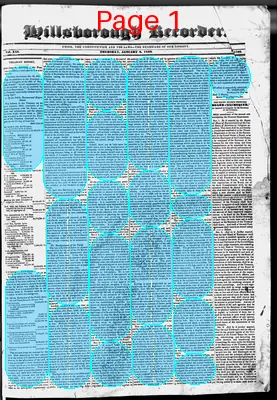
The Hillsborough Recorder
Hillsboro, Orange County, North Carolina
What is this article about?
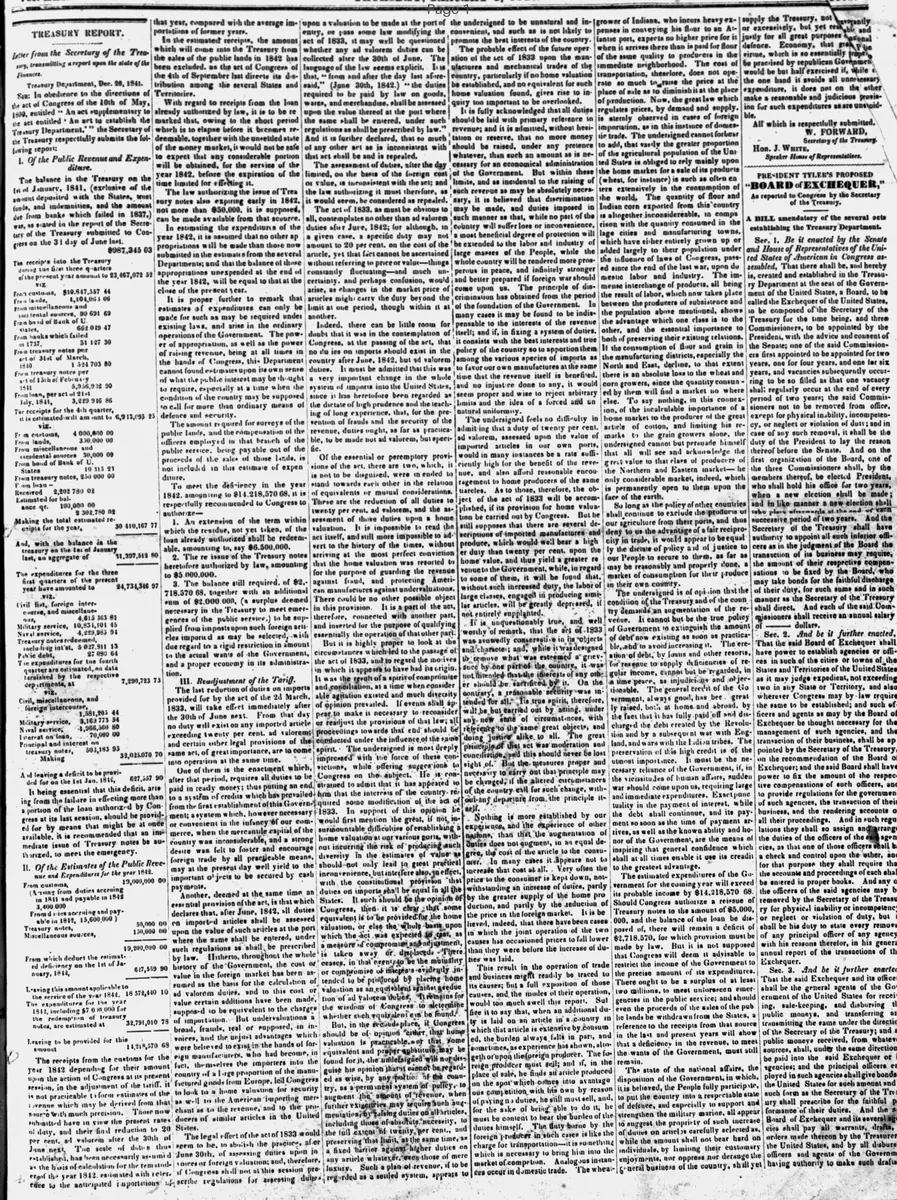
On December 20, 1841, Secretary of the Treasury Walter Forward submitted a report to Congress detailing the state of U.S. finances, including revenue and expenditures for 1841, estimates for 1842 showing a deficit, recommendations for Treasury notes and loans, and proposals for tariff readjustment to address revenue needs while protecting domestic industry.
Clipping
OCR Quality
Full Text
transmitting a report upon the state of the Finances.
Treasury Department, Dec. 20, 1841.
Sir: In obedience to the directions of the act of Congress of the 10th of May, the act entitled 'An act to establish the Treasury Department.' 'the Secretary of the Treasury respectfully submits the following report:
I. Of the Public Revenue and Expenditure.
The balance in the Treasury on the 1st of January, 1841, (exclusive of the amount deposited with the States, trust funds, indemnities, and the amount due from banks which failed in 1837,) was, as stated in the report of the Secretary of the Treasury submitted to Congress on the 31st day of June last, $987,345 03
The receipts into the Treasury during the first three quarters of the present year amount to $23,467,072 52
VIZ:
From customs, $10,647,557 44
From lands, 1,101,063 06
From miscellaneous and incidental sources, $90,691 69
From bond of Bank of the United States, 662,019 47
From banks which failed in 1837, 51,127 30
From treasury notes per act of 31st of March, 1840, $1,524,703 80
From treasury notes per act of 15th of February, 1841, 5,956,932 90
From loan, per act of 21st July, 1841, 3,229,916 86
The receipts for the 4th quarter, estimated at $6,913,952
And leaving a deficit to be provided for on the 1st Jan. 1842, $627,557 90
It being essential that this deficit, arising from the failure in effecting more than a portion of the loan authorized by Congress at its last session, should be provided for by means that might be at once available, it is recommended that an immediate issue of Treasury notes be authorized, to meet the emergency.
II. Of the Estimates of the Public Revenue and Expenditure for the year 1842.
From customs, 19,000,000 00
(Arising from duties accruing in 1841 and payable in 1842, 3,400,000
From duties accruing and payable in 1842, 15,600,000) 50,000 00)
Treasury notes,
Miscellaneous sources, 131,000 00
19,200,000 00
From which deduct the estimated deficiency on the 1st of January, 1842, 617,559 90
Leaving this amount applicable to the service of the year 1842. $18,573,440 10
The expenditure for the year 1842, including $7,000,000 for the redemption of treasury notes, are estimated at 32,791,010 73
Leaving to be provided for this amount $11,218,570 69
The receipts from the customs for the year 1842 depending for their amount upon the action of Congress at its present session, in the adjustment of the tariff. it is not practicable to form estimates of the revenue which may be derived from that source with much precision.
Those now submitted have in view the present rates of duty. and their final reduction to 20 per cent, ad valorem after the 30th of June next. The scale of duties thus established, has been necessarily assumed as the basis of calculation for the remainder of the year 1842. estimated with reference
that year, compared with the average importations of former years.
In the estimated receipts, the amount which will come into the Treasury from the sale of the public lands in 1842 has been excluded. as the act of Congress of the 4th of September last directs its distribution among the several States and Territories.
With regard to receipts from the loan already authorized by law, it is to be remarked that, owing to the short period which is to elapse before it becomes redeemable, together with the unsettled state of the money market, it would not be safe to expect that any considerable portion will be obtained, for the service of the year 1842, before the expiration of the time limited for effecting it.
The law authorizing the issue of Treasury notes also expiring early in 1842, not more than $50,000, it is supposed, can be made available from that source.
In estimating the expenditures of the year 1842, it is assumed that no other appropriations will be made than those now submitted in the estimates from the several Departments; and that the balance of those appropriations unexpended at the end of the year 1842, will be equal to that at the close of the present year.
It is proper further to remark that estimates of expenditures can only be made for such as may be required under existing laws, and arise in the ordinary operations of the Government. The power of appropriation, as well as the power of raising revenue, being at all times in the hands of Congress, this Department cannot found estimates upon its own sense of what the public interest may be thought to require, especially at a time when the condition of the country may be supposed to call for more than ordinary means of defence and security.
The amount required for surveys of the public lands, and the compensation of the officers employed in that branch of the public service, being payable out of the proceeds of the sales of those lands, is not included in this estimate of expenditure.
To meet the deficiency in the year 1842, amounting to $14,218,570 68, it is respectfully recommended to Congress to authorize—
1. An extension of the term within which the residue, not yet taken, of the loan already authorized shall be redeemable, amounting to, say $6,500,000.
2. The re-issue of the Treasury notes heretofore authorized by law, amounting to $5,000,000.
3. The balance still required, of $2,718,570 68, together with an additional sum of $2,000,000, (a surplus deemed necessary in the Treasury to meet emergencies of the public service.) to be supplied from imposts upon such foreign articles imported as may be selected, with due regard to a rigid restriction in amount to the actual wants of the Government, and a proper economy in its administration.
III. Readjustment of the Tariff.
The last reduction of duties on imports provided for by the act of the 2d March, 1833, will take effect immediately after the 30th of June next. From that day no duty will exist on any imported article exceeding twenty per cent. ad valorem; and certain other legal provisions of the same act, of great importance, are to come into operation at the same time.
One of them is the enactment which, after that period, requires all duties to be paid in ready money; thus putting an end, to a system of credits which has prevailed from the first establishment of this Government; a system which, however necessary or convenient in the infancy of our commerce, when the mercantile capital of the country was inconsiderable, and a strong desire was felt to foster and encourage foreign trade by all practicable means, may at the present day well yield to the important objects to be secured by cash payments.
Another, deemed at the same time an essential provision of the act, is that which declares that, after June, 1842, all duties on imported articles shall be assessed upon the value of such articles at the port where the same shall be entered, under such regulations as shall be prescribed by law. Hitherto, throughout the whole history of the Government, the cost or value in the foreign market has been assumed as the basis for the calculation of ad valorem duties. and to this cost or value certain additions have been made, supposed to be equivalent to the charges of importation. But undervaluations abroad, frauds, real or supposed, in invoices, and the unjust advantages which were believed to exist in the hands of foreign manufacturers, who had become, in fact, themselves the importers into the country of a large proportion of the manufactured goods from Europe, led Congress to look to a home valuation for security as well to the American importing merchant as to the revenue, and to the producers of similar articles in the United States.
The legal effect of the act of 1833 would seem to be, to abolish the practice, after June 30th, of assessing duties upon invoices or foreign valuation; and, therefore, if Congress shall not at this session prescribe regulations for assessing duties upon a valuation to be made at the port of entry, or pass some law modifying the act of 1833, it may well be questioned whether any ad valorem duties can be collected after the 30th of June. The language of the law seems explicit. It is that, 'from and after the day last aforesaid,' (June 30th, 1842.) 'the duties required to be paid by law on goods, wares, and merchandise, shall be assessed upon the value thereof at the port where the same shall be entered, under such regulations as shall be prescribed by law.' And it is further declared, that so much of any other act as is inconsistent with that act shall be and is repealed.
The assessment of duties, after the day limited, on the basis of the foreign cost or value, is inconsistent with the act; and the law authorizing it must therefore, as it would seem, be considered as repealed.
The act of 1833, as must be obvious to all, contemplates no other than ad valorem duties after June, 1842; for although, in a given case, a specific duty may not amount to 20 per cent, on the cost of the article, yet that fact cannot be ascertained without referring to price or value—things constantly fluctuating and much uncertainty, and perhaps confusion, would arise, as changes in the market price of articles might carry the duty beyond the limit at one period, though within it at another.
Indeed, there can be little room for doubt that it was in the contemplation of Congress, at the passing of the act, that no duties on imports should exist in the country after June, 1842, but ad valorem duties. It must be admitted that this was a very important change in the whole system of imports into the United States, since it has heretofore been regarded as the dictate of high prudence and the teaching of long experience, that, for the prevention of frauds and the security of the revenue, duties ought, as far as practicable, to be made not ad valorem, but specific.
Of the essential or peremptory provisions of the act, there are two, which, it is not to be disguised, were intended to stand towards each other in the relation of equivalents or mutual considerations. These are the reduction of all duties to twenty per cent, ad valorem, and the assessment of those duties upon a home valuation. It is impossible to read the act itself, and still more impossible to advert to the history of the times, without arriving at the most perfect conviction that the home valuation was resorted to for the purpose of guarding the revenue against fraud, and protecting American manufactures against undervaluations.
There could be no other possible object in this provision. It is a part of the act, therefore, connected with another part, and inserted for the purpose of qualifying essentially the operation of that other part.
But it is highly proper to look at the circumstances which led to the passage of the act of 1833, and to regard the motives in which it appears to have had its origin. It was the result of a spirit of compromise and conciliation, at a time when considerable agitation existed and much diversity of opinion prevailed. If events shall appear to make it necessary to reconsider or readjust the provisions of that law; all proceedings towards that end should be conducted under the influence of the same spirit. The undersigned is most deeply impressed with the force of these convictions, while offering suggestions to Congress on the subject. He is constrained to admit that it has appeared to him that the interests of the country require some modification of the act of 1833. In support of this opinion he would first mention the great, if not insurmountable difficulties of establishing a home valuation at our various ports, without incurring the risk of producing such diversity in the estimates of value as should not only lead to great practical inconvenience, but interfere also, in effect, with the constitutional provision that duties on imports shall be equal in all the States. If such should be the opinion of Congress, then it is clear that some equivalent is to be provided for the home valuation, or else the whole basis upon which the act was expected to rest, as a measure of compromise and adjustment, is taken away or displaced. There ceases, in that event, to be the mutuality or compromise of interests—evidently intended to be produced by placing home valuation as an equivalent against a reduction of ad valorem duties. It remains for the wisdom of Congress to determine whether such equivalent can be found.
But, in the second place, if Congress should be of opinion either, that home valuation is practicable, or that some equivalent and proper substitute may be found for it, the undersigned will not disguise his opinion that it cannot be regarded as wise, by any portion of the country, as a permanent system of policy,—to augment the amount of revenue, when further exigencies may require such augmentation; by raising duties on all articles, including those of absolute necessity, to the fullest extent of twenty per cent., and preserving that limit, at the same time, as a fixed barrier against higher duties on any article whatever, even those of mere luxury. Such a plan of revenue, so as to be regarded as a settled system, appears to the undersigned to be unnatural and inconvenient, and such as is not likely to promote the best interests of the country.
The probable effect of the future operation of the act of 1833 upon the manufactures and mechanical trade of the country, particularly if no home valuation be established, and no equivalent for such home valuation found, gives rise to inquiry too important to be overlooked.
It is fully acknowledged that all duties should be laid with primary reference to revenue; and it is admitted, without hesitation or reserve, that no more money should be raised, under any pretence whatever, than such an amount as is necessary for an economical administration of the Government. But within these limits, and as incidental to the raising of such revenue as may be absolutely necessary, it is believed that discrimination may be made, and duties imposed in such manner as that, while no part of the Country will suffer loss or inconvenience, a most beneficial degree of protection will be extended to the labor and industry of large masses of the People, while the whole country will be rendered more prosperous in peace, and infinitely stronger and better prepared if foreign war should come upon us. The principle of discrimination has obtained from the period of the foundation of the Government. In many cases it may be found to be indispensable to the interests of the revenue itself; and if, in fixing a system of duties, it consists with the best interests and true policy of the country so to apportion them among the various species of imports as to favor our own manufactures at the same time that the revenue itself is benefited, and no injustice done to any, it would seem proper and wise to reject arbitrary limits and the idea of a forced and unnatural uniformity.
The undersigned feels no difficulty in admitting that a duty of twenty per cent. ad valorem, assessed upon the value of imported articles in our own ports, would in many instances be a rate sufficiently high for the benefit of the revenue, and also afford reasonable encouragement to home producers of the same articles. As to those, therefore, the object of the act of 1833 will be accomplished, if its provision for home valuation be carried out by Congress. But he still supposes that there are several descriptions of imported manufactures and produce, which would well bear a higher duty than twenty per cent. upon the home value, and thus yield a greater revenue to the Government, while, in regard to some of them, it will be found that, without such increased duty, the labor of large classes, engaged in producing similar articles, will be greatly depressed, if not entirely supplanted.
It is unquestionably true, and well worthy of remark, that the act of 1833 was avowedly conservative in its objects and character; and, while it was designed to remove what was esteemed a grievance by one part of the country, it was not intended that the interests of any other should be sacrificed by it. On the contrary, a reasonable security was intended for all. Its true spirit, therefore, will be but carried out by acting, under any new state of circumstances, with reference to the same great objects, and doing justice alike to all. The great principle of that act was moderation and conciliation. And this should never be lost sight of. But the measures proper and necessary to carry out that principle may be changed; if the altered circumstances of the country call for such change, without a departure from the principle itself.
Nothing is more established by our experience, and the experience of other nations, than that the augmentation of duties does not augment, in an equal degree, the cost of the article to the consumer. In many cases it appears not to increase that cost at all. Very often the price to the consumer is kept down, notwithstanding an increase of duties, partly by the greater supply of the home production, and partly by the reduction of the price in the foreign market. It is believed, indeed, that there have been cases in which the joint operation of the two causes has occasioned prices to fall lower than they were before the increase of duties was laid.
This result in the operation of trade and business might readily be traced to its causes; but a full exposition of those causes, and the modes of their operation, would too much swell this report. Suffice it to say that, when an additional duty is laid on an article in a country in which that article is extensively consumed, the burden always falls in part, and sometimes, as experience has shown, altogether upon the foreign producer. The foreign producer must sell; and if, in the place of sale, he finds an article produced on the spot which comes into advantageous competition with his own by reason of paying no duties, he still must sell, and, for the sake of being able to do it; he must be content to bear the burden of the duties himself. The duty borne by the foreign producer in such cases is like the charge for transportation—it is something which is necessary to bring him into the market of competition. Analogous instances occur in domestic trade. The wheat grower of Indiana, who incurs heavy expense in conveying his flour to an Atlantic port, expects no higher price for it when it arrives there than is paid for flour of the same quality to producers in the immediate neighborhood. The cost of transportation, therefore, does not operate so much to raise the price at the place of sale as to diminish it at the place of production. Now, the great law which regulates prices, by demand and supply, is sternly observed in cases of foreign importation, as in this instance of domestic trade. The undersigned cannot forbear to add, that vastly the greater proportion of the agricultural population of the United States is obliged to rely mainly upon the home market for a sale of its products (wheat, for instance) is such as often enters extensively in the consumption of the world. The quantity of flour and Indian corn exported from this country is altogether inconsiderable, in comparison with the quantity consumed in the large cities and manufacturing towns, which have either entirely grown up or added largely to their population under the influence of laws of Congress, passed since the end of the last war, upon domestic labor and industry. The immense interchange of products, all being the result of labor, which now takes place between the producers of subsistence and the population above mentioned, shows the advantage which one class is to the other, and the essential importance to both of preserving their existing relations.
If the consumption of flour and grain in the manufacturing districts, especially the North and East, decline, to that extent there is an absolute loss to the wheat and corn growers, since the quantity consumed by them will find a market nowhere else. To say nothing, in this connection, of the incalculable importance of a home market to the producer of the great article of cotton, and limiting his remarks to the grain growers alone, the undersigned cannot but persuade himself that all will see and acknowledge the great value to that class of producers of the Northern and Eastern market—the only considerable market, indeed, which is permanently open to them upon the face of the earth.
So long as the policy of other countries shall continue to exclude the products of our agriculture from their ports, and thus deny to us the advantage of a fair reciprocity in trade, it would appear to be equally the dictate of policy and of justice to our People—to secure to them, as far as may be reasonably and properly done, a market of consumption for their produce in their own country.
The undersigned is of opinion that the condition of the Treasury and of the country demands an augmentation of the revenue. It cannot but be the true policy of Government to extinguish the amount of debt now existing as soon as practicable, and to avoid increasing it. The creation of debt, by loans and other resorts, for revenue to supply the deficiencies of regular income, cannot but be regarded, in a time of peace, as injudicious and objectionable. The general credit of the Government, always good, has been greatly raised, both at home and abroad, by the fact that it has fully paid off and discharged the debt created by the Revolution and by a subsequent war with England, and wars with the Indian tribes. The preservation of this high credit is of the utmost importance. It must be the necessary reliance of the Government, if, in the vicissitudes of human affairs, sudden war should come upon us, requiring large and immediate expenditures. Exact punctuality in the payment of interest, while the debt shall continue, and its payment so soon as the time of payment arrives, as well as the known ability and honor of the Government, are the means of inspiring that general confidence which shall at all times enable it to use its credit to the greatest advantage.
The estimated expenditures of the Government for the coming year will exceed its probable income by $14,218,570 68. Should Congress authorize a reissue of Treasury notes to the amount of $5,000,000, and the balance of the loan be disposed of, there will remain a deficit of $2,718,570, for which provision must be made by law. But it is not supposed that Congress will deem it advisable to restrict the income of the Government to the precise amount of its expenditures. There ought to be a surplus of at least two millions, to meet unforeseen emergencies in the public service; and should even the proceeds of the sales of the public lands be withdrawn from the States, a reference to the receipts from that source in the last and present years will show that a deficiency in the revenue, to meet the wants of the Government, must still remain.
The state of the national affairs, the disposition of the Government, in which, it is believed, the People fully participate, to put the country into a respectable state of defence, and especially to support and strengthen the military marine, all appear to suggest the propriety of such increase of duties on articles carefully selected as, while the amount shall not bear hard on individuals, by limiting their customary enjoyments, nor oppress nor derange the general business of the country, shall yet supply the Treasury, not avariciously or excessively, but yet really and justly for all great purposes national defence. Economy, that great virtue, which is so essentially proper to be practiced by republican Governments would be but half exercised if, while on the one hand it avoids all unnecessary expenditure, it does not on the other make a reasonable and judicious provision for such expenditures as are unavoidable.
All which is respectfully submitted.
W. FORWARD,
Secretary of the Treasury.
Hon. J. White,
Speaker House of Representatives.
What sub-type of article is it?
What keywords are associated?
What entities or persons were involved?
Domestic News Details
Event Date
Dec. 20, 1841
Key Persons
Outcome
estimated deficit for 1842 of $14,218,570.68; recommendations for loan extension, re-issue of treasury notes, and tariff adjustments to raise revenue.
Event Details
Report on public revenue and expenditures for 1841, estimates for 1842 showing deficits, recommendations for financing measures including Treasury notes and loans, and discussion on tariff readjustment under the 1833 act, advocating modifications for revenue and protection of domestic industry.