Thank you for visiting SNEWPapers!
Sign up free
The Virginian
Lynchburg, Virginia
What is this article about?
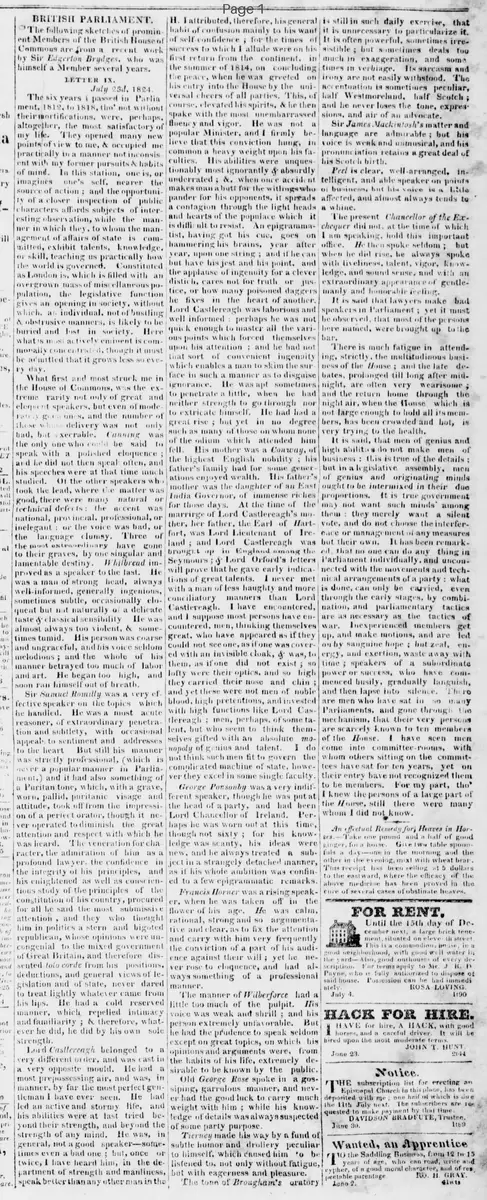
Sir Egerton Brydges reflects on his 1812-1818 tenure in the British House of Commons, describing the rarity of eloquent speakers and providing sketches of prominent members including Canning, Whitbread, Romilly, Castlereagh, and others, noting their styles, backgrounds, and parliamentary roles.
Merged-components note: Continuation of the same article sketching prominent members of the British House of Commons.
Clipping
OCR Quality
Full Text
"The following sketches of prominent
Members of the British House of
Commons are from a recent work
by Sir Egerton Brydges, who was
himself a Member several years."
LETTER IX.
July 23d, 1824.
The six years I passed in Parliament, 1812, to 1818, tho' not without
their mortifications, were, perhaps.
altogether, the most satisfactory of
my life. They opened many new
points of view to me, & occupied me
practically in a manner not inconsistent
with my former pursuits a habits
of mind. In this station, one is, or
imagines one's self, nearer the
source of action; and the opportunity
of a closer inspection of public
characters affords subjects of interesting
observation, while the manner
in which they, to whom the management
of affairs of state is committed,
exhibit talents, knowledge.
or skill, teaching us practically how
the world is governed. Constituted
as London is, which is filled with an
overgrown mass of miscellaneous population,
the legislative function
gives an opening in society, without
which, an individual, not of bustling
& obtrusive manners, is likely to be
buried and lost in society. Here
what's most actively eminent is commercially
concentrated, though it must
be admitted that it grows less so every
day.
What first and most struck me in
the House of Commons, was the extreme
rarity not only of great and
eloquent speakers, but even of moderate
ones, and the number of
those whose delivery was not only
bad, but execrable. Canning was
the only one who could be said to
speak with a polished eloquence;
and he did not then speak often, and
his speeches were at that time much
studied. Of the other speakers who
took the lead, where the matter was
good, there were many natural or
technical defects: the accent was
national, provincial, professional, or
inelegant: or the voice was bad, or
the language clumsy. Three of
the most extraordinary have gone
to their graves, by one singular and
lamentable destiny. Whitbread improved
as a speaker to the last. He
was a man of strong head, always
well-informed, generally ingenious,
sometimes subtle, occasionally eloquent
but not naturally or a delicate
taste & classical sensibility He was
almost always too violent, & sometimes
tumid. His person was coarse
and ungraceful, and his voice seldom
melodious; and the whole of his
manner betrayed too much of labor
and art. He began too high, and
soon ran himself out of breath.
Sir Samuel Romilly was a very effective
speaker on the topics which
he handled. He was a most acute
reasoner, of extraordinary penetration
and subtlety, with occasional
appeals to sentiment and addresses
to the heart But still his manner
was strictly professional, (which is
never a popular manner in Parliament.)
and it had also something of
a Puritan tone, which, with a grave,
worn, pallid, puritanical visage and
attitude, took off from the impression
of a perfect orator, though it never
operated to diminish the great
attention and respect with which he
was heard. The veneration for character,
the admiration of him as a
profound lawyer, the confidence in
the integrity of his principles, and
his enlightened as well as conscientious
study of the principles of the
constitution of his country, procured
for all he said the most submissive
attention, and they who thought
him in politics a stern and bigoted
republican, whose opinions were uncongenial
to the mixed government
of Great Britain, and therefore dissented
toto corde from his positions,
deductions, and general views of legislation
and of state, never dared
to treat lightly whatever came from
his lips. He had a cold reserved
manner, which repelled intimacy
and familiarity; but therefore, whatever
he did, he did by his own sole
strength.
Lord Castlereagh belonged to a
very different order, and was cast in
a very opposite mould. He had a
most prepossessing air, and was, in
manner, by far the most perfect gentleman
I have ever seen. He had
led an active and stormy life, and
his abilities were at last tried beyond
their strength, and beyond the
strength of any mind. He was, in
general, not a good speaker-sometimes
even a bad one; but, once or
twice, I have heard him, in the department
of strength and manliness,
speak better than any other man in the
House. I attributed, therefore, his general
habit of confusion mainly to his want
of self-confidence: for the times of
success to which I allude were on his
first return from the continent, in
the summer of 1814, on concluding
the peace, when he was greeted on
his entry into the House by the universal
cheers of all parties. This, of
course, elevated his spirits, & he then
spake with the most unembarrassed
fluency and vigor. He was not a
popular Minister, and I firmly believe
that this conviction hung, in
common a heavy weight upon his faculties.
His abilities were unquestionably
most ignorantly & absurdly
underrated; &. when once accident
makes man a butt for the witlings who
pander for his opponents, it spreads
a contagion through the light heads
and hearts of the populace which it
is difficult to resist. An epigrammatist,
having got his cue, goes on
hammering his brains, year after
year, upon one string; and if he can
but have his jest and his point, and
the applause of ingenuity for a clever
distich, cares not for truth or justice,
or how many poisoned daggers
he fixes in the heart of another.
Lord Castlereagh was laborious and
well informed: perhaps he was not
quick enough to master all the various
points which forced themselves
upon his attention: and he had not
that sort of convenient ingenuity
which enables a man to skim the surface
in such a manner as to disguise
ignorance. He was apt sometimes
to penetrate a little, when he had
neither strength to go through nor
to extricate himself. "He had had a
great rise; but yet in no degree
such as many of those on whom none
of the odium which attended him
fell. His mother was a Conway, of
the highest English nobility; his
father's family had for some generations
enjoyed wealth. His father's
mother was the daughter of an East
India Governor, of immense riches
for those days. At the time of the
marriage of Lord Castlereagh's mother,
her father, the Earl of Hartford,
was Lord Lieutenant of Ireland; and
Lord Castlereagh was brought up in
England among the Seymours; Lord
Orford's letters will prove that he
gave early indications of great talents.
I never met with a man of less haughty
and more conciliatory manners than
Lord Castlereagh. I have encountered,
and I suppose most persons have encountered,
men, thinking themselves
great, who have appeared as if they
could not see one, as if one was covered
with an invisible cloak, & was, to
them, as if one did not exist; so
lofty were their optics, and so high
they carried their nose and chin;
and yet these were not men of noble
blood, high pretensions, and invested
with high functions like Lord Castlereagh;
men, perhaps, of some talent,
but who seem to think themselves
gifted with an absolute monopoly of
genius and talent. I do not think
such men fit to govern the complicated
machine of state, however they
excel in some single faculty.
George Ponsonby was a very indifferent
speaker, though he was put at
the head of a party, and had been
Lord Chancellor of Ireland. Perhaps
he was worn out at this time,
though not sixty; for his knowledge
was scanty, his ideas were new, and
he always treated a subject in a
strangely detached manner, as if his
whole ambition was confined to a
few epigrammatic remarks.
Francis Horner was a rising speaker,
when he was taken off in the
flower of his age. He was calm,
rational, strong and so argumentative
and clear, as to fix the attention
and carry with him very frequently
the conviction of a part of his audience
against their will; yet he never
rose to eloquence, and had always
something of a professional
manner.
The manner of Wilberforce had a
little too much of the pulpit. His
voice was weak and shrill; and his
person extremely unfavorable. But
he had the prudence to speak seldom
except on great topics, on which his
opinions and arguments were, from
the habits of his life, extremely desirable
to be known by the public.
Old George Rose spoke in a gossiping,
garrulous manner, and never
had the good luck to carry much
weight with him; while his knowledge
of details was always suspected
of some party purpose.
Tierney made his way by a fund of
subtle humor and drollery peculiar
to himself, which caused him to be
listened to, not only without fatigue,
but with eagerness and pleasure.
The tone of Brougham's oratory
is still in such daily exercise, that
it is unnecessary to particularize it.
It is often powerful, sometimes irresistible;
but sometimes deals too
much in exaggeration, and some
times in verbiage, Its sarcasm and
irony are not easily withstood. The
accentuation is sometimes peculiar,
half Westmoreland, half Scotch;
and he never loses the tone, expressions,
and air of an advocate.
Sir James Mackintosh's matter and
language are admirable; but his
voice is weak and untuneful, and his
pronunciation retains a great deal of
his Scotch birth.
Peel is clear, well-arranged, intelligent,
and able speaker on points
of business, but his voice is a little
affected, and almost always tends to
a whine.
The present Chancellor of the Ex-
chequer did not, at the time of which
I am speaking, hold this important
office. He then spoke seldom; but
when he did rise, he always spoke
with liveliness, talent, vigor, knowledge,
and sound sense, and with an
extraordinary appearance of gentlemanly
and honorable feeling.
It is said that lawyers make bad
speakers in Parliament; yet it must
be observed, that most of the persons
here named, were brought up to the
bar.
There is much fatigue in attending,
strictly, the multitudinous business
of the House; and the late debates,
prolonged till long after midnight,
are often very wearisome;
and the return home through the
night air, when the House which is
not large enough to hold all its members,
has been crowded and hot, is
very trying to the health.
It is said, that men of genius and
high abilities do not make men of
business: this is true of the details;
but in a legislative assembly, men
of genius and originating minds
ought to be intermixed in their due
proportions. it is true government
may not want such minds among
them: they merely want a silent
vote. and do not choose the interference
or management of any measures
but their own. It has been remarked,
that no one can do any thing in
Parliament individually, and unconnected
with the movements and technical
arrangements of a party: what
is done, can only be carried, even
through the early stages, by combination,
and parliamentary tactics
are as necessary as the tactics of
war. Inexperienced members get
up, and make motions, and are led
on by sanguine hope; but zeal, energy,
and exertion, waste away with
time; speakers of a subordinate
power or success, who have commenced
busily, gradually languish,
and then lapse into silence. There
are men who have sat in so many
Parliaments, and gone through the
mechanism, that their very persons
are scarcely known to ten members
of the House. I have seen men
come into committee-rooms, with
whom others sitting on the committees
have sat for ten years, yet on
their entry have not recognized them
to be members. For my part, tho'
I knew the persons of a large part of
the House, still there were many
whom I did not know.
What sub-type of article is it?
What themes does it cover?
What keywords are associated?
What entities or persons were involved?
Where did it happen?
Story Details
Key Persons
Location
British House Of Commons, London
Event Date
1812 To 1818
Story Details
Sir Egerton Brydges recounts his parliamentary years, highlighting the scarcity of eloquent speakers and offering detailed character sketches of key figures, their oratory styles, backgrounds, and contributions, while reflecting on the demands and dynamics of parliamentary life.