Thank you for visiting SNEWPapers!
Sign up free
The Leavenworth Echo
Leavenworth, Chelan County, Washington
What is this article about?
The Nonpartisan League suffered defeat in a North Dakota recall election last Friday, resulting in the recall of the governor, attorney general, and commissioner of agriculture, and adoption of new laws, ending years of league control marred by mismanagement and economic chaos.
Clipping
OCR Quality
Full Text
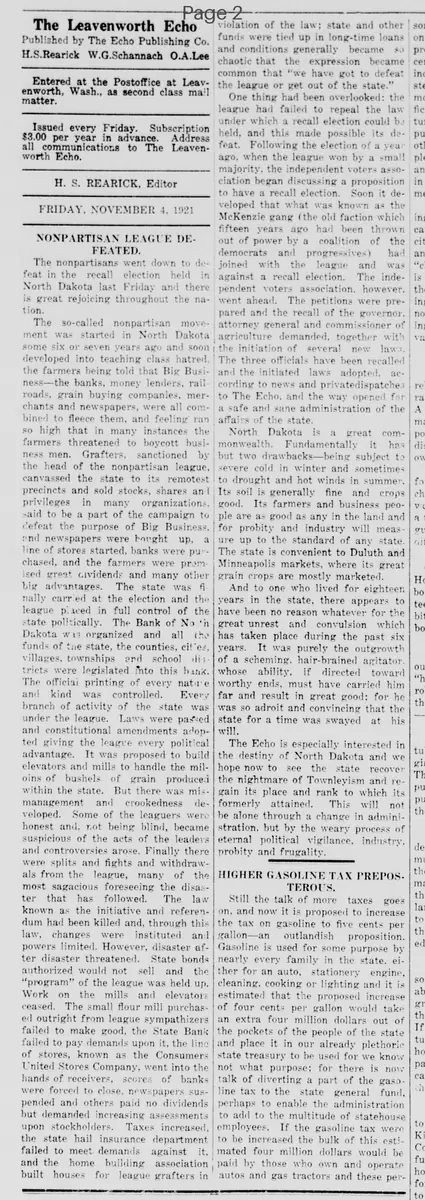
The nonpartisans went down to defeat in the recall election held in North Dakota last Friday and there is great rejoicing throughout the nation.
The so-called nonpartisan movement was started in North Dakota some six or seven years ago and soon developed into teaching class hatred the farmers being told that Big Business-the banks, money lenders, railroads, grain buying companies, merchants and newspapers, were all combined to fleece them, and feeling ran so high that in many instances the farmers threatened to boycott business men. Grafters, sanctioned by the head of the nonpartisan league, canvassed the state to its remotest precincts and sold stocks, shares and privileges in many organizations said to be a part of the campaign to defeat the purpose of Big Business, and newspapers were bought up, a line of stores started, banks were purchased, and the farmers were promised great dividends and many other big advantages. The state was finally carried at the election and the league placed in full control of the state politically. The Bank of North Dakota was organized and all the funds of the state, the counties, cities, villages, townships and school districts were legislated into this bank. The official printing of every nature and kind was controlled. Every branch of activity of the state was under the league. Laws were passed and constitutional amendments adopted giving the league every political advantage. It was proposed to build elevators and mills to handle the millions of bushels of grain produced within the state. But there was mismanagement and crookedness developed. Some of the leaguers were honest and, not being blind, became suspicious of the acts of the leaders and controversies arose. Finally there were splits and fights and withdrawals from the league, many of the most sagacious foreseeing the disaster that has followed. The law known as the initiative and referendum had been killed and, through this law, changes were instituted and powers limited. However, disaster after disaster threatened. State bonds authorized would not sell and the "program" of the league was held up. Work on the mills and elevators ceased. The small flour mill purchased outright from league sympathizers failed to make good, the State Bank failed to pay demands upon it, the line of stores, known as the Consumers United Stores Company, went into the hands of receivers, scores of banks were forced to close, newspapers suspended and others paid no dividends but demanded increasing assessments upon stockholders. Taxes increased, the state hail insurance department failed to meet demands against it, and the home building association built houses for league grafters in violation of the law; state and other funds were tied up in long-time loans and conditions generally became so chaotic that the expression became common that "we have got to defeat the league or get out of the state."
One thing had been overlooked: the league had failed to repeal the law under which a recall election could be held, and this made possible its defeat. Following the election of a year ago, when the league won by a small majority, the independent voters association began discussing a proposition to have a recall election. Soon it developed that what was known as the McKenzie gang (the old faction which fifteen years ago had been thrown out of power by a coalition of the democrats and progressives) had joined with the league and was against a recall election. The independent voters association, however, went ahead. The petitions were prepared and the recall of the governor, attorney general and commissioner of agriculture demanded, together with the initiation of several new laws. The three officials have been recalled and the initiated laws adopted, according to news and private dispatches to The Echo, and the way opened for a safe and sane administration of the affairs of the state.
North Dakota is a great commonwealth. Fundamentally it has but two drawbacks-being subject to severe cold in winter and sometimes to drought and hot winds in summer. Its soil is generally fine and crops good. Its farmers and business people are as good as any in the land and for probity and industry will measure up to the standard of any state. The state is convenient to Duluth and Minneapolis markets, where its great grain crops are mostly marketed. And to one who lived for eighteen years in the state, there appears to have been no reason whatever for the great unrest and convulsion which has taken place during the past six years. It was purely the outgrowth of a scheming, hair-brained agitator, whose ability, if directed toward worthy ends, must have carried him far and result in great good; for he was so adroit and convincing that the state for a time was swayed at his will.
The Echo is especially interested in the destiny of North Dakota and we hope now to see the state recover from the nightmare of Townleyism and regain its place and rank to which it formerly attained. This will not be alone through a change in administration, but by the weary process of eternal political vigilance, industry, probity and frugality.
What sub-type of article is it?
What keywords are associated?
Where did it happen?
Domestic News Details
Primary Location
North Dakota
Event Date
Last Friday
Outcome
the three officials recalled and the initiated laws adopted.
Event Details
The nonpartisan league was defeated in the recall election held in North Dakota last Friday. The recall of the governor, attorney general and commissioner of agriculture was demanded along with the initiation of several new laws. The league had controlled the state politically for years but faced mismanagement, splits, and economic failures leading to its downfall.