Thank you for visiting SNEWPapers!
Sign up free
Concord Register
Concord, Merrimack County, New Hampshire
What is this article about?
An observer tours Pennsylvania counties, noting better farms where Society for the Promotion of Agriculture members reside. Compares Mr. B.'s well-manured 6-acre corn field yielding 450 bushels and $52.50 profit against Mr. C.'s unmanured 25-acre field yielding 375 bushels and $93.75 loss, emphasizing good farming's benefits.
Clipping
OCR Quality
Full Text
From the Pennsylvanian Examiner.
DIFFERENCE BETWEEN GOOD AND BAD FARMING.
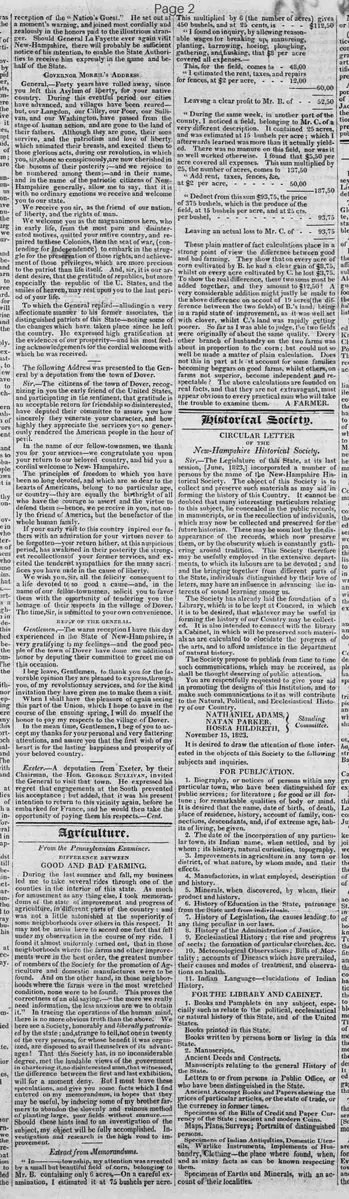
During the last summer and fall, my business led me to take several rides through one of the counties in the interior of this state. As much for amusement as any thing else, I took memorandums of the state of improvement and progress of agriculture, in different parts of the country: and was not a little astonished at the superiority of some neighborhoods over others in this respect. It may not be amiss here to record one fact that fell under my observation in the course of my ride. I found it almost uniformly turned out, that in those neighborhoods where the farms and other improvements were in the best order, the greatest number of members of the Society for the promotion of Agriculture and domestic manufactures were to be found. And on the other hand, in those neighborhoods where the farms were in the most wretched condition, none were to be found. This proves the correctness of an old saying,-"the more we really need information, the less anxious are we to obtain it." In tracing the operations of the human mind, there is no more obvious truth than the above. We here see a Society, honorably and liberally patronized by the state; and, strange to tell, not one in twenty of the very persons, for whose benefit it was organized, are disposed to avail themselves of its advantages! That this Society has, in no inconsiderable degree, met the laudable views of the government in chartering it, no disinterested man, that witnessed the difference between the first and last exhibition, will for a moment deny. But I must leave these speculations, and give you some facts which I find entered on my memorandums, in hopes that they may be useful, by inducing some of my brother farmers to abandon the slovenly and ruinous method of planting large, poor fields without manure.-
Should these hints lead to an investigation of the subject, my object will be fully accomplished. Investigation and research is the high road to improvement.
Extract from Memorandums.
"In--township, my attention was arrested by a small but beautiful field of corn, belonging to Mr. B. containing only 6 acres.-On a careful examination, I estimated it at 75 bushels per acre.
This multiplied by 6 (the number of acres) gives 450 bushels, and at 25 cents, is $112,50
"I found on inquiry, by allowing reasonable wages for breaking up, manuring, planting, harrowing, hoeing, ploughing, gathering, and husking, that $8 per acre covered all expenses.-
This, for the field, comes to - 48,00
I estimated the rent, taxes, and repairs for fences, at $2 per acre, - : - 12,00
-60,00
Leaving a clear profit to Mr. B. of . - 52,50
"During the same week, in another part of the county, I noticed a field, belonging to Mr. C. of a very different description. It contained 25 acres, and was estimated at 15 bushels per acre; which I afterwards learned was more than it actually yielded. There was no manure on this field, nor was it so well worked otherwise. I found that $5,50 per acre covered all expenses. This sum multiplied by 25, the number of acres, comes to 137,50
"Add rent, taxes, fences, &c. at $2 per acre, 50,00
187,50
"Deduct from this sum $93,75, the price of 375 bushels, which is the produce of the field, at 15 bushels per acre, and at 25 cts. per bushel, 93,75
Leaving an actual loss to Mr. C. of . . 93.75
These plain matter of fact calculations place in a strong point of view the difference between good and bad farming. They show that on every acre of corn cultivated by B. he had a clear gain of $8,75, whilst on every acre cultivated by C. he lost $3,75. To show the real difference, these two sums must be added together, and they amount to $12,50! A very considerable addition might justly be made to the above difference on account of 19 acres (the difference between the two fields) of B.'s land, being in a rapid state of improvement, as it was well set with clover, whilst C.'s land was rapidly getting poorer. So far as I was able to judge, the two fields were originally of about the same quality. Every other branch of husbandry on the two farms was about in proportion to the corn; but could not so well be made a matter of plain calculation. Does not this in part at least account for some families becoming beggars on good farms, whilst others, on farms not superior, become independent and respectable? The above calculations are founded on real facts, and that they are not extravagant, must appear obvious to every practical man who will take the trouble to examine them.
A FARMER.
What sub-type of article is it?
What themes does it cover?
What keywords are associated?
What entities or persons were involved?
Where did it happen?
Story Details
Key Persons
Location
Interior County Of Pennsylvania
Event Date
Last Summer And Fall
Story Details
Observer records superior agricultural practices in neighborhoods with Society members. Details profitable 6-acre corn field of Mr. B. (75 bushels/acre, $52.50 profit) vs. loss-making 25-acre field of Mr. C. (15 bushels/acre, $93.75 loss), advocating manuring and proper cultivation for improvement.