Thank you for visiting SNEWPapers!
Sign up free
Literary
August 13, 1926
The Midland Journal
Rising Sun, Cecil County, Maryland
What is this article about?
In the Canadian fur country, wolf-dog Baree, driven by hunger and past hatred, haunts trapper Bush McTaggart's line, stealing baits, destroying furs, and evading traps. McTaggart pursues the cunning 'black wolf,' their conflict escalating into a primal struggle amid deep winter snows.
Merged-components note: The images serve as illustrations accompanying the serial literary story chapters, forming a single cohesive component.
Clipping
OCR Quality
75%
Good
Full Text
Chapter XIII
The trap-line of Pierre Eustache ran thirty miles straight west of Lac Bain. It was not as long a line as Pierrot's had been, but it was like a main artery running through the heart of a rich fur country. It had belonged to Pierre Eustache's father, and his grandfather, and his great-grandfather, and beyond that it reached, Pierre averred, back to the very pulse of the finest blood in France. The books at McTaggart's post went back only as far as the great-grandfather end of it, the older evidence of ownership being at Churchill. It was the finest game country between Reindeer Lake and the Barren Lands. It was in December that Baree came to it.
Again he was traveling southward in a slow and wandering fashion, seeking food in the deep snows. The Kistisew Kestin, or Great Storm, had come earlier than usual this winter, and for a week after it scarcely a hoof or claw was moving. Every trapper from Hudson's Bay to the country of the Athabasca knew that after the Big Storm the famished fur animals would be seeking food, and that traps and deadfalls properly set and baited stood the biggest chance of the year of being filled. Some of them set out over their trap-lines on the sixth day; some on the seventh, and others on the eighth. It was on the seventh day that Bush McTaggart started over Pierre Eustache's line, which was now his own for the season. It took him two days to uncover the traps, dig the snow from them, rebuild the fallen "trap-houses," rearrange the baits. On the third day he was back at Lac Bain.
It was on this day that Baree came to the cabin at the far end of McTaggart's line. McTaggart's trail was fresh in the snow about the cabin, and the instant Baree sniffed of it every drop of blood in his body seemed to leap suddenly with a strange excitement. It took perhaps half a minute for the scent that filled his nostrils to associate itself with what had gone before, and at the end of that half-minute there rumbled in Baree's chest a deep and sullen growl. For many minutes after that he stood like a black rock in the snow, watching the cabin. Then slowly he began circling about it, drawing nearer and nearer, until at last he was sniffing at the threshold. No sound or smell of life came from inside, but he could smell the old smell of McTaggart. Then he faced the wilderness—the direction in which the trap-line ran back to Lac Bain. He was trembling. His muscles twitched. He whined. Pictures were assembling more and more vividly in his mind—the fight in the cabin, Nepeese, the wild chase through the snow to the chasm's edge—even the memory of that age-old struggle when McTaggart had caught him in the rabbit snare. In his whine there was a great yearning, almost expectation. Then it died slowly away. After all, the scent in the snow was of a thing that he had hated and wanted to kill, and not of anything that he had loved. For an instant nature had impressed on him the significance of associations—a brief space only, and then it was gone. The whine died away, but in its place came again that ominous growl.
Slowly he followed the trail and a quarter of a mile from the cabin struck the first trap on the line. Hunger had caved in his sides until he was like a starved wolf. In the first trap-house McTaggart had placed as bait the hind-quarter of a snowshoe rabbit. Baree reached in cautiously. He had learned many things on Pierrot's line: he had learned what the snap of a trap meant; he had felt the cruel pain of steel jaws; he knew better than the shrewdest fox what a deadfall would do when the trigger was sprung—and Nepeese herself had taught him that he was never to touch poison-bait. So he closed his teeth gently in the rabbit flesh and drew it forth as cleverly as McTaggart himself could have done. He visited five traps before dark, and ate the five baits without springing a pan. Then he went on into a warm balsam swamp and found himself a bed for the night.
The next day saw the beginning of the struggle that was to follow between the wits of man and beast. To Baree the encroachment of Bush McTaggart's trap-line was not war; it was existence. It was to furnish him food, as Pierrot's line had furnished him food for many weeks. But he sensed the fact that in this instance he was law-breaker and had an enemy to outwit. Had it been good hunting weather he might have gone on, for the unseen hand that was guiding his wanderings was drawing him slowly but surely back to the old beaver pond and the Gray Loon. As it was, with the snow deep and soft under him—so deep that in places he plunged into it over his ears—McTaggart's trap-line was like a trail of manna made for his special use. He followed in the factor's snowshoe tracks, and in the third trap killed a rabbit. Starved as he was, there seemed to McTaggart almost a human devilishness to his work. He evaded the poisons. Not once did he stretch his head or paw within the danger zone of a deadfall. For apparently no reason whatever he had destroyed a splendid mink, whose glossy fur lay scattered in worthless bits over the snow. Toward the end of the day McTaggart came to a deadfall in which a lynx had died. Baree had torn the silvery flank of the animal until the skin was of less than half value. McTaggart cursed aloud, and his breath came hot.
The second day, being less hungry and more keenly alive to the hated smell of his enemy, Baree ate less but was more destructive. McTaggart was not as skillful as Pierre Eustache in keeping the scent of his hands from the traps and "houses," and every now and then the smell of him was strong in Baree's nose. This wrought in Baree a swift and definite antagonism, a steadily increasing hatred where a few days before hatred had left his footprints freely within a radius of a hundred yards of the cabin. It was half an hour before McTaggart could pick out the straight trail, and he followed this for two hours into a thick banksian swamp.
Baree kept with the wind. Now and then he caught the scent of his pursuer: a dozen times he waited until the other was so close he could hear the snap of brush, or the metallic click of twigs against his rifle barrel. And then, with a sudden inspiration that brought the curses afresh to McTaggart's lips, he swung in a wide circle and cut straight back for the trap-line. When the Factor reached the line, along toward noon, Baree had already begun his work. He had killed and eaten a rabbit; he had robbed three traps in the distance of a half mile, and he was headed again straight over the trap-line for Post Lac Bain.
It was the fifth day that Bush McTaggart returned to his post. He was in an ugly mood. Only Valence of the four Frenchmen was there, and it was Valence who heard his story, and afterward heard him cursing Marie. She came into the store a little later, big-eyed and frightened, one of her cheeks flaming red where McTaggart had struck her.
Chapter XIV
By the middle of January the war between Baree and Bush McTaggart had become more than an incident—more than a passing adventure to the beast, and more than an irritating happening to the man. It was, for the time, the elemental raison d'etre of their lives. Baree hung to the trap-line. He haunted it like a devastating specter, and each time that he sniffed afresh the scent of the Factor from Lac Bain he was impressed still more strongly with the instinct that he was avenging himself upon a deadly enemy. Again and again he outwitted McTaggart; he continued to strip his traps of their bait; the humor grew in him more strongly to destroy the fur he came across; his greatest pleasure came to be—not in eating, but in destroying. The fires of his hatred burned fiercer as the weeks passed, until at last he would snap and tear with his long fangs at the snow where McTaggart's feet had passed. And all of the time, away back of his madness, there was a vision of Nepeese that continued to grow more and more clearly in his brain. That first great loneliness—the loneliness of the long days and longer nights of his waiting and seeking on the Gray Loon, oppressed him again as it had oppressed him in the early days of her loss. On starry or moonlit nights he sent forth his wailing cries for her again, and Bush McTaggart, listening to them in the middle of the night, felt strange shivers run up his spine.
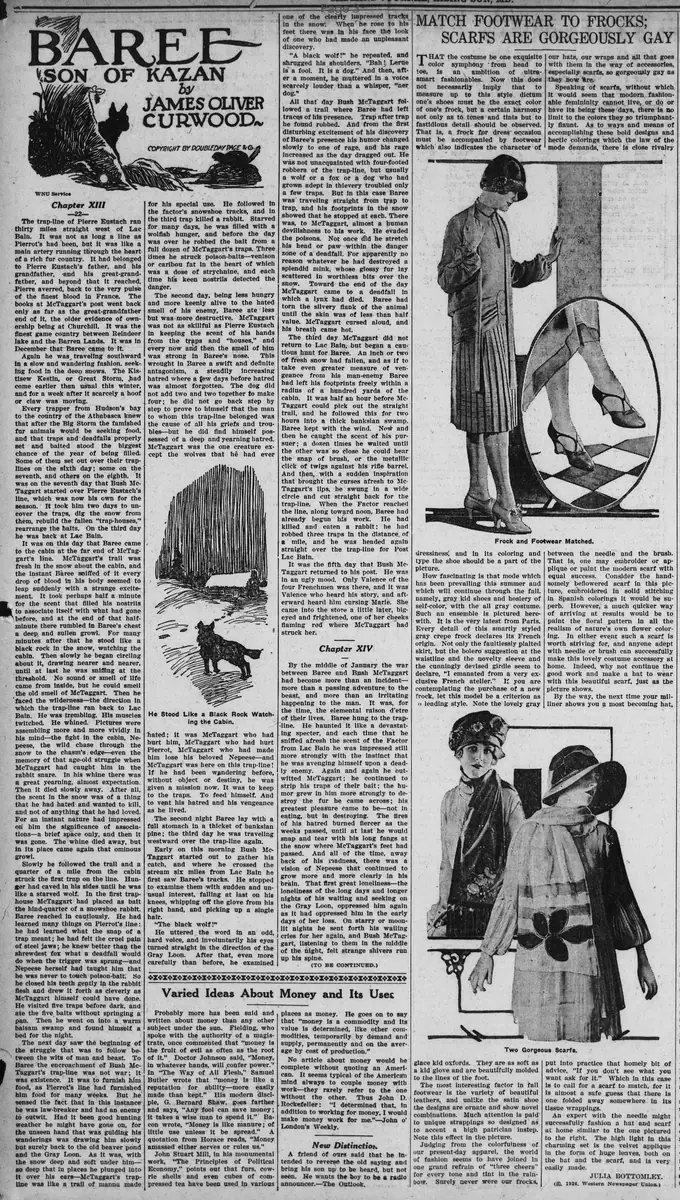
He stood like a black rock watching the cabin.
After that, even more carefully than before, he examined the tracks he found along the trap-line. Early on this morning Bush McTaggart started out to gather his catch, and where he crossed the stream six miles from Lac Bain he first saw Baree's tracks. He stopped to examine them with sudden and unusual interest, falling at last on his knees, whipping off the glove from his right hand, and picking up a single hair.
"The black wolf!"
He uttered the word in an odd, hard voice, and involuntarily his eyes turned straight in the direction of the Gray Loon.
"A black wolf!" he repeated, and shrugged his shoulders. "Bah! Lerue is a fool. It is a dog." And then, after a moment, he muttered in a voice scarcely louder than a whisper, "Nor dog."
All that day Bush McTaggart followed a trail where Baree had left traces of his presence. Trap after trap he found robbed. And from the first disturbing excitement of his discovery of Baree's presence his humor changed slowly to one of rage, and his rage increased as the day dragged out. He was not unacquainted with four-footed robbers of the trap-line, but usually a wolf or a fox or a dog who had grown adept in thievery troubled only a few traps. But in this case Baree was traveling straight from trap to trap, and his footprints in the snow showed that he stopped at each. There was, to McTaggart, almost a human devilishness to his work. He evaded the poisons. Not once did he stretch his head or paw within the danger zone of a deadfall. For apparently no reason whatever he had destroyed a splendid mink, whose glossy fur lay scattered in worthless bits over the snow. Toward the end of the day McTaggart came to a deadfall in which a lynx had died. Baree had torn the silvery flank of the animal until the skin was of less than half value. McTaggart cursed aloud, and his breath came hot.
The second day, being less hungry and more keenly alive to the hated smell of his enemy, Baree ate less but was more destructive. McTaggart was not as skillful as Pierre Eustache in keeping the scent of his hands from the traps and "houses," and every now and then the smell of him was strong in Baree's nose. This wrought in Baree a swift and definite antagonism, a steadily increasing hatred where a few days before hatred had left his footprints freely within a radius of a hundred yards of the cabin. It was half an hour before McTaggart could pick out the straight trail, and he followed this for two hours into a thick banksian swamp.
Baree kept with the wind. Now and then he caught the scent of his pursuer: a dozen times he waited until the other was so close he could hear the snap of brush, or the metallic click of twigs against his rifle barrel. And then, with a sudden inspiration that brought the curses afresh to McTaggart's lips, he swung in a wide circle and cut straight back for the trap-line. When the Factor reached the line, along toward noon, Baree had already begun his work. He had killed and eaten a rabbit; he had robbed three traps in the distance of a half mile, and he was headed again straight over the trap-line for Post Lac Bain.
It was the fifth day that Bush McTaggart returned to his post. He was in an ugly mood. Only Valence of the four Frenchmen was there, and it was Valence who heard his story, and afterward heard him cursing Marie. She came into the store a little later, big-eyed and frightened, one of her cheeks flaming red where McTaggart had struck her.
(TO BE CONTINUED.)
The trap-line of Pierre Eustache ran thirty miles straight west of Lac Bain. It was not as long a line as Pierrot's had been, but it was like a main artery running through the heart of a rich fur country. It had belonged to Pierre Eustache's father, and his grandfather, and his great-grandfather, and beyond that it reached, Pierre averred, back to the very pulse of the finest blood in France. The books at McTaggart's post went back only as far as the great-grandfather end of it, the older evidence of ownership being at Churchill. It was the finest game country between Reindeer Lake and the Barren Lands. It was in December that Baree came to it.
Again he was traveling southward in a slow and wandering fashion, seeking food in the deep snows. The Kistisew Kestin, or Great Storm, had come earlier than usual this winter, and for a week after it scarcely a hoof or claw was moving. Every trapper from Hudson's Bay to the country of the Athabasca knew that after the Big Storm the famished fur animals would be seeking food, and that traps and deadfalls properly set and baited stood the biggest chance of the year of being filled. Some of them set out over their trap-lines on the sixth day; some on the seventh, and others on the eighth. It was on the seventh day that Bush McTaggart started over Pierre Eustache's line, which was now his own for the season. It took him two days to uncover the traps, dig the snow from them, rebuild the fallen "trap-houses," rearrange the baits. On the third day he was back at Lac Bain.
It was on this day that Baree came to the cabin at the far end of McTaggart's line. McTaggart's trail was fresh in the snow about the cabin, and the instant Baree sniffed of it every drop of blood in his body seemed to leap suddenly with a strange excitement. It took perhaps half a minute for the scent that filled his nostrils to associate itself with what had gone before, and at the end of that half-minute there rumbled in Baree's chest a deep and sullen growl. For many minutes after that he stood like a black rock in the snow, watching the cabin. Then slowly he began circling about it, drawing nearer and nearer, until at last he was sniffing at the threshold. No sound or smell of life came from inside, but he could smell the old smell of McTaggart. Then he faced the wilderness—the direction in which the trap-line ran back to Lac Bain. He was trembling. His muscles twitched. He whined. Pictures were assembling more and more vividly in his mind—the fight in the cabin, Nepeese, the wild chase through the snow to the chasm's edge—even the memory of that age-old struggle when McTaggart had caught him in the rabbit snare. In his whine there was a great yearning, almost expectation. Then it died slowly away. After all, the scent in the snow was of a thing that he had hated and wanted to kill, and not of anything that he had loved. For an instant nature had impressed on him the significance of associations—a brief space only, and then it was gone. The whine died away, but in its place came again that ominous growl.
Slowly he followed the trail and a quarter of a mile from the cabin struck the first trap on the line. Hunger had caved in his sides until he was like a starved wolf. In the first trap-house McTaggart had placed as bait the hind-quarter of a snowshoe rabbit. Baree reached in cautiously. He had learned many things on Pierrot's line: he had learned what the snap of a trap meant; he had felt the cruel pain of steel jaws; he knew better than the shrewdest fox what a deadfall would do when the trigger was sprung—and Nepeese herself had taught him that he was never to touch poison-bait. So he closed his teeth gently in the rabbit flesh and drew it forth as cleverly as McTaggart himself could have done. He visited five traps before dark, and ate the five baits without springing a pan. Then he went on into a warm balsam swamp and found himself a bed for the night.
The next day saw the beginning of the struggle that was to follow between the wits of man and beast. To Baree the encroachment of Bush McTaggart's trap-line was not war; it was existence. It was to furnish him food, as Pierrot's line had furnished him food for many weeks. But he sensed the fact that in this instance he was law-breaker and had an enemy to outwit. Had it been good hunting weather he might have gone on, for the unseen hand that was guiding his wanderings was drawing him slowly but surely back to the old beaver pond and the Gray Loon. As it was, with the snow deep and soft under him—so deep that in places he plunged into it over his ears—McTaggart's trap-line was like a trail of manna made for his special use. He followed in the factor's snowshoe tracks, and in the third trap killed a rabbit. Starved as he was, there seemed to McTaggart almost a human devilishness to his work. He evaded the poisons. Not once did he stretch his head or paw within the danger zone of a deadfall. For apparently no reason whatever he had destroyed a splendid mink, whose glossy fur lay scattered in worthless bits over the snow. Toward the end of the day McTaggart came to a deadfall in which a lynx had died. Baree had torn the silvery flank of the animal until the skin was of less than half value. McTaggart cursed aloud, and his breath came hot.
The second day, being less hungry and more keenly alive to the hated smell of his enemy, Baree ate less but was more destructive. McTaggart was not as skillful as Pierre Eustache in keeping the scent of his hands from the traps and "houses," and every now and then the smell of him was strong in Baree's nose. This wrought in Baree a swift and definite antagonism, a steadily increasing hatred where a few days before hatred had left his footprints freely within a radius of a hundred yards of the cabin. It was half an hour before McTaggart could pick out the straight trail, and he followed this for two hours into a thick banksian swamp.
Baree kept with the wind. Now and then he caught the scent of his pursuer: a dozen times he waited until the other was so close he could hear the snap of brush, or the metallic click of twigs against his rifle barrel. And then, with a sudden inspiration that brought the curses afresh to McTaggart's lips, he swung in a wide circle and cut straight back for the trap-line. When the Factor reached the line, along toward noon, Baree had already begun his work. He had killed and eaten a rabbit; he had robbed three traps in the distance of a half mile, and he was headed again straight over the trap-line for Post Lac Bain.
It was the fifth day that Bush McTaggart returned to his post. He was in an ugly mood. Only Valence of the four Frenchmen was there, and it was Valence who heard his story, and afterward heard him cursing Marie. She came into the store a little later, big-eyed and frightened, one of her cheeks flaming red where McTaggart had struck her.
Chapter XIV
By the middle of January the war between Baree and Bush McTaggart had become more than an incident—more than a passing adventure to the beast, and more than an irritating happening to the man. It was, for the time, the elemental raison d'etre of their lives. Baree hung to the trap-line. He haunted it like a devastating specter, and each time that he sniffed afresh the scent of the Factor from Lac Bain he was impressed still more strongly with the instinct that he was avenging himself upon a deadly enemy. Again and again he outwitted McTaggart; he continued to strip his traps of their bait; the humor grew in him more strongly to destroy the fur he came across; his greatest pleasure came to be—not in eating, but in destroying. The fires of his hatred burned fiercer as the weeks passed, until at last he would snap and tear with his long fangs at the snow where McTaggart's feet had passed. And all of the time, away back of his madness, there was a vision of Nepeese that continued to grow more and more clearly in his brain. That first great loneliness—the loneliness of the long days and longer nights of his waiting and seeking on the Gray Loon, oppressed him again as it had oppressed him in the early days of her loss. On starry or moonlit nights he sent forth his wailing cries for her again, and Bush McTaggart, listening to them in the middle of the night, felt strange shivers run up his spine.
He stood like a black rock watching the cabin.
After that, even more carefully than before, he examined the tracks he found along the trap-line. Early on this morning Bush McTaggart started out to gather his catch, and where he crossed the stream six miles from Lac Bain he first saw Baree's tracks. He stopped to examine them with sudden and unusual interest, falling at last on his knees, whipping off the glove from his right hand, and picking up a single hair.
"The black wolf!"
He uttered the word in an odd, hard voice, and involuntarily his eyes turned straight in the direction of the Gray Loon.
"A black wolf!" he repeated, and shrugged his shoulders. "Bah! Lerue is a fool. It is a dog." And then, after a moment, he muttered in a voice scarcely louder than a whisper, "Nor dog."
All that day Bush McTaggart followed a trail where Baree had left traces of his presence. Trap after trap he found robbed. And from the first disturbing excitement of his discovery of Baree's presence his humor changed slowly to one of rage, and his rage increased as the day dragged out. He was not unacquainted with four-footed robbers of the trap-line, but usually a wolf or a fox or a dog who had grown adept in thievery troubled only a few traps. But in this case Baree was traveling straight from trap to trap, and his footprints in the snow showed that he stopped at each. There was, to McTaggart, almost a human devilishness to his work. He evaded the poisons. Not once did he stretch his head or paw within the danger zone of a deadfall. For apparently no reason whatever he had destroyed a splendid mink, whose glossy fur lay scattered in worthless bits over the snow. Toward the end of the day McTaggart came to a deadfall in which a lynx had died. Baree had torn the silvery flank of the animal until the skin was of less than half value. McTaggart cursed aloud, and his breath came hot.
The second day, being less hungry and more keenly alive to the hated smell of his enemy, Baree ate less but was more destructive. McTaggart was not as skillful as Pierre Eustache in keeping the scent of his hands from the traps and "houses," and every now and then the smell of him was strong in Baree's nose. This wrought in Baree a swift and definite antagonism, a steadily increasing hatred where a few days before hatred had left his footprints freely within a radius of a hundred yards of the cabin. It was half an hour before McTaggart could pick out the straight trail, and he followed this for two hours into a thick banksian swamp.
Baree kept with the wind. Now and then he caught the scent of his pursuer: a dozen times he waited until the other was so close he could hear the snap of brush, or the metallic click of twigs against his rifle barrel. And then, with a sudden inspiration that brought the curses afresh to McTaggart's lips, he swung in a wide circle and cut straight back for the trap-line. When the Factor reached the line, along toward noon, Baree had already begun his work. He had killed and eaten a rabbit; he had robbed three traps in the distance of a half mile, and he was headed again straight over the trap-line for Post Lac Bain.
It was the fifth day that Bush McTaggart returned to his post. He was in an ugly mood. Only Valence of the four Frenchmen was there, and it was Valence who heard his story, and afterward heard him cursing Marie. She came into the store a little later, big-eyed and frightened, one of her cheeks flaming red where McTaggart had struck her.
(TO BE CONTINUED.)
What sub-type of article is it?
Prose Fiction
What themes does it cover?
Nature
War Peace
What keywords are associated?
Baree
Mctaggart
Trap Line
Wolf Dog
Fur Trapping
Revenge
Wilderness
Lac Bain
Literary Details
Title
Chapter Xiii And Chapter Xiv
Key Lines
He Stood Like A Black Rock Watching The Cabin.
The Black Wolf!
It Was, For The Time, The Elemental Raison D'etre Of Their Lives.