Thank you for visiting SNEWPapers!
Sign up free
Buckeye Valley News And Buckeye Review
Buckeye, Maricopa County, Arizona
What is this article about?
US and British carrier planes and fleets bombard Japanese homeland, including Hokkaido, Honshu, and Tokyo Bay, while peace rumors circulate involving Stalin possibly bringing Japanese terms to Berlin, Truman's surrender conditions, and speculation on Hirohito's role in ending the war.
Clipping
OCR Quality
Full Text
Keep Going.
While the nation's capital buzzed with peace talk and Australian newspapers hinted of sensational developments, U. S. and British carrier planes continued to rake the Japanese homeland and the Allied fleets kept up the bombardment of Nippon's sprawling coastline.
Scorched by Allied fire, the Japs still refused to come out and fight. Propagandists were seeking to calm the populace with the assertion that the U. S. and British attacks were designed to feel them out and they would strike at the proper time.
Having joined with the fleet in raking shipping and transport facilities linking the coal-producing island of Hokkaido with Honshu, and pounding factories on Honshu itself, carrier planes swept over Tokyo bay to shoot up combat vessels at anchor.
Presumably remnants of the once proud Imperial fleet, the warships were covered by a heavy screen of anti-aircraft fire as U. S. and British airmen closed in.
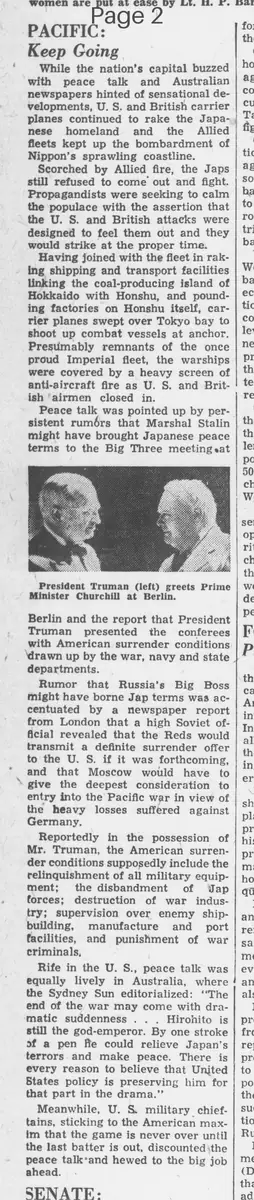
Peace talk was pointed up by persistent rumors that Marshal Stalin might have brought Japanese peace terms to the Big Three meeting at Berlin and the report that President Truman presented the conferees with American surrender conditions drawn up by the war, navy and state departments.
Rumor that Russia's Big Boss might have borne Jap terms was accentuated by a newspaper report from London that a high Soviet official revealed that the Reds would transmit a definite surrender offer to the U. S. if it was forthcoming, and that Moscow would have to give the deepest consideration to entry into the Pacific war in view of the heavy losses suffered against Germany.
Reportedly in the possession of Mr. Truman, the American surrender conditions supposedly include the relinquishment of all military equipment; the disbandment of Jap forces; destruction of war industry; supervision over enemy shipbuilding, manufacture and port facilities, and punishment of war criminals.
Rife in the U. S., peace talk was equally lively in Australia, where the Sydney Sun editorialized: "The end of the war may come with dramatic suddenness . . . Hirohito is still the god-emperor. By one stroke of a pen he could relieve Japan's terrors and make peace. There is every reason to believe that United States policy is preserving him for that part in the drama."
Meanwhile, U. S. military chieftains, sticking to the American maxim that the game is never over until the last batter is out, discounted the peace talk and hewed to the big job ahead.
What sub-type of article is it?
What keywords are associated?
What entities or persons were involved?
Where did it happen?
Foreign News Details
Primary Location
Japan
Key Persons
Outcome
ongoing allied bombardments of japanese targets; rumors of japanese peace terms and american surrender conditions including relinquishment of military equipment, disbandment of forces, destruction of war industry, supervision of shipbuilding and ports, and punishment of war criminals.
Event Details
US and British carrier planes and Allied fleets continued attacks on the Japanese homeland, raking shipping and transport facilities between Hokkaido and Honshu, pounding factories on Honshu, and shooting up warships in Tokyo Bay amid heavy anti-aircraft fire. Japanese forces refused to engage, with propagandists claiming the attacks were probes. Peace rumors persisted, including Stalin possibly bringing Japanese terms to the Berlin Big Three meeting, Truman presenting US surrender conditions, and Soviet consideration of Pacific entry. Australian media speculated on Hirohito's potential role in sudden peace. US military leaders discounted rumors and focused on continuing operations.