Thank you for visiting SNEWPapers!
Sign up free
Lynchburg Virginian
Lynchburg, Virginia
What is this article about?
Historical overview of vegetable absence in early Tudor England, linking poor diets of salted meat and grains to shortened lifespans, scurvy in navy (e.g., 1725 voyage), and medieval health crises with leper hospitals.
Clipping
OCR Quality
Full Text
VEGETABLES
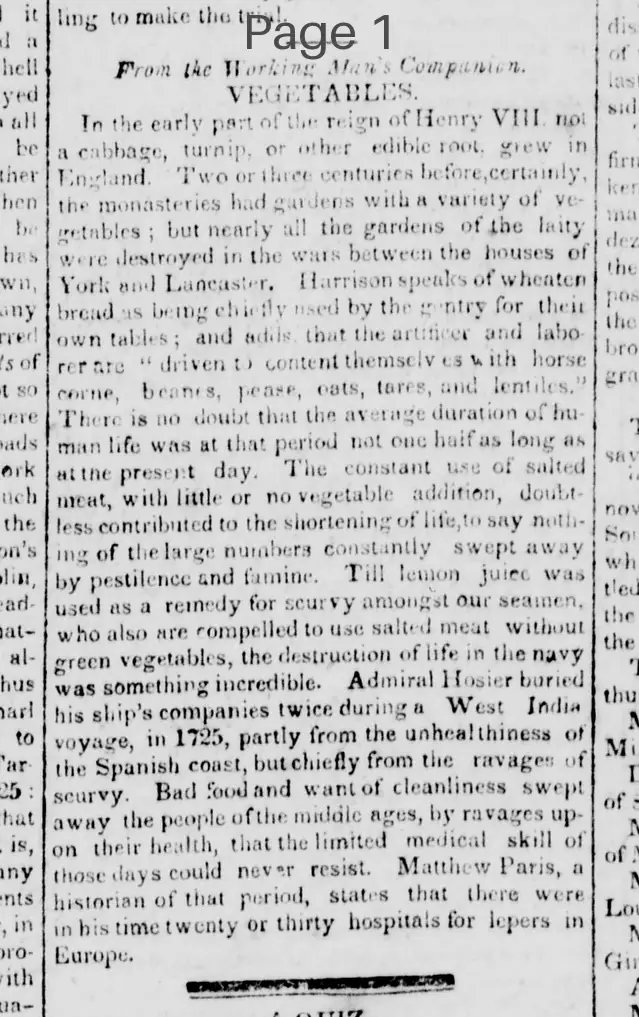
In the early part of the reign of Henry VIII not a cabbage, turnip, or other edible root grew in England. Two or three centuries before, certainly, the monasteries had gardens with a variety of vegetables; but nearly all the gardens of the laity were destroyed in the wars between the houses of York and Lancaster. Harrison speaks of wheaten bread as being chiefly used by the gentry for their own tables; and adds that the artificer and laborer are "driven to content themselves with horse corne, beanes, pease, oats, tares, and lentiles." There is no doubt that the average duration of human life was at that period not one half as long as at the present day. The constant use of salted meat, with little or no vegetable addition, doubtless contributed to the shortening of life, to say nothing of the large numbers constantly swept away by pestilence and famine. Till lemon juice was used as a remedy for scurvy amongst our seamen, who also are compelled to use salted meat without green vegetables, the destruction of life in the navy was something incredible. Admiral Hosier buried his ship's companies twice during a West India voyage, in 1725, partly from the unhealthiness of the Spanish coast, but chiefly from the ravages of scurvy. Bad food and want of cleanliness swept away the people of the middle ages, by ravages upon their health, that the limited medical skill of those days could never resist. Matthew Paris, a historian of that period, states that there were in his time twenty or thirty hospitals for lepers in Europe.
What sub-type of article is it?
What themes does it cover?
What keywords are associated?
What entities or persons were involved?
Where did it happen?
Story Details
Key Persons
Location
England, Europe, West India
Event Date
Early Reign Of Henry Viii, 1725
Story Details
In early Henry VIII's reign, few vegetables grew in England due to prior wars destroying gardens; common people ate mostly grains and legumes, leading to shorter lifespans from salted meat diets without vegetables, exacerbated by pestilence and famine; scurvy ravaged sailors until lemon juice remedy; medieval bad food and uncleanliness caused widespread health issues, with many leper hospitals.