Thank you for visiting SNEWPapers!
Sign up free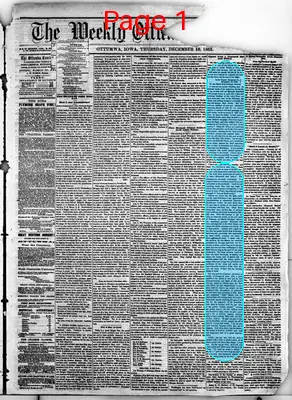
Letter to Editor
December 10, 1863
The Weekly Ottumwa Courier
Ottumwa, Wapello County, Iowa
What is this article about?
A Union officer imprisoned in Libby Prison, Richmond, writes to the Chicago Journal editor, passionately urging immediate mass enlistment to reinforce armies, launch a winter campaign to capture Richmond, and rescue starving prisoners suffering in Confederate prisons, including vivid descriptions of their dire conditions.
Clipping

OCR Quality
95%
Excellent
Full Text
We this morning received the following letter from one of our Illinois officers now prisoners in Libby Prison, at Richmond He feels what he says, and we wish he could make our people feel just as he does. At his own request we suppress his name, but his letter can be seen at our office:
LIBBY Prison RICHMOND,Va.,
November 19, 1863.
To the Editor of the Chicago Journal:
O what are our people thinking, that the thinned ranks of our regiments are not filled up at once, and our Generals furnished with plenty of men to push this rotten and tottering rebellion to the wall? True, we have more men now in the field than the rebels, and perhaps enough to eventually defeat and destroy their armies. But why with our millions of men and unbounded resources, should we wait for our veteran soldiers to contend with and gradually conquer armies nearly as strong as their own, when we have the ability to hurl such an avalanche of men upon them as shall in one short winter's campaign drive their leaders from the land, and their soldiers into submission to the Constitution and laws of the country? These Mr. Editor, are questions which we prisoners--as we lay here month after month, wearing out our lives in these wretched prisons-ask ourselves daily. It may be said that it is too late now to operate in the field this winter. Let me say I was in the field last winter, and I would ask for no better weather for field operations than we had in December and January in Tennessee and Mississippi. It is a mistake to suppose that armies cannot operate in this country in the winter. I know by experience that the open field is a much better place for a soldier, both as regards his comfort, his health and fare, than the best of the rebel prisons,
I have now been here four months, and there has not been a time during those months but what an army of 30,000 men or less-well commanded, could have landed on the York river, moved over the peninsula, taken Richmond, and held it. This statement is not made unadvisedly. It is objected that Lee would prevented any such movement on the peninsula. Could we ask anything better than that Lee could be drawn from his present strongholds, if that could be done without reducing the present strength of General Meade's army?
Illinois can throw into the field-without the least detriment to her agricultural, manufacturing or commercial interests- 30,000 men within the next thirty days. No man who is worthy of the proud name of Illinoisan will deny this. Other States doing their duty, the first day of January next would see our armies increased by 800,000 men. With this increase to our armies, our Generals would, ere the bad roads of February and March interfered with active operations, garrison Richmond and every principal city in the rebel States; and rescue the 12,000 prisoners now laying idle in their prisons. Another and a great reason why our people should flock to the standard now and overwhelm this insurrection is, these 12,000 prisoners are many of them suffering for food. I speak now of the privates, for the officers are receiving provisions by the boat load from our loved ones at home, and as long as we are supplied, can bear our close confinement in these filthy dens as long as the good of our cause demands it. But these privates, brave fellows who have left homes of comfort and plenty, the loving care of gentle wife or anxious mother and the sunny smiles of happy little ones, to bear the privations and hardships of the camp and march, and brave the awful thunders of the rebel cannon, are many of them this day starving slowly to death.
Can any well-fed alderman, merchant or banker of Chicago sit down with a good appetite to his sirloin of beef and its rich accompaniments, and think of this fact? Can any farmer in Illinois enjoy the food with which his well heaped-board is supplied, while he sees in his mind's eye his neighbor's son, his nephew, or perchance his own brave boy, standing on that filthy spot misnamed "Belle" Island, with his tattered shirt, his soleless shoes and unsheltered head, eagerly watching the gate of his den for the approach of his breakfast. And there he watches until the last tints of the golden "Indian summer" evening are giving way to the raw chilling wind of a November night, when the gate opens and a file of slovenly negroes, carrying dirty wooden buckets filled with cold boiled rice, come in. He gets one pint of this for his breakfast, dinner, supper, his all of food for twenty-four hours. I do not pretend that this happens every day, but it happens. And when this is not the portion, the moiety of bread of unsifted corn meal and tough poor beef is no great improvement.
O God! can any man who can carry a musket, ride a horse or wield a sabre, sit at home quietly and know these things. I hope not. Let the cry go forth, let it roll over every prairie and shake every hill-top in the West, "To arms! to arms! a rescue! a rescue!!" until our brave boys are delivered from their semi-barbarous captors, who are murdering them by the slow torture of starvation.
GEBOLD
LIBBY Prison RICHMOND,Va.,
November 19, 1863.
To the Editor of the Chicago Journal:
O what are our people thinking, that the thinned ranks of our regiments are not filled up at once, and our Generals furnished with plenty of men to push this rotten and tottering rebellion to the wall? True, we have more men now in the field than the rebels, and perhaps enough to eventually defeat and destroy their armies. But why with our millions of men and unbounded resources, should we wait for our veteran soldiers to contend with and gradually conquer armies nearly as strong as their own, when we have the ability to hurl such an avalanche of men upon them as shall in one short winter's campaign drive their leaders from the land, and their soldiers into submission to the Constitution and laws of the country? These Mr. Editor, are questions which we prisoners--as we lay here month after month, wearing out our lives in these wretched prisons-ask ourselves daily. It may be said that it is too late now to operate in the field this winter. Let me say I was in the field last winter, and I would ask for no better weather for field operations than we had in December and January in Tennessee and Mississippi. It is a mistake to suppose that armies cannot operate in this country in the winter. I know by experience that the open field is a much better place for a soldier, both as regards his comfort, his health and fare, than the best of the rebel prisons,
I have now been here four months, and there has not been a time during those months but what an army of 30,000 men or less-well commanded, could have landed on the York river, moved over the peninsula, taken Richmond, and held it. This statement is not made unadvisedly. It is objected that Lee would prevented any such movement on the peninsula. Could we ask anything better than that Lee could be drawn from his present strongholds, if that could be done without reducing the present strength of General Meade's army?
Illinois can throw into the field-without the least detriment to her agricultural, manufacturing or commercial interests- 30,000 men within the next thirty days. No man who is worthy of the proud name of Illinoisan will deny this. Other States doing their duty, the first day of January next would see our armies increased by 800,000 men. With this increase to our armies, our Generals would, ere the bad roads of February and March interfered with active operations, garrison Richmond and every principal city in the rebel States; and rescue the 12,000 prisoners now laying idle in their prisons. Another and a great reason why our people should flock to the standard now and overwhelm this insurrection is, these 12,000 prisoners are many of them suffering for food. I speak now of the privates, for the officers are receiving provisions by the boat load from our loved ones at home, and as long as we are supplied, can bear our close confinement in these filthy dens as long as the good of our cause demands it. But these privates, brave fellows who have left homes of comfort and plenty, the loving care of gentle wife or anxious mother and the sunny smiles of happy little ones, to bear the privations and hardships of the camp and march, and brave the awful thunders of the rebel cannon, are many of them this day starving slowly to death.
Can any well-fed alderman, merchant or banker of Chicago sit down with a good appetite to his sirloin of beef and its rich accompaniments, and think of this fact? Can any farmer in Illinois enjoy the food with which his well heaped-board is supplied, while he sees in his mind's eye his neighbor's son, his nephew, or perchance his own brave boy, standing on that filthy spot misnamed "Belle" Island, with his tattered shirt, his soleless shoes and unsheltered head, eagerly watching the gate of his den for the approach of his breakfast. And there he watches until the last tints of the golden "Indian summer" evening are giving way to the raw chilling wind of a November night, when the gate opens and a file of slovenly negroes, carrying dirty wooden buckets filled with cold boiled rice, come in. He gets one pint of this for his breakfast, dinner, supper, his all of food for twenty-four hours. I do not pretend that this happens every day, but it happens. And when this is not the portion, the moiety of bread of unsifted corn meal and tough poor beef is no great improvement.
O God! can any man who can carry a musket, ride a horse or wield a sabre, sit at home quietly and know these things. I hope not. Let the cry go forth, let it roll over every prairie and shake every hill-top in the West, "To arms! to arms! a rescue! a rescue!!" until our brave boys are delivered from their semi-barbarous captors, who are murdering them by the slow torture of starvation.
GEBOLD
What sub-type of article is it?
Persuasive
Emotional
What themes does it cover?
Military War
What keywords are associated?
Libby Prison
Civil War Prisoners
Enlistment Urgency
Winter Campaign
Richmond Capture
Prisoner Starvation
Belle Isle
Illinois Troops
What entities or persons were involved?
Gebold
The Editor Of The Chicago Journal
Letter to Editor Details
Author
Gebold
Recipient
The Editor Of The Chicago Journal
Main Argument
the union must immediately enlist more men to reinforce armies and launch a decisive winter campaign to capture richmond, end the rebellion quickly, and rescue the 12,000 starving prisoners in confederate prisons.
Notable Details
Describes Potential For 30,000 Men From Illinois In 30 Days
Details Harsh Winter Campaign Feasibility From Experience In Tennessee And Mississippi
Vivid Account Of Prisoner Rations: One Pint Of Cold Boiled Rice Per Day Or Unsifted Corn Meal And Tough Beef
Mentions Belle Isle Prison Conditions
References General Meade's Army And Drawing Lee From Strongholds