Thank you for visiting SNEWPapers!
Sign up free
Editorial
September 7, 1876
The Valley Virginian
Clifton Forge, Staunton, Virginia
What is this article about?
This editorial defends Republican references to the Civil War legacy (the 'bloody shirt') against Democratic criticism, accusing Southern Democrats of hypocrisy by invoking Confederate service in politics. It calls for national reconciliation and acceptance of war outcomes as fixed principles.
Clipping
OCR Quality
98%
Excellent
Full Text
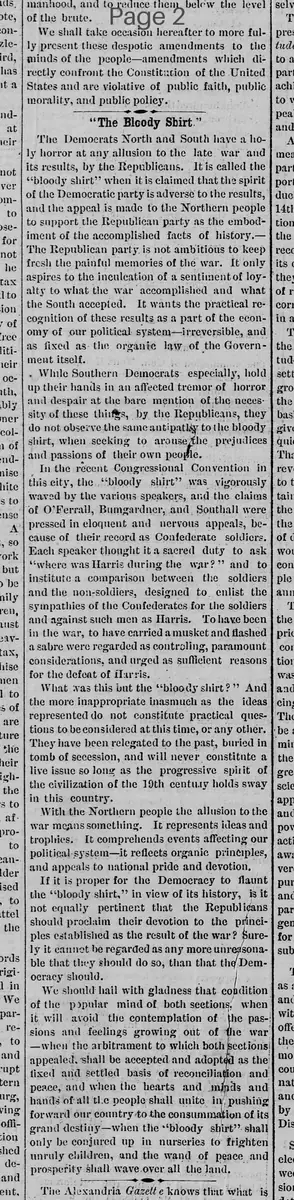
"The Bloody Shirt."
The Democrats North and South have a holy horror at any allusion to the late war and its results, by the Republicans. It is called the "bloody shirt" when it is claimed that the spirit of the Democratic party is adverse to the results, and the appeal is made to the Northern people to support the Republican party as the embodiment of the accomplished facts of history.
The Republican party is not ambitious to keep fresh the painful memories of the war. It only aspires to the inculcation of a sentiment of loyalty to what the war accomplished and what the South accepted. It wants the practical recognition of these results as a part of the economy of our political system—irreversible, and as fixed as the organic law of the Government itself.
While Southern Democrats especially, hold up their hands in an affected tremor of horror and despair at the bare mention of the necessity of these things, by the Republicans, they do not observe the same antipathy to the bloody shirt, when seeking to arouse the prejudices and passions of their own people.
In the recent Congressional Convention in this city, the "bloody shirt" was vigorously waved by the various speakers, and the claims of O'Ferrall, Bumgardner, and Southall were pressed in eloquent and nervous appeals, because of their record as Confederate soldiers. Each speaker thought it a sacred duty to ask "where was Harris during the war?" and to institute a comparison between the soldiers and the non-soldiers, designed to enlist the sympathies of the Confederates for the soldiers and against such men as Harris. To have been in the war, to have carried a musket and flashed a sabre were regarded as controlling, paramount considerations, and urged as sufficient reasons for the defeat of Harris.
What was this but the "bloody shirt?" And the more inappropriate inasmuch as the ideas represented do not constitute practical questions to be considered at this time, or any other. They have been relegated to the past, buried in the tomb of secession, and will never constitute a live issue so long as the progressive spirit of the civilization of the 19th century holds sway in this country.
With the Northern people the allusion to the war means something. It represents ideas and trophies. It comprehends events affecting our political system—it reflects organic principles, and appeals to national pride and devotion.
If it is proper for the Democracy to flaunt the "bloody shirt," in view of its history, is it not equally pertinent that the Republicans should proclaim their devotion to the principles established as the result of the war? Surely it cannot be regarded as any more unreasonable that they should do so, than that the Democracy should.
We should hail with gladness that condition of the popular mind of both sections, when it will avoid the contemplation of the passions and feelings growing out of the war—when the arbitrament to which both sections appealed, shall be accepted and adopted as the fixed and settled basis of reconciliation and peace, and when the hearts and minds and hands of all the people shall unite in pushing forward our country to the consummation of its grand destiny—when the "bloody shirt" shall only be conjured up in nurseries to frighten unruly children, and the wand of peace and prosperity shall wave over all the land.
The Democrats North and South have a holy horror at any allusion to the late war and its results, by the Republicans. It is called the "bloody shirt" when it is claimed that the spirit of the Democratic party is adverse to the results, and the appeal is made to the Northern people to support the Republican party as the embodiment of the accomplished facts of history.
The Republican party is not ambitious to keep fresh the painful memories of the war. It only aspires to the inculcation of a sentiment of loyalty to what the war accomplished and what the South accepted. It wants the practical recognition of these results as a part of the economy of our political system—irreversible, and as fixed as the organic law of the Government itself.
While Southern Democrats especially, hold up their hands in an affected tremor of horror and despair at the bare mention of the necessity of these things, by the Republicans, they do not observe the same antipathy to the bloody shirt, when seeking to arouse the prejudices and passions of their own people.
In the recent Congressional Convention in this city, the "bloody shirt" was vigorously waved by the various speakers, and the claims of O'Ferrall, Bumgardner, and Southall were pressed in eloquent and nervous appeals, because of their record as Confederate soldiers. Each speaker thought it a sacred duty to ask "where was Harris during the war?" and to institute a comparison between the soldiers and the non-soldiers, designed to enlist the sympathies of the Confederates for the soldiers and against such men as Harris. To have been in the war, to have carried a musket and flashed a sabre were regarded as controlling, paramount considerations, and urged as sufficient reasons for the defeat of Harris.
What was this but the "bloody shirt?" And the more inappropriate inasmuch as the ideas represented do not constitute practical questions to be considered at this time, or any other. They have been relegated to the past, buried in the tomb of secession, and will never constitute a live issue so long as the progressive spirit of the civilization of the 19th century holds sway in this country.
With the Northern people the allusion to the war means something. It represents ideas and trophies. It comprehends events affecting our political system—it reflects organic principles, and appeals to national pride and devotion.
If it is proper for the Democracy to flaunt the "bloody shirt," in view of its history, is it not equally pertinent that the Republicans should proclaim their devotion to the principles established as the result of the war? Surely it cannot be regarded as any more unreasonable that they should do so, than that the Democracy should.
We should hail with gladness that condition of the popular mind of both sections, when it will avoid the contemplation of the passions and feelings growing out of the war—when the arbitrament to which both sections appealed, shall be accepted and adopted as the fixed and settled basis of reconciliation and peace, and when the hearts and minds and hands of all the people shall unite in pushing forward our country to the consummation of its grand destiny—when the "bloody shirt" shall only be conjured up in nurseries to frighten unruly children, and the wand of peace and prosperity shall wave over all the land.
What sub-type of article is it?
Partisan Politics
War Or Peace
What keywords are associated?
Bloody Shirt
Civil War Legacy
Partisan Hypocrisy
Reconstruction Principles
Confederate Soldiers
National Reconciliation
What entities or persons were involved?
Democrats
Republicans
Southern Democrats
O'ferrall
Bumgardner
Southall
Harris
Confederate Soldiers
Editorial Details
Primary Topic
Republican Defense Against Democratic Criticism Of Civil War References
Stance / Tone
Supportive Of Republican Appeals And Call For Reconciliation
Key Figures
Democrats
Republicans
Southern Democrats
O'ferrall
Bumgardner
Southall
Harris
Confederate Soldiers
Key Arguments
Democrats Hypocritically Decry Republican 'Bloody Shirt' While Using It Themselves
Republicans Seek Loyalty To War's Irreversible Results
Southern Convention Invoked Confederate Service To Support Candidates Against Harris
War Legacy Represents Fixed Political Principles For Northerners
Both Parties Should Accept War Outcomes For National Unity