Thank you for visiting SNEWPapers!
Sign up free
The New York Journal, And Weekly Register
New York, New York County, New York
What is this article about?
An Anti-Federalist editorial compares the French people's resistance to royal despotism and centralization to American opposition against the new U.S. Constitution, which threatens state governments. It praises French provincial parliaments and criticizes federalists like Franklin and Wilson.
Merged-components note: Merged continuation of the 'Centinel No. XXI' essay discussing French political events and parallels to American constitutional debates.
Clipping
OCR Quality
Full Text
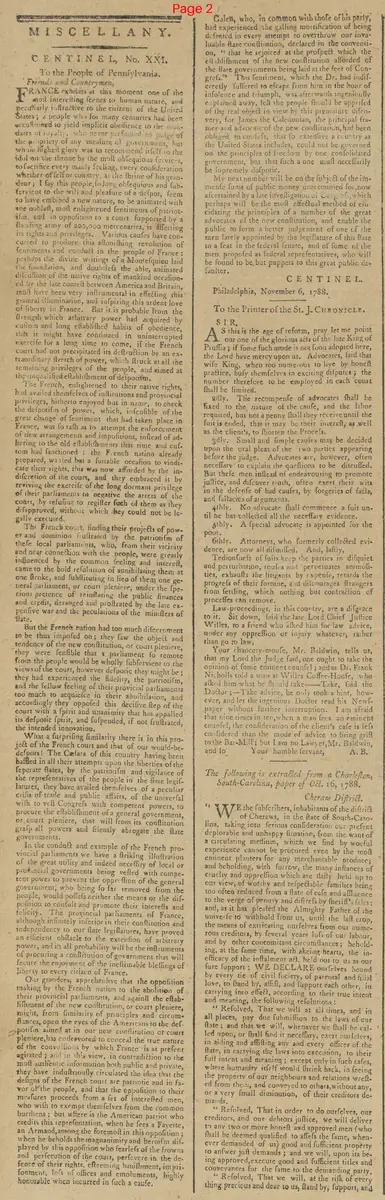
CENTINEL. NO. XXI.
To the People of Pennsylvania.
Friends and Countrymen,
FRANCE exhibits at this moment one of the most interesting scenes to human nature and peculiarly instructive to the citizens of the United States; a people who for many centuries had been accustomed to yield implicit obedience to the mandates of royalty, who never presumed to judge of the propriety of any measure of government, but whose highest glory was to recommend itself to the idol on the throne by the most obsequious services, to sacrifice every manly feeling, every consideration whether of self or country, at the shrine of his grandeur; I say this people, so long obsequious and subservient to the will and pleasure of a despot, seem to have imbibed a new nature, to be animated with the noblest, most enlightened sentiments of patriotism, and in opposition to a court supported by a standing army of 200,000 mercenaries, is asserting its rights and privileges. Various causes have concurred to produce this astonishing revolution of sentiments and conduct in the people of France: perhaps the divine writings of a Montesquieu laid the foundation, and doubtless the able, animated discussion of the native rights of mankind occasioned by the late contest between America and Britain, must have been very instrumental in effecting this general illumination, and inspiring this ardent love of liberty in France. But it is probable from the strength which arbitrary power had acquired by custom and long established habits of obedience, that it might have continued in uninterrupted exercise for a long time to come, if the French court had not precipitated its destruction by an extraordinary stretch of power, which struck at all the remaining privileges of the people, and aimed at the unqualified establishment of despotism.
The French, enlightened to their native rights, had availed themselves of institutions and provincial privileges, hitherto enjoyed but in name, to check the despotism of power, which, insensible of the great change of sentiment that had taken place in France, was so rash as to attempt the enforcement of new arrangements and impositions, instead of adhering to the old establishments that time and custom had sanctioned: the French nation already prepared, wanted but a suitable occasion to vindicate their rights, this was now afforded by the indiscretion of the court, and they embraced it by reviving the exercise of the long dormant privilege of their parliaments to negative the arrets of the court, by refusing to register such of them as they disapproved, without which they could not be legally executed.
The French court, finding their projects of power and dominion frustrated by the patriotism of these local parliaments, who, from their vicinity and near connection with the people, were greatly influenced by the common feeling and interest, came to the bold resolution of annihilating them at one stroke, and substituting in lieu of them one general parliament, or court pleniere, under the precious pretense of reinstating the public finances and credit, deranged and prostrated by the late expensive war and the peculations of the ministers of state.
But the French nation had too much discernment to be thus imposed on; they saw the object and tendency of the new constitution, or court pleniere, they were sensible that a parliament so remote from the people would be wholly subservient to the views of the court, however despotic they might be; they had experienced the fidelity, the patriotism, and the fellow feeling of their provincial parliaments too much to acquiesce in their annihilation, and accordingly they opposed this decisive step of the court with a spirit and unanimity that has appalled its despotic spirit, and suspended, if not frustrated, the intended innovation.
What a surprising similarity there is in this project of the French court and that of our would-be-despots! The Czars of this country having been baffled in all their attempts upon the liberties of the separate states, by the patriotism and vigilance of the representatives of the people in the state legislatures, they have availed themselves of a peculiar crisis of trade and public affairs, of the universal wish to vest Congress with competent powers, to procure the establishment of a general government, or court pleniere, that will from its constitution grasp all powers and silently abrogate the state governments.
In the conduct and example of the French provincial parliaments we have a striking illustration of the great utility and indeed necessity of local or provincial governments being vested with competent powers to prevent the oppression of the general government, who being so far removed from the people, would possess neither the means or the disposition to consult and promote their interests and felicity. The provincial parliaments of France, although infinitely inferior in their constitution and independency to our state legislatures, have proved an efficient obstacle to the extension of arbitrary power, and in all probability will be the instruments of procuring a constitution of government that will secure the enjoyment of the inestimable blessings of liberty to every citizen of France
Our grandees, apprehensive that the opposition making by the French nation to the abolition of their provincial parliaments, and against the establishment of the new constitution, or court pleniere, might, from similarity of principles and circumstances, open the eyes of the Americans to the despotism aimed at in our new constitution or court pleniere, has endeavored to conceal the true nature of the convulsions by which France is at present agitated; and in this view, in contradiction to the most authentic information both public and private, they have industriously circulated the idea that the designs of the French court are patriotic and in favor of the people, and that the opposition to their measures proceeds from a set of interested men, who wish to exempt themselves from the common burthens; but where is the American patriot who credits this representation, when he sees a Fayette, an Armand, among the foremost in this opposition; when he beholds the magnanimity and heroism displayed by this opposition who fearless of the frowns and persecution of the court, persevere in the defence of their rights, esteeming banishment, imprisonment, loss of offices and emoluments, highly honorable when incurred in such a cause.
Franklin, who, in common with those of his party. had experienced the galling mortification of being defeated in every attempt to overthrow our invaluable state constitution, declared in the convention, "that he rejoiced at the prospect which the establishment of the new constitution afforded of the state governments being laid at the feet of Congress." This sentiment, which the Dr. had indiscreetly suffered to escape from him in the hour of insolence and triumph, was afterwards ingeniously explained away, lest the people should be apprised of the real object in view by this premature discovery, for James the Caledonian, the principal framer and advocate of the new constitution, had been obliged to confess, that so extensive a country as the United States includes, could not be governed on the principles of freedom by one consolidated government, but that such a one must necessarily be supremely despotic.
My next number will be on the subject of the immense sums of public money unaccounted for, now ascertained by a late investigation of Congress, which perhaps will be the most effectual method of elucidating the principles of a number of the great advocates of the new constitution, and enable the public to form a better judgement of one of the men lately appointed by the legislature of this state to a seat in the federal senate, and of some of the men proposed as federal representatives, who will be found to be but puppets to this great public defaulter.
CENTINEL
What sub-type of article is it?
What keywords are associated?
What entities or persons were involved?
Editorial Details
Primary Topic
Opposition To U.S. Federal Consolidation Drawing Parallels To French Resistance Against Centralization
Stance / Tone
Anti Federalist Cautionary Warning
Key Figures
Key Arguments