Thank you for visiting SNEWPapers!
Sign up free
Norfolk Gazette And Publick Ledger
Norfolk, Virginia
What is this article about?
London reports from early April 1815 detail diplomatic despatches from France, preparations for an allied council in Brussels to address Napoleon's return, potential proclamation to French people, war preparations, and internal French discontent with Bonaparte's regime amid troop shortages and royalist support.
Clipping
OCR Quality
Full Text
Consuls at London, April 5-6
London, April 9.
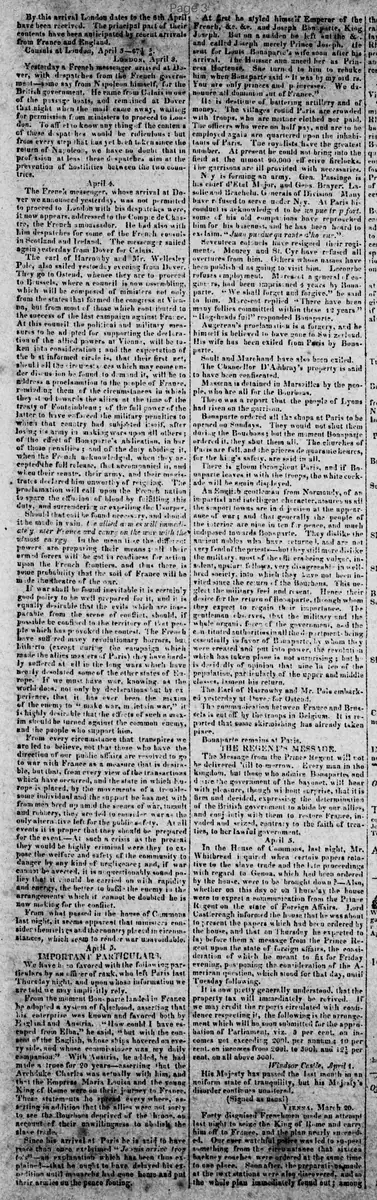
Yesterday a French messenger arrived at Dover, with despatches from the French government—some say from Napoleon himself, for the British government. He came from Calais in one of the passage boats, and remained at Dover that night when the mail came away, waiting for permission from ministers to proceed to London. To affect to know any thing of the contents of these despatches would be ridiculous: but from every step that has yet been taken since the return of Napoleon, we have no doubt that in profession at least these despatches aim at the prevention of hostilities between the two countries.
April 4.
The French messenger, whose arrival at Dover we announced yesterday, was not permitted to proceed to London with his despatches were, it now appears, addressed to the Comte de Chatre, the French ambassador. He had also with him despatches for some of the French consuls in Scotland and Ireland. The messenger sailed again yesterday from Dover for Calais.
The Earl of Harrowby and Mr. Wellesley Pole, also sailed yesterday evening from Dover. They go to Ostend, whence they are to proceed to Brussels, where a council is now assembling, which will be composed of ministers not only from the states that formed the congress at Vienna, but from most of those which contributed to the success of the last campaign against France.
At this council the political and military measures to be adopted for supporting the declaration of the allied powers at Vienna, will be taken into consideration; and the expectation of the best informed circle is, that their first act, should all the circumstances which may come under discussion be found to demand it, will be to address a proclamation to the people of France, reminding them of the circumstances in which they stood towards the allies at the time of the treaty of Fontainbleau; of the full power of the latter to have enforced the military penalties to which that country had subjected itself, after losing its army in making wars upon all others; of the effect of Bonaparte's abdication, in bar of those penalties; and of the duty abiding it, when the French acknowledged, when they accepted the full release that accompanied it, and when their senate, their army, and their magistrates declared him unworthy of reigning. The proclamation will call upon the French nation to spare the effusion of blood by fulfilling this duty, and surrendering or expelling the Usurper.
Should that end be found necessary, and should it be made in vain, the allied armies will immediately enter France and carry on the war with the utmost energy. In the mean time the different powers are preparing their means; all their armed forces will be got in readiness for action upon the French frontiers, and thus there is some probability that the soil of France will be made the theatre of the war.
If war shall be found inevitable it is certainly good policy to be well prepared for it, and it is equally desirable that the evils which are inseparable from the scene of conflict, should, if possible be confined to the territory of that people which has provoked the contest. The French have suffered many revolutionary horrors, but hitherto (except during the campaign which made the allies masters of Paris they have hardly suffered at all in the long wars which have nearly desolated some of the other states of Europe. If we must have war, knowing, as the world does, not only by declarations but by experience, that it has ever been the maxim of the enemy to "make war, maintain war," it is highly desirable that the effects of such a maxim should be turned against the common enemy, and the people who support him.
From every circumstance that transpires we are led to believe, not that those who have the direction of our public affairs are resolved to go to war with France as a measure that is desirable, but that, from every view of the transactions which have occurred, and the state in which Europe is placed, by the movements of a troublesome individual and the support he has met with from men bred up amid the scenes of war, tumult and robbery, they are led to consider war as the only alternative left for the public safety. At all events it is proper that they should be prepared for the event.--At such a crisis as the present they would be highly criminal were they to expose the welfare and safety of the community to danger by any kind of negligence; and, if war cannot be averted, it is unquestionably sound policy that it should be carried on with rapidity and energy, the better to baffle the enemy in the arrangements which it cannot be doubted he is now making for the conflict.
From what passed in the House of Commons last night, it seems apparent that ministers consider themselves and the country placed in circumstances, which seem to render war unavoidable.
April 5.
IMPORTANT PARTICULARS
We have been favored with the following particulars by an officer of rank, who left Paris last Thursday night, and upon whose information we are told we may implicitly rely.
From the moment Bonaparte landed in France he adopted a system of falsehood, asserting that his enterprise was known and favored both by Russia and Austria. "How could I have escaped from Elba," he said, but with the consent of the English, whose ships hovered on every side, and whose commissioner was my daily companion." With Russia, he added, he had made a truce for 20 years—asserting that the Archduke Charles was actually with him, and that the Empress Maria Louisa and the young King of Rome were on their journey to France.
These statements he spread every where, asserting in addition that the allies were not sorry to see the Bourbons deprived of the throne, on account of their unwillingness to abolish the slave trade.
Since his arrival at Paris he is said to have more than once exclaimed "I came too soon from Elba" an exclamation which has been thus explained that he ought to have delayed his expedition until his enemies had come home and put their armies on the peace footing.
At first he styled himself Emperor of the French, &c. &c. and Joseph Bonaparte King Joseph. But on a sudden he left out the &c. and called Joseph merely Prince Joseph, he sent for Louis Bonaparte's wife soon after his arrival. The Usher announced her as Princess Hortense. She turned to him to rebuke him when Bonaparte said "It was by my order. You are only princes and princesses. We denounce all dominion out of France."
He is destitute of battering artillery and of money. The villages round Paris are crowded with troops, who are neither clothed nor paid. The officers who were on half pay, and are to be employed again are quartered upon the inhabitants of Paris. The royalists have the greatest number. At present he could not bring into the field at the utmost 90,000 effective firelocks.
The garrisons are ill provided with necessaries. Ney is forming an army. Gen. Passinge is his chief d'État Major, and Gens. Brayer, Lassole and Brachelu. Generals of Division. Many have refused to serve under Ney. At Paris his conduct is acknowledged to be unpardonable. Some of his old companions have reproached him for his baseness, and he has been heard to exclaim. "J'ai perdu quarante d'honneur."
Seventeen colonels have resigned their regiments. Moncey and St. Cyr have refused all overtures from him. Others whose names have been published as going to visit him. Lecourbe refuses employment. Moreau, a general of engineers, had been imprisoned 4 years by Bonaparte. "We shall forget and forgive." he said to him. Moreau replied "There have been many follies committed within these 15 years."
"Hogsheads full" responded Bonaparte.
Augereau's proclamation is a forgery, and he himself is believed to have gone to Switzerland. His wife has been exiled from Paris by Bonaparte.
Soult and Marchand have also been exiled.
The Chancellor D'Athbaye's property is said to have been confiscated.
Massena is detained in Marseilles by the people, who are all for the Bourbons.
There was a report that the people of Lyons had risen on the garrison.
Bonaparte ordered all the shops at Paris to be opened on Sundays. They would not shut them during the Bourbons; but the moment Bonaparte ordered it, they shut them all. The churches of Paris are full, and the prieres de quarante heures, for the king's safety, are said in all.
There is gloom throughout Paris, and if Bonaparte leaves it with the troops, the white cockade will be again displayed.
An English gentleman from Normandy, of an impartial and intelligent character, assures us all the seaport towns are in disruption at the appearance of war; and that generally the people of the interior are nine in ten for peace, and much indisposed towards Bonaparte. They dislike the ancient nobles who have returned, and are not very fond of the priests—but they still more dislike the military, most of the officers being vulgar, insolent, upstart fellows, very disagreeable in well-bred society, into which they have not been invited since the return of the Bourbons. This neglect the military feel and resent. Hence their desire for the return of Bonaparte, through whom they expect to regain their importance. The gentleman observes, that the military and the whole organized force of the government, and the constituted authorities in all the departments—being essentially in favor of Bonaparte, by whom they were created and put into power, the revolution which has taken place is not surprising: but he is decidedly of opinion that nine in ten of the population, particularly of the upper and middle classes, lament his return.
The Marquis of Harrowby and Mr. Pole embarked yesterday at Dover for Ostend.
The communication between France and Brussels is cut off by the troops in Belgium. It is reported that some skirmishing has already taken place.
Bonaparte remains at Paris.
THE REGENT'S MESSAGE.
The Message from the Prince Regent will not be delivered till to-morrow. Every man in the kingdom, but those who admire Bonaparte and desire the government of the bayonet, will hear with pleasure, though without surprise, that it is firm and decided, expressing the determination of the British government to abide by our allies, and conjointly with them to restore France, invaded and seized, contrary to the faith of treaties, to her lawful government.
April 5.
In the House of Commons, last night, Mr. Whitbread inquired when certain papers relative to the slave trade and the late proceedings with regard to Genoa, which had been ordered by the house, were to be brought down—also, whether on this day or on Thursday the house were to expect a communication from the Prince Regent on the state of Foreign Affairs. Lord Castlereagh informed the house that he was about to present the papers which had been ordered by the house, and that on Thursday he expected to lay before them a message from the Prince Regent upon the state of foreign affairs, the consideration of which he meant to fix for Friday evening, postponing the consideration of the American question, which stood for that day, until Tuesday following.
It is now pretty generally understood, that the property tax will immediately be revived. If we may credit the reports circulated with confidence respecting it, the following is the arrangement which will be soon submitted for the approbation of Parliament, viz. 5 per cent. on incomes not exceeding 200l. per annum; 10 per cent. on incomes from 200l. to 300l. ann and 12 per cent. on all above 300l.
Windsor Castle, April 1.
His Majesty has passed the last month in an uniform state of tranquillity, but his Majesty's disorder continues unaltered.
(Signed as usual)
Vienna, March 20.
Forty disguised Frenchmen made an attempt last night to seize the King of Rome and carry him off to France, and the plan nearly succeeded. Our ever watchful police was led to suspect something from the circumstance that sixteen hackney coaches were ordered at the same time to one place. Soon after, the preparations made at the next stations were also discovered, and so the whole plan immediately found out; among
What sub-type of article is it?
What keywords are associated?
What entities or persons were involved?
Where did it happen?
Foreign News Details
Primary Location
France
Event Date
April 1815
Key Persons
Outcome
allied powers preparing for potential invasion of france; internal french resistance to bonaparte with troop shortages, resignations, and widespread discontent; possible revival of property tax in britain.
Event Details
Reports from London detail a French messenger with despatches to Britain and consuls; allied council assembling in Brussels to consider measures against Napoleon's return, including a potential proclamation to French people to expel him; preparations for war by allies; internal French situation shows Bonaparte's falsehoods, lack of resources, military disloyalty, and public support for Bourbons; British government firm on supporting allies to restore lawful French government; minor report of attempted seizure of King of Rome in Vienna.