Thank you for visiting SNEWPapers!
Sign up free
The Jersey City News
Jersey City, Hudson County, New Jersey
What is this article about?
On March 24, 1899, in Trenton, the New Jersey Legislature rapidly passed numerous bills for infrastructure, pensions, and public services, including several for Jersey City. A heated debate between Senators McDermott and Pitney over a water supply condemnation bill failed by party vote, amid accusations of scandals.
Merged-components note: These components continue a single legislative story on water rights and politics; the second starts mid-sentence from the first. Relabeled the second from 'domestic_news' to 'story' for coherence.
Clipping
OCR Quality
Full Text
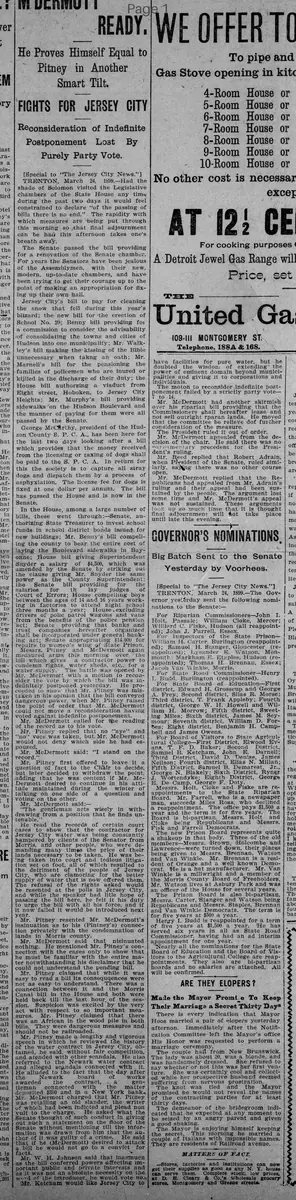
He Proves Himself Equal to Pitney in Another Smart Tilt.
FIGHTS FOR JERSEY CITY
Reconsideration of Indefinite Postponement Lost By Purely Party Vote.
[Special to "The Jersey City News."]
TRENTON. March 24, 1899.-Had the shade of Solomon visited the Legislative chambers of the State House any time during the past two days it would feel constrained to declare "of the passing of bills there is no end." The rapidity with which measures are being put through this morning so that final adjournment can be had this afternoon takes one's breath away.
The Senate passed the bill providing for a renovation of the Senate chamber. For years the Senators have been jealous of the Assemblymen, with their new, modern, up-to-date chambers, and have been trying to get their courage up to the point of making an appropriation for fixing up their own hall.
Jersey City's bill to pay for cleaning the snow that fell during this year's blizzard; the new bill for the erection of School No. 20; Benny's bill providing for a commission to consider the advisability of consolidating the towns and cities of Hudson into one municipality; Mr. Walkley's bill making the kissing of the Bible unnecessary when taking an oath; Mr. Marnell's bill for pensioning the families of policemen who are injured or killed in the discharge of their duty; the House bill authorizing a viaduct from Eighth street, Hoboken, to Jersey City Heights; Mr. Murphy's bill providing sidewalks on the Hudson Boulevard and the manner of paying for them were all passed by the Senate.
George McCarthy, president of the Hudson County S. P. C. A., has been here for the last two days looking after a bill which provides that the money received from the licensing or taxing of dogs shall be paid to the S. P. C. A. In return for this the society is to capture all stray dogs and dispatch them by a process of asphyxiation. The license fee for dogs is fixed at one dollar per annum. The bill has passed the House and is now in the Senate.
In the House, among a large number of bills, these went through: Senate bill authorizing State Treasurer to invest school funds in school district bonds issued for new buildings; Mr. Benny's bill compelling the county to bear the entire cost of laying the Boulevard sidewalks in Bayonne; House bill giving Superintendent Snyder a salary of $4,500, which was amended by the Senate by striking out the clause giving Mr. Snyder the same power as the County Superintendent; the Senate bill providing for the salaries for the lay judges of Court of Errors; House bill compelling boys between the ages of 14 and 16 years working in factories to attend night school three months a year; House bill excluding drivers of police patrol wagons and vans from the benefits of the police pension act; Senate bill providing that banks and trust companies hereafter organized shall be incorporated under general banking act; Senate bill appropriating $14,000 for repairs to women's wing of State Prison.
Messrs. Pitney and McDermott again measured arms this morning over the bill which gives a contractor power to condemn rights, water sheds, etc., for a water supply. The battle was opened by Mr. McDermott with a motion to reconsider the vote by which the bill was indefinitely postponed yesterday. He proceeded to show that Mr. Pitney was mistaken in his opinion that the bill conveyed dangerous power, when Mr. Pitney raised the point of order that Mr. McDermott could not move a reconsideration having voted against indefinite postponement.
Mr. McDermott called for the reading of the record as to his vote. Mr. Pitney replied that no "aye" and "no" vote was taken, but Mr. McDermott would not deny which side he had espoused.
Mr. McDermott said: "I stand on the record."
Mr. Pitney first offered to leave it a question of fact to the Chair to decide, but later decided to withdraw the point, adding that he was content if Mr. McDermott desired to continue in his attitude maintained during the winter of talking on one side of a question and voting on the other.
Mr. McDermott said:-
"The gentleman acts wisely in withdrawing from a position that he finds untenable."
He read the records of certain court cases to show that the contractor for Jersey City water was being constantly hampered by clients of the Senator from Morris, and other people, who were demanding many times the price of their lands necessary to be taken. He was being taken into court and tedious litigation set on foot, all of which resulted to the detriment of the people of Jersey City, who are clamoring for the better supply of water that is now offered them.
The refusal of the rights asked would be resented at the polls in Jersey City, and while the speaker had little hope of passing the bill here, he felt it his duty to urge the bill with all his force, and if it now failed it would be introduced next year.
Mr. Pitney resented Mr. McDermott's insinuation as to his (Pitney's) connection privately with the condemnation of lands in Morris county.
Mr. McDermott said that insinuated nothing. He mentioned Mr. Pitney's connection with the cases only to show that he must be familiar with the entire matter notwithstanding his disclaimer that he could not understand the pending bill.
Mr. Pitney claimed that while it was easy to read a bill its consequences were not as easy to understand. There was a connection between it and the Morris Canal bill in the House and both were held back till the last hour of the session. Suspicion was excited by the very act with respect to important measures. Mr. Pitney claimed that there was an African in the wood pile in both bills. They were dangerous measures and should not be railroaded.
Mr. Pitney made a lengthy and vigorous speech in which he reviewed the history the water contract Jersey obtained, he said, without fair competition, and attended with other scandals. He also referred to the Newark water contract and alleged scandals connected with it. He alluded to the fact that the day after the Newark board of works awarded the contract, a gentleman connected with the matter deposited $350 and in a New York bank.
Mr. McDermott charged that Mr. Pitney was retailing an old slander, the writer of which had been indicted and pleaded non vult the charge.
Senate thought of such conduct in giving out such a statement on the floor of the Senate without mentioning till the information was drawn from him that the author of it was guilty of a crime. He said that if he (McDermott) desired to attack a bill he would not go to a convict for facts.
Mr. W. H. Johnson said that inasmuch as the bill conferred powers affecting important public and private interests and as it was not an absolute necessity on the word of the introducer, he would vote no.
Mr. Ketcham would like Jersey City to have facilities for pure water, but he doubted the wisdom of extending the power of eminent domain beyond municipalities and giving it to corporations and individuals.
The motion to reconsider indefinite postponement failed by a strictly party vote- 7 to 14.
Mr. McDermott had another skirmish over his riparian bill providing that the Commissioners shall hereafter lease and not sell outright riparian lands. He moved that the committee be relieved of further consideration of the measure.
The President ruled it out of order. Mr. McDermott appealed from the decision of the chair. He said there was no parliamentary precedent for the President's ruling.
Mr. Reed replied that Robert Adrain, when President of the Senate, ruled similarly, saying there was no other course open.
Mr. McDermott replied that the Republicans had appealed from Mr. Adrain's ruling and their appeal had been sustained by the people. The argument lost some time and Mr. McDermott's appeal was not sustained. These arguments took up so much time that it is thought final adjournment will not take place until late this evening.
What sub-type of article is it?
What themes does it cover?
What keywords are associated?
What entities or persons were involved?
Where did it happen?
Story Details
Key Persons
Location
Trenton, New Jersey State House
Event Date
March 24, 1899
Story Details
The New Jersey Legislature passed numerous bills related to infrastructure, education, pensions, and public services, particularly benefiting Jersey City. A contentious debate ensued between Senators McDermott and Pitney over a bill granting contractors condemnation powers for water supply, involving accusations of scandals and procedural disputes, ultimately failing on a party-line vote. Additional arguments occurred over a riparian lands bill.