Thank you for visiting SNEWPapers!
Sign up free
Story
March 1, 1943
The Daily Monitor Leader
Mount Clemens, Macomb County, Michigan
What is this article about?
Thomas E. Dewey, New York's new Republican governor since January 1, earns respect from politicians for his administrative skills, smoothly passing budgets, tax reforms, and other measures amid a Democratic-dominated legacy, without major controversy.
Clipping
OCR Quality
98%
Excellent
Full Text
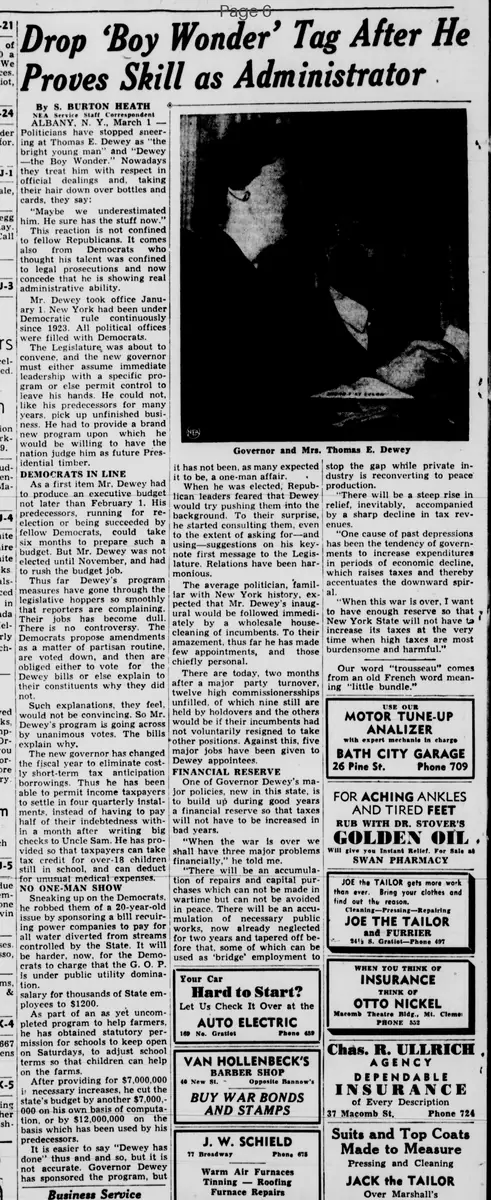
Drop 'Boy Wonder' Tag After He Proves Skill as Administrator
By Burton Heath
ALBANY, N. Y., March 1 - Politicians have stopped sneering at Thomas E. Dewey as "the bright young man" and "Dewey —the Boy Wonder." Nowadays they treat him with respect in official dealings and, taking their hair down over bottles and cards, they say: "Maybe we underestimated him. He sure has the stuff now."
This reaction is not confined to fellow Republicans. It comes also from Democrats who thought his talent was confined to legal prosecutions and now concede that he is showing real administrative ability.
Mr. Dewey took office January 1. New York had been under Democratic rule continuously since 1923. All political offices were filled with Democrats. The Legislature was about to convene, and the new governor must either assume immediate leadership with a specific program or else permit control to leave his hands. He could not, like his predecessors for many years, pick up unfinished business. He had to provide a brand new program upon which he would be willing to have the nation judge him as future Presidential timber.
DEMOCRATS IN LINE
As a first item Mr. Dewey had to produce an executive budget not later than February 1. His predecessors, running for re-election or being succeeded by fellow Democrats, could take six months to prepare such a budget. But Mr. Dewey was not elected until November, and had to rush the budget job.
Thus far Dewey's program measures have gone through the legislative hoppers so smoothly that reporters are complaining. Their jobs has become dull. There is no controversy. The Democrats propose amendments as a matter of partisan routine, are voted down, and then are obliged either to vote for the Dewey bills or else explain to their constituents why they did not.
Such explanations, they feel, would not be convincing. So Mr. Dewey's program is going across by unanimous votes. The bills explain why.
The new governor has changed the fiscal year to eliminate costly short-term tax anticipation borrowings. Thus he has been able to permit income taxpayers to settle in four quarterly installments. instead of having to pay half of their indebtedness within a month after writing big checks to Uncle Sam. He has provided so that taxpayers can take tax credit for over-18 children still in school, and can deduct for unusual medical expenses.
NO ONE-MAN SHOW
Sneaking up on the Democrats. he robbed them of a 20-year-old issue by sponsoring a bill requiring power companies to pay for all water diverted from streams controlled by the State. It will be harder, now, for the Democrats to charge that the G. O. P. is under public utility domination.
He raised salary for thousands of State employees to $1200.
As part of an as yet uncompleted program to help farmers. he has obtained statutory permission for schools to keep open on Saturdays, to adjust school terms so that children can help on the farms.
After providing for $7,000,000 in necessary increases, he cut the state's budget by another $7,000,000 on his own basis of computation, or by $12,000,000 on the basis which has been used by his predecessors.
It is easier to say "Dewey has done" thus and so, but it is not accurate. Governor Dewey has sponsored the program, but
When he was elected; Republican leaders feared that Dewey would try pushing them into the background. To their surprise. he started consulting them, even to the extent of asking for-and using-suggestions on his keynote first message to the Legislature. Relations have been harmonious.
The average politician, familiar with New York history, expected that Mr. Dewey's inaugural would be followed immediately by a wholesale house-cleaning of incumbents. To their amazement. thus far he has made few appointments, and those chiefly personal.
There are today, two months after a major party turnover, twelve high commissionerships unfilled. of which nine still are held by holdovers and the others would be if their incumbents had not voluntarily resigned to take other positions. Against this, five major jobs have been given to Dewey appointees.
FINANCIAL RESERVE
One of Governor Dewey's major policies, new in this state, is to build up during good years a financial reserve so that taxes will not have to be increased in bad years.
"When the war is over we shall have three major problems financially," he told me.
"There will be an accumulation of repairs and capital purchases which can not be made in wartime but can not be avoided in peace. There will be an accumulation of necessary public works, now already neglected for two years and tapered off before that. some of which can be used as 'bridge' employment to stop the gap while private industry is reconverting to peace production.
"There will be a steep rise in relief, inevitably, accompanied by a sharp decline in tax revenues.
"One cause of past depressions has been the tendency of governments to increase expenditures in periods of economic decline, which raises taxes and thereby accentuates the downward spiral.
"When this war is over. I want to have enough reserve so that New York State will not have ta increase its taxes at the very time when high taxes are most burdensome and harmful."
By Burton Heath
ALBANY, N. Y., March 1 - Politicians have stopped sneering at Thomas E. Dewey as "the bright young man" and "Dewey —the Boy Wonder." Nowadays they treat him with respect in official dealings and, taking their hair down over bottles and cards, they say: "Maybe we underestimated him. He sure has the stuff now."
This reaction is not confined to fellow Republicans. It comes also from Democrats who thought his talent was confined to legal prosecutions and now concede that he is showing real administrative ability.
Mr. Dewey took office January 1. New York had been under Democratic rule continuously since 1923. All political offices were filled with Democrats. The Legislature was about to convene, and the new governor must either assume immediate leadership with a specific program or else permit control to leave his hands. He could not, like his predecessors for many years, pick up unfinished business. He had to provide a brand new program upon which he would be willing to have the nation judge him as future Presidential timber.
DEMOCRATS IN LINE
As a first item Mr. Dewey had to produce an executive budget not later than February 1. His predecessors, running for re-election or being succeeded by fellow Democrats, could take six months to prepare such a budget. But Mr. Dewey was not elected until November, and had to rush the budget job.
Thus far Dewey's program measures have gone through the legislative hoppers so smoothly that reporters are complaining. Their jobs has become dull. There is no controversy. The Democrats propose amendments as a matter of partisan routine, are voted down, and then are obliged either to vote for the Dewey bills or else explain to their constituents why they did not.
Such explanations, they feel, would not be convincing. So Mr. Dewey's program is going across by unanimous votes. The bills explain why.
The new governor has changed the fiscal year to eliminate costly short-term tax anticipation borrowings. Thus he has been able to permit income taxpayers to settle in four quarterly installments. instead of having to pay half of their indebtedness within a month after writing big checks to Uncle Sam. He has provided so that taxpayers can take tax credit for over-18 children still in school, and can deduct for unusual medical expenses.
NO ONE-MAN SHOW
Sneaking up on the Democrats. he robbed them of a 20-year-old issue by sponsoring a bill requiring power companies to pay for all water diverted from streams controlled by the State. It will be harder, now, for the Democrats to charge that the G. O. P. is under public utility domination.
He raised salary for thousands of State employees to $1200.
As part of an as yet uncompleted program to help farmers. he has obtained statutory permission for schools to keep open on Saturdays, to adjust school terms so that children can help on the farms.
After providing for $7,000,000 in necessary increases, he cut the state's budget by another $7,000,000 on his own basis of computation, or by $12,000,000 on the basis which has been used by his predecessors.
It is easier to say "Dewey has done" thus and so, but it is not accurate. Governor Dewey has sponsored the program, but
When he was elected; Republican leaders feared that Dewey would try pushing them into the background. To their surprise. he started consulting them, even to the extent of asking for-and using-suggestions on his keynote first message to the Legislature. Relations have been harmonious.
The average politician, familiar with New York history, expected that Mr. Dewey's inaugural would be followed immediately by a wholesale house-cleaning of incumbents. To their amazement. thus far he has made few appointments, and those chiefly personal.
There are today, two months after a major party turnover, twelve high commissionerships unfilled. of which nine still are held by holdovers and the others would be if their incumbents had not voluntarily resigned to take other positions. Against this, five major jobs have been given to Dewey appointees.
FINANCIAL RESERVE
One of Governor Dewey's major policies, new in this state, is to build up during good years a financial reserve so that taxes will not have to be increased in bad years.
"When the war is over we shall have three major problems financially," he told me.
"There will be an accumulation of repairs and capital purchases which can not be made in wartime but can not be avoided in peace. There will be an accumulation of necessary public works, now already neglected for two years and tapered off before that. some of which can be used as 'bridge' employment to stop the gap while private industry is reconverting to peace production.
"There will be a steep rise in relief, inevitably, accompanied by a sharp decline in tax revenues.
"One cause of past depressions has been the tendency of governments to increase expenditures in periods of economic decline, which raises taxes and thereby accentuates the downward spiral.
"When this war is over. I want to have enough reserve so that New York State will not have ta increase its taxes at the very time when high taxes are most burdensome and harmful."
What sub-type of article is it?
Biography
Historical Event
Personal Triumph
What themes does it cover?
Triumph
Fortune Reversal
What keywords are associated?
Thomas Dewey
New York Governor
Administrative Success
Political Reform
Budget Cuts
Tax Relief
What entities or persons were involved?
Thomas E. Dewey
Where did it happen?
Albany, N. Y., New York State
Story Details
Key Persons
Thomas E. Dewey
Location
Albany, N. Y., New York State
Event Date
January 1
Story Details
Thomas E. Dewey, new Republican governor of New York, demonstrates administrative ability by quickly preparing and passing a budget, implementing tax reforms, sponsoring bills for utilities and farmers, cutting state spending, and maintaining harmonious relations with legislators, earning respect from both parties.