Thank you for visiting SNEWPapers!
Sign up free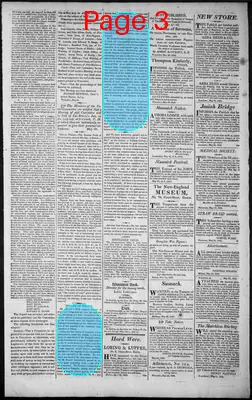
The Massachusetts Spy
Worcester, Worcester County, Massachusetts
What is this article about?
Commentary on John Quincy Adams's remarks criticizing Jonathan Russell's letter regarding the Treaty of Ghent negotiations, focusing on disputes over fisheries and Mississippi navigation rights among American commissioners.
Clipping
OCR Quality
Full Text
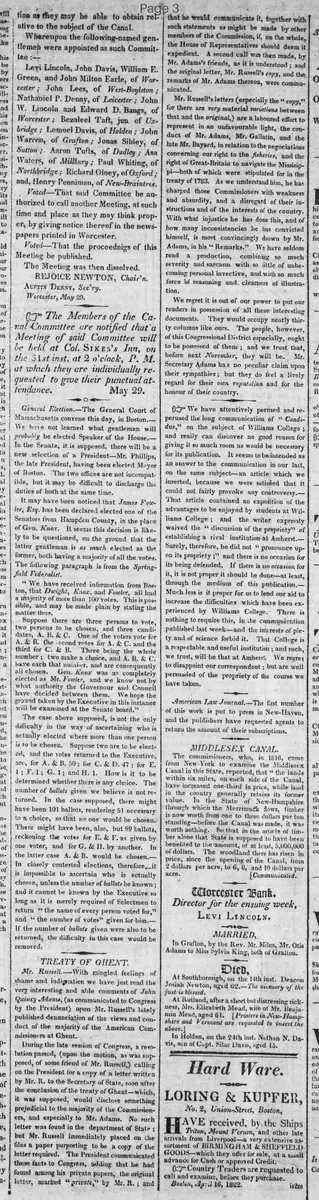
Mr. Russell.—With mingled feelings of shame and indignation we have just read the very interesting and able comments of John Quincy Adams, (as communicated to Congress by the President) upon Mr. Russell's lately published denunciation of the views and conduct of the majority of the American Commissioners at Ghent.
During the late session of Congress, a resolution passed, (upon the motion, as was supposed, of some friend of Mr. Russell,) calling on the President for a copy of a letter written by Mr. R. to the Secretary of State, soon after the conclusion of the treaty of Ghent—which, it was supposed, would disclose something prejudicial to the majority of the Commissioners, and especially to Mr. Adams. No such letter was found in the department of State; but Mr. Russell immediately placed on the files a paper purporting to be a copy of the letter required. The President communicated these facts to Congress, adding that he had found among his private papers, the original letter, marked "private," by Mr. R.; and that he would communicate it, together with such statements as might be made by other members of the Commission, if, on the whole, the House of Representatives should deem it expedient. A second call was then made, by Mr. Adams's friends, as it is understood; and the original letter, Mr. Russell's copy, and the remarks of Mr. Adams thereon, were communicated.
Mr. Russell's letters (especially the "copy," for there are very material variations between that and the original,) are a laboured effort to represent in an unfavourable light, the conduct of Mr. Adams, Mr. Gallatin, and the late Mr. Bayard, in relation to the negociations concerning our right to the fisheries, and the right of Great-Britain to navigate the Mississippi—both of which were stipulated for in the treaty of 1783. As we understand him, he has charged those Commissioners with weakness and absurdity, and a disregard of their instructions and of the interests of the country. With what injustice he has done this, and of how many inconsistencies he has convicted himself, is most convincingly shown by Mr. Adams, in his "Remarks." We have seldom read a production, combining so much severity and sarcasm with so little of unbecoming personal invective, and with so much force of reasoning and clearness of illustration.
We regret it is out of our power to put our readers in possession of all these interesting documents. They would occupy nearly thirty columns like ours. The people, however, of this Congressional District especially, ought to be possessed of them; and we trust that, before next November, they will be. Mr. Secretary Adams has no peculiar claim upon their sympathies; but they do feel a lively regard for their own reputation and for the honour of their country.
What sub-type of article is it?
What keywords are associated?
What entities or persons were involved?
Where did it happen?
Foreign News Details
Primary Location
Ghent
Event Date
Soon After The Conclusion Of The Treaty Of Ghent
Key Persons
Outcome
controversy over negotiations on fisheries rights and british navigation of the mississippi, as stipulated in the 1783 treaty; adams's remarks defend the commissioners and highlight russell's inconsistencies.
Event Details
Article discusses congressional inquiries into a letter by Mr. Russell criticizing the conduct of American commissioners (Adams, Gallatin, Bayard) during Treaty of Ghent negotiations. Russell's letter and copy vary, portraying the majority unfavorably on key issues. Adams's communicated remarks to Congress refute these charges with reasoning and sarcasm.