Thank you for visiting SNEWPapers!
Sign up free
National Gazette
Philadelphia, Philadelphia County, Pennsylvania
What is this article about?
In the French National Convention on April 13, a decree arrested Marat; Stingel, Miranda, Miazinski, and L'Ecuyer were sent to the revolutionary tribunal. Reports from General Dampierre and Valenciennes commissioners detailed army disorganization due to Dumourier, enemy movements against Conde, and firm republican defenses. Danton proposed non-interference in foreign governments and death penalty for negotiating with enemies on constitution. Marat complained of his arrest.
Clipping
OCR Quality
Full Text
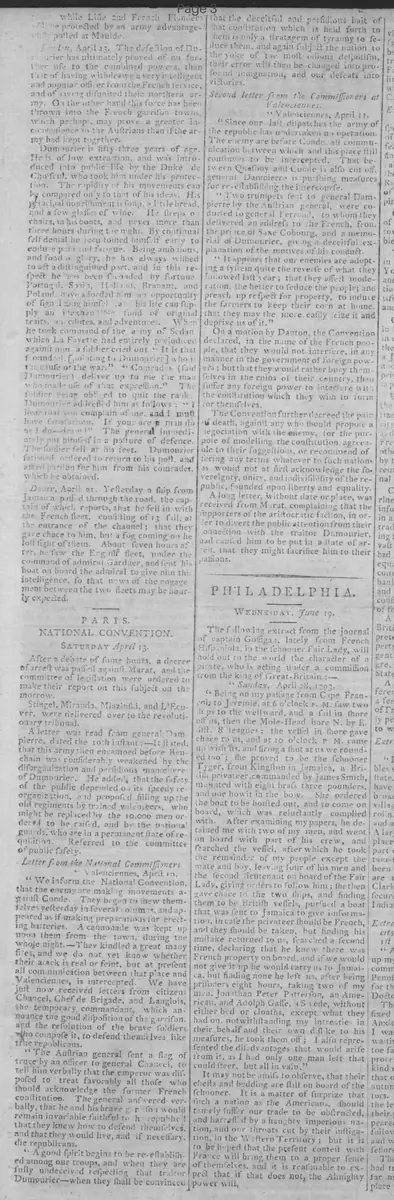
NATIONAL CONVENTION.
SATURDAY April 13.
After a debate of some hours, a decree of arrest was passed against Marat, and the committee of legislation were ordered to make their report on this subject on the morrow.
Stingel, Miranda, Miazinski, and L' Ecuyer, were delivered over to the revolutionary tribunal.
A letter was read from general Dampierre, dated the 10th instant: It stated, that this army then encamped before Bouchain was considerably weakened by the disorganization and perfidious manoeuvres of Dumourier. He added, that the safety of the public depended on its speedy re-organization, and proposed filling up the old regiments by trained volunteers, who might be replaced by the 30,000 men ordered to be raised, and by the national guards, who are in a permanent state of readiness of public safety.
Requisition. Referred to the committee.
Letter from the National Commissioners at Valenciennes, April 10.
"We inform the National Convention, that the enemy are making movements against Conde. They began to shew themselves yesterday in several columns, and appeared as if making preparations for erecting batteries. A cannonade was kept up upon them from the town, during the whole night. They kindled a great many fires, and we do not yet know whether their attack is real or feint, but at present all communication between that place and Valenciennes, is intercepted. We have just now received letters from citizens Chancel, Chef de Brigade, and Langlois, the temporary commandant, which announce the good disposition of the garrison, and the resolution of the brave soldiers who compose it, to defend themselves like true republicans.
The Austrian general sent a flag of truce by an officer to general Chancel, to tell him verbally that the emperor was disposed to treat favorably all those who should acknowledge the former French constitution. The general answered verbally, that he and his brave garrison would remain invariable faithful to the republic! that they knew how to defend themselves, and that they would live, and if necessary, die republicans.
A good spirit begins to be re-established among our troops, and when they are fully undevinced respecting that traitor Dumourier—when they shall be convinced that the deceitful and perfidious bait of that constitution which is held forth to them is only a stratagem of tyranny to seduce them, and again subject the nation to the yoke of the most odious despotism, their error will then be changed into profound indignation, and our defeats into victories."
Second letter from the Commissioners at Valenciennes.
Valenciennes, April 11.
"Since our last dispatches the army of the republic has undertaken no operation. The enemy are before Conde, all communication between which and this place still continues to be intercepted. That between Quesnoy and Conde is also cut off, general Dampierre is pursuing measures for re-establishing the intercourse.
Two trumpets sent to general Dampierre by the Austrian general, were conducted to general Ferrand, to whom they delivered an address to the French, from the prince of Saxe Cobourg, and a memorial of Dumourier, giving a deceitful explanation of the motives of his conduct.
It appears that our enemies are adopting a system quite the reverse of what they followed last year; that they affect moderation, the better to seduce the people; and preach up respect for property, to induce the farmers to keep their corn at home, that they may the more easily seize it and deprive us of it."
On a motion by Danton, the Convention declared, in the name of the French people, that they would not interfere, in any manner in the government of foreign powers; but that they would rather bury themselves in the ruins of their country, than suffer any foreign power to interfere with the constitution which they wish to form for themselves.
The Convention further decreed the pain of death, against any who should propose a negociation with the enemy, for the purpose of modelling the constitution agreeable to their suggestions, or recommend entering into any terms whatever to such nations as would not at first acknowledge the sovereignty, unity, and indivisibility of the republic, founded upon liberty and equality.
A long letter, without date or place, was received from Marat, complaining that the supporters of the aristocratic faction, in order to divert the public attention from their connection with the traitor Dumourier, had caused him to be put in a state of arrest, that they might sacrifice him to their passions.
What sub-type of article is it?
What keywords are associated?
What entities or persons were involved?
Where did it happen?
Foreign News Details
Primary Location
Paris
Event Date
April 13
Key Persons
Outcome
decree of arrest against marat; stingel, miranda, miazinski, and l'ecuyer delivered to revolutionary tribunal; convention declares non-interference in foreign governments and death penalty for negotiating with enemies on constitution; reports of enemy movements against conde repelled with cannonade, firm defenses by garrison.
Event Details
The National Convention debated and passed a decree arresting Marat, ordering a report on him. Several individuals were sent to the revolutionary tribunal. General Dampierre's letter reported army weakening due to Dumourier's maneuvers and proposed reorganization. Letters from Valenciennes described enemy preparations against Conde, intercepted communications, garrison's resolve, rejection of Austrian overtures, and improving troop morale. Danton's motion led to declarations against foreign interference and negotiations. Marat's letter complained of his arrest as a diversion from aristocratic ties to Dumourier.