Thank you for visiting SNEWPapers!
Sign up free
The New Hampshire Gazette
Portsmouth, Rockingham County, New Hampshire
What is this article about?
Report from Colonel Coote details the British siege and capture of Pondicherry, India, in January 1761 during the Seven Years' War. Involves land batteries, naval blockade by Admirals Stevens and Cornish, and French surrender under Lally after provisions ran out. Minimal casualties; garrison taken as prisoners.
Merged-components note: Continuation of the detailed report on the siege of Pondicherry and related documents from the London Gazette; the second component picks up directly from the text of the first.
Clippings
1 of 2
OCR Quality
Full Text
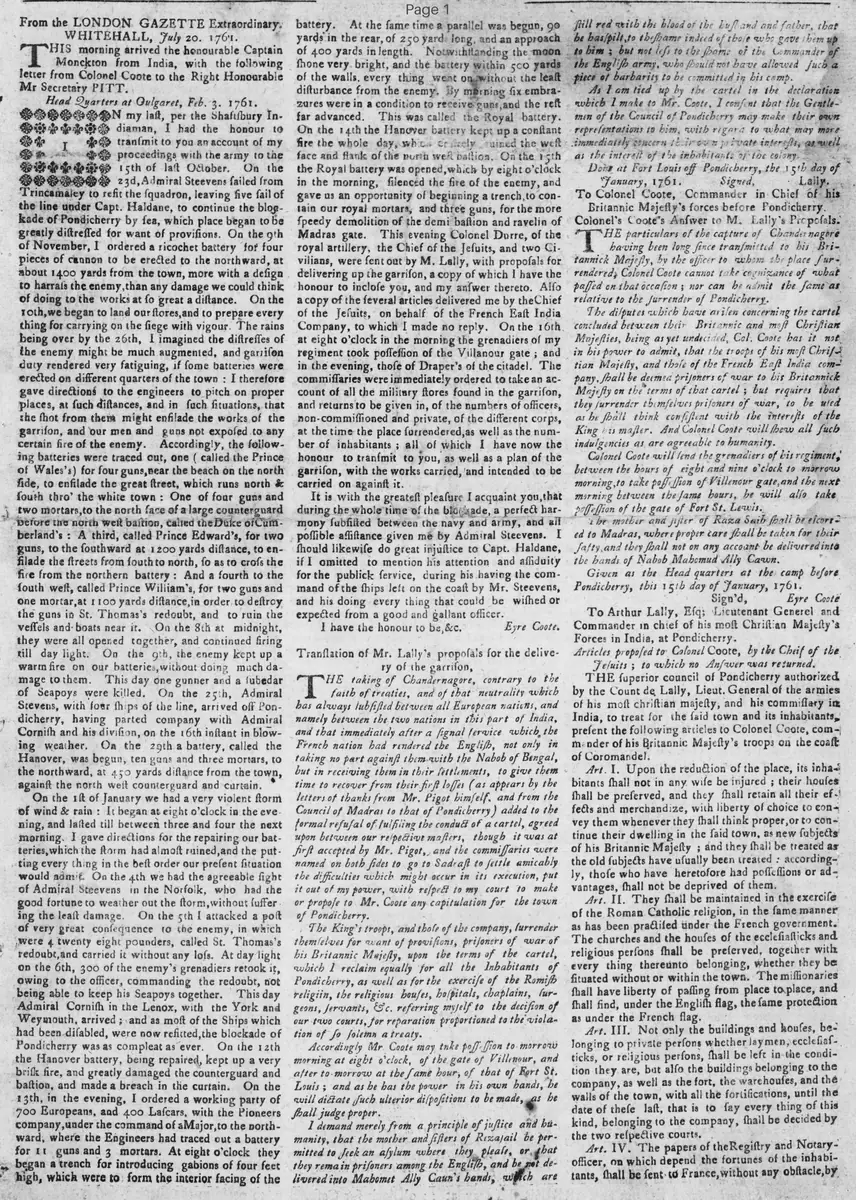
WHITEHALL. July 20. 1761.
This morning arrived the honourable Captain Monckton from India, with the following Letter from Colonel Coote to the Right Honourable Mr Secretary PITT.
Head Quarters at Cuddalore. Feb. 3. 1761.
Sir,
In my last, per the Shaftesbury East Indiaman, I had the honour to transmit to you an account of my above proceedings with the army to the Commodore 15th of last October. On the 23d, Admiral Stevens sailed from Trincomalee to refit the squadron, leaving five ships of the line under Capt. Haldane, to continue the blockade of Pondicherry by sea, which place began to be greatly distressed for want of provisions. On the 9th of November, I ordered a ricochet battery for four pieces of cannon to be erected to the northward, at about 1400 yards from the town, more with a design to harass the enemy, than any damage we could think of doing to the works at so great a distance. On the 10th, we began to land our stores, and to prepare every thing for carrying on the siege with vigour. The rains being over by the 26th, I imagined the distresses of the enemy might be much augmented, and garrison duty rendered very fatiguing, if some batteries were erected on different quarters of the town: I therefore gave directions to the engineers to pitch on proper places, at such distances, and in such situations, that the shot from them might enfilade the works of the garrison, and our men and guns not exposed to any certain fire of the enemy. Accordingly, the following batteries were traced out, one (called the Prince of Wales's) for four guns, near the beach on the north side, to enfilade the great street, which runs north and south thro' the white town: One of four guns and two mortars, to the north face of a large counterguard before the north west bastion, called the Duke of Cumberland's: A third, called Prince Edward's, for two guns, to the southward at 1200 yards distance, to enfilade the streets from south to north, so as to cross the fire from the northern battery: And a fourth to the south west, called Prince William's, for two guns and one mortar, at 1100 yards distance, in order to destroy the guns in St. Thomas's redoubt, and to ruin the vessels and boats near it. On the 8th at midnight, they were all opened together, and continued firing till day light. On the 9th, the enemy kept up a warm fire on our batteries, without doing much damage to them. This day one gunner and a Subedar of Seapoys were killed. On the 25th, Admiral Stevens, with four ships of the line, arrived off Pondicherry, having parted company with Admiral Cornish and his division, on the 16th instant in blowing weather. On the 29th a battery, called the Hanover, was begun, ten guns and three mortars, to the northward, at 450 yards distance from the town, against the north west counterguard and curtain. On the 1st of January we had a very violent storm of wind & rain: It began at eight o'clock in the evening, and lasted till between three and four the next morning. I gave directions for the repairing our batteries, which the storm had almost ruined, and the putting every thing in the best order our present situation would admit. On the 4th we had the agreeable sight of Admiral Stevens in the Norfolk, who had the good fortune to weather out the storm, without suffering the least damage. On the 5th I attacked a post of very great consequence to the enemy, in which were 4 twenty eight pounders, called St. Thomas's redoubt, and carried it without any loss. At day light on the 6th, 300 of the enemy's grenadiers retook it, owing to the officer, commanding the redoubt, not being able to keep his Seapoys together. This day Admiral Cornish in the Lenox, with the York and Weymouth, arrived; and as most of the Ships which had been disabled, were now refitted, the blockade of Pondicherry was as complete as ever. On the 12th the Hanover battery, being repaired, kept up a very brisk fire, and greatly damaged the counterguard and bastion, and made a breach in the curtain. On the 13th, in the evening, I ordered a working party of 700 Europeans, and 400 Lacars, with the Pioneers company, under the command of a Major, to the northward, where the Engineers had traced out a battery for 11 guns and 3 mortars. At eight o'clock they began a trench for introducing gabions of four feet high, which were to form the interior facing of the battery. At the same time a parallel was begun, 90 yards in the rear, of 290 yards long, and an approach of 400 yards in length. Notwithstanding the moon shone very bright, and the battery within 200 yards of the walls, every thing went on without the least disturbance from the enemy. By morning six embrasures were in a condition to receive guns, and the rest far advanced. This was called the Royal battery. On the 14th the Hanover battery kept up a constant fire the whole day, which entirely ruined the west face and flank of the north west bastion. On the 15th the Royal battery was opened, which by eight o'clock in the morning, silenced the fire of the enemy, and gave us an opportunity of beginning a trench, to contain our royal mortars, and three guns, for the more speedy demolition of the demi bastion and ravelin of Madras gate. This evening Colonel Durre, of the royal artillery, the Chief of the Jesuits, and two Civilians, were sent out by M. Lally, with proposals for delivering up the garrison, a copy of which I have the honour to enclose you, and my answer thereto. Also a copy of the several articles delivered me by the Chief of the Jesuits, on behalf of the French East India Company, to which I made no reply. On the 16th at eight o'clock in the morning the grenadiers of my regiment took possession of the Villenour gate; and in the evening, those of Draper's of the citadel. The commissaries were immediately ordered to take an account of all the military stores found in the garrison, and returns to be given in, of the numbers of officers, non-commissioned and private, of the different corps, at the time the place surrendered, as well as the number of inhabitants: all of which I have now the honour to transmit to you, as well as a plan of the garrison, with the works carried, and intended to be carried on against it.
It is with the greatest pleasure I acquaint you, that during the whole time of the blockade, a perfect harmony subsisted between the navy and army, and all possible assistance given me by Admiral Stevens. I should likewise do great injustice to Capt. Haldane, if I omitted to mention his attention and assiduity for the public service, during his having the command of the ships left on the coast by Mr. Stevens, and his doing every thing that could be wished or expected from a good and gallant officer.
I have the honour to be, &c.
Eyre Coote.
Translation of Mr. Lally's proposals for the delivery of the garrison.
The taking by violence, contrary to the treaty of the garrison, has always subsisted between all European nations, and namely between the two nations in this part of India, and that immediately after a signal service which the French nation had rendered the English, not only in taking no part against them with the Nabob of Bengal, but in receiving them in their settlements, to give them time to recover from their first losses (as appears by the letters of thanks from Mr. Pigot himself, and from the Council of Madras to that of Pondicherry) added to the formal refusal of fulfilling the conduct of a cartel, agreed upon between our respective masters, though it was at first accepted by Mr. Pigot, and the commissaries were named on both sides to go to Sadras to settle amicably the difficulties which might occur in its execution, put it out of my power, with respect to my court to make or propose to Mr. Coote any capitulation for the town of Pondicherry.
The King's troops, and those of the company, surrender themselves for want of provisions, prisoners of war of his Britannic Majesty, upon the terms of the cartel, which I reclaim equally for all the Inhabitants of Pondicherry, as well as for the exercise of the Romish religion, the religious houses, hospitals, chaplains, surgeons, servants, &c. referring myself to the decision of our two courts, for reparation proportioned to the violation of so solemn a treaty.
Accordingly Mr. Coote may take possession to-morrow morning at eight o'clock, of the gate of Villenour, and after to-morrow at the same hour, of that of Fort St. Louis; and as he has the power in his own hands, he will dictate such ulterior dispositions to be made, as he shall judge proper.
I demand merely from a principle of justice and humanity, that the mother and sisters of Raza Saib be permitted to seek an asylum where they please, or that they remain prisoners among the English, and be not delivered into Mahomet Ally Caun's hands, which are still red with the blood of the husband and father, that he has spilt, to the shame indeed of those who gave them up to him; but not less to the shame of the Commander of the English army, who should not have allowed such a piece of barbarity to be committed in his camp.
As I am tied up by the cartel in the declaration which I make to Mr. Coote, I consent that the Gentlemen of the Council of Pondicherry may make their own representations to him, with regard to what may more immediately concern their own private interests, as well as the interest of the inhabitants of the colony.
Done at Fort Louis of Pondicherry, the 15th day of January, 1761.
Signed, Lally.
To Colonel Coote, Commander in Chief of his Britannic Majesty's forces before Pondicherry.
Colonel Coote's Answer to M. Lally's Proposals.
The particulars of the capture of Chandernagore having been long since transmitted to his Britannic Majesty, by the officer to whom the place surrendered, Colonel Coote cannot take cognizance of what passed on that occasion; nor can he admit the same as relative to the surrender of Pondicherry.
The disputes which have arisen concerning the cartel concluded between their Britannic and most Christian Majesties, being as yet undecided, Col. Coote has it not in his power to admit, that the troops of his most Christian Majesty, and those of the French East India company, shall be deemed prisoners of war to his Britannic Majesty on the terms of that cartel; but requires that they surrender themselves prisoners of war, to be used as he shall think consistent with the interests of the King his master. And Colonel Coote will show all such indulgencies as are agreeable to humanity.
Colonel Coote will send the grenadiers of his regiment, between the hours of eight and nine o'clock to morrow morning, to take possession of Villenour gate, and the next morning between the same hours, he will also take possession of the gate of Fort St. Louis.
The mother and sister of Raza Saib shall be escorted to Madras, where proper care shall be taken for their safety, and they shall not on any account be delivered into the hands of Nabob Mahomud Ally Cawn.
Given at the Head quarters at the camp before Pondicherry, this 15th day of January, 1761.
Sign'd, Eyre Coote
To Arthur Lally, Esq; Lieutenant General and Commander in chief of his most Christian Majesty's Forces in India, at Pondicherry.
Articles proposed to Colonel Coote, by the Chief of the Jesuits; to which no Answer was returned.
THE superior council of Pondicherry authorized by the Count de Lally, Lieut. General of the armies of his most Christian Majesty, and his commissary in India, to treat for the said town and its inhabitants, present the following articles to Colonel Coote, commander of his Britannic Majesty's troops on the coast of Coromandel.
Art. I. Upon the reduction of the place, its inhabitants shall not in any wise be injured; their houses shall be preserved, and they shall retain all their effects and merchandize, with liberty of choice to convey them whenever they shall think proper, or to continue their dwelling in the said town, as new subjects of his Britannic Majesty: and they shall be treated as the old subjects have usually been treated: accordingly, those who have heretofore had possessions or advantages, shall not be deprived of them.
Art. II. They shall be maintained in the exercise of the Roman Catholic religion, in the same manner as has been practised under the French government. The churches and the houses of the ecclesiastics and religious persons shall be preserved, together with every thing thereunto belonging, whether they be situated without or within the town. The missionaries shall have liberty of passing from place to place, and shall find, under the English flag, the same protection as under the French flag.
Art. III. Not only the buildings and houses belonging to private persons whether laymen, ecclesiastics, or religious persons, shall be left in the condition they are, but also the buildings belonging to the company, as well as the fort, the warehouses, and the walls of the town, with all the fortifications, until the fate of these last, that is to say every thing of this kind, belonging to the company, shall be decided by the two respective courts.
Art. IV. The papers of the Registry and Notary-officer, on which depend the fortunes of the inhabitants, shall be sent to France, without any obstacle, by
such conveyance as they shall think fit, who are now charged with them, and in whose possession they shall, in the mean time, remain.
Art. V. The treatment herein before stipulated by the first article, for the inhabitants of Pondicherry, shall be extended to all the members of the council company's agents, officers settled in the said town, and all others who have been or now are in service of the company, and so in like manner to the merchants, whether Armenians, or of any other nation, settled heretofore in Pondicherry for their trade.
Art. VI. The Creoles, or natives of Mauritius and of Bourbon, amounting in number to forty one, including five officers, as well those who are in health, as those who have been wounded, or are invalids, having served as volunteers, and not being soldiers, should have the liberty of returning to their home by the first good opportunity they may find:
Art. VII. Safe guards shall be granted to prevent disorder.
Art. VIII. All the foregoing Articles shall be executed agreeable to good faith.
A true copy,
Francis Rowland, Secr.
What sub-type of article is it?
What keywords are associated?
What entities or persons were involved?
Where did it happen?
Foreign News Details
Primary Location
Pondicherry
Event Date
Events From October 1760 To January 16, 1761; Letter Dated February 3, 1761
Key Persons
Outcome
one gunner and a subedar of seapoys killed; french garrison surrendered as prisoners of war due to lack of provisions; british took possession of villenour gate and fort st. louis; terms included protections for inhabitants and religion, but coote rejected full cartel terms.
Event Details
British forces under Colonel Coote conducted a siege of Pondicherry starting in October 1760, with naval blockade by ships under Captain Haldane and later Admirals Stevens and Cornish. Batteries including Prince of Wales's, Duke of Cumberland's, Prince Edward's, Prince William's, Hanover, and Royal were constructed and fired upon the town. After storms and assaults, including temporary capture and retaking of St. Thomas's redoubt, the French under Lally proposed surrender on January 15, 1761, citing lack of provisions. Coote accepted possession on January 16, with French troops as prisoners not under disputed cartel terms. Jesuits proposed articles for inhabitants' protection, to which no reply was given.