Thank you for visiting SNEWPapers!
Sign up free
Story
March 3, 1897
The Fairfield News And Herald
Winnsboro, Fairfield County, South Carolina
What is this article about?
An editorial critiques sensationalism in preaching, noting how it mirrors societal trends and detracts from spiritual focus. Examples include Gales' meetings disrupted by police matters and Atlanta ministers debating bicycle-riding girls, urging preachers to address real sins over personal tastes.
Clipping
OCR Quality
98%
Excellent
Full Text
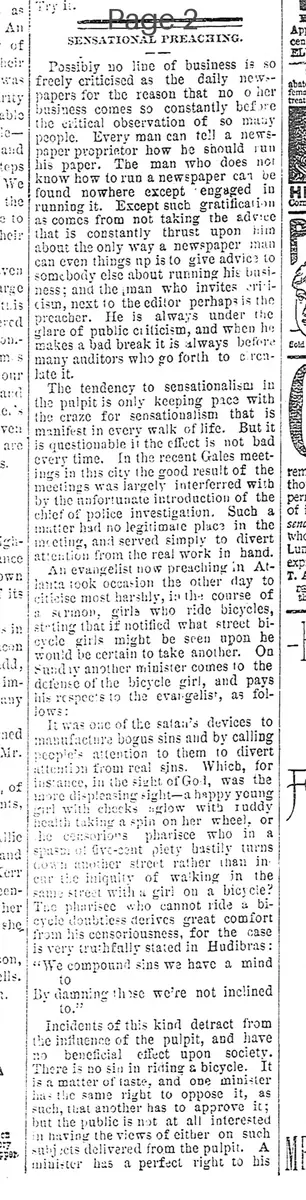
SENSATIONAL PREACHING.
Possibly no line of business is so freely criticised as the daily newspapers for the reason that no other business comes so constantly before the critical observation of so many people. Every man can tell a newspaper proprietor how he should run his paper. The man who does not know how to run a newspaper can be found nowhere except engaged in running it. Except such gratification as comes from not taking the advice that is constantly thrust upon him about the only way a newspaper man can even things up is to give advice to somebody else about running his business; and the man who invites criticism, next to the editor perhaps is the preacher. He is always under the glare of public criticism, and when he makes a bad break it is always before many auditors who go forth to circulate it. The tendency to sensationalism in the pulpit is only keeping pace with the craze for sensationalism that is manifest in every walk of life. But it is questionable if the effect is not bad every time. In the recent Gales meetings in this city the good result of the meetings was largely interfered with by the unfortunate introduction of the chief of police investigation. Such a matter had no legitimate place in the meeting, and served simply to divert attention from the real work in hand. An evangelist now preaching in Atlanta took occasion the other day to criticise most harshly, in the course of a sermon, girls who ride bicycles, stating that if notified what street bicycle girls might be seen upon he would be certain to take another. On Sunday another minister comes to the defense of the bicycle girl, and pays his respects to the evangelist, as follows: It was one of the satan's devices to manufacture bogus sins and by calling people's attention to them to divert attention from real sins. Which, for instance, in the sight of God, was the more displeasing sight—a happy young girl with cheeks aglow with ruddy health taking a spin on her wheel, or the censorious pharisee who in a spasm of five-cent piety hastily turns down another street rather than incur the iniquity of walking in the same street with a girl on a bicycle? The pharisee who cannot ride a bicycle doubtless derives great comfort from his censoriousness, for the case is very truthfully stated in Hudibras: "We grant although he had much wit H' was very shy of using it, As being loth to wear it out, And therefore bore it not about Unless on holidays or so, As men their best apparel do." Besides, as a general thing, he has so little to do that it is a recreation to him to raise a dust. Incidents of this kind detract from the influence of the pulpit, and have no beneficial effect upon society. There is no sin in riding a bicycle. It is a matter of taste, and one minister has the same right to oppose it, as such, that another has to approve it; but the public is not at all interested in having the views of either on such subjects delivered from the pulpit. A minister has a perfect right to his opinion in all current topics and fashions, and a perfect right to express his opinion, under proper conditions, but he should not seek to give to his individual opinion the weight of Biblical or divine disapproval and inhibition. There is no lack of sin in the world, that ministers need to go running for offences against their ideas of good taste. We will be nearing the millennium when preachers have nothing more serious to attack than riding bicycles.
Possibly no line of business is so freely criticised as the daily newspapers for the reason that no other business comes so constantly before the critical observation of so many people. Every man can tell a newspaper proprietor how he should run his paper. The man who does not know how to run a newspaper can be found nowhere except engaged in running it. Except such gratification as comes from not taking the advice that is constantly thrust upon him about the only way a newspaper man can even things up is to give advice to somebody else about running his business; and the man who invites criticism, next to the editor perhaps is the preacher. He is always under the glare of public criticism, and when he makes a bad break it is always before many auditors who go forth to circulate it. The tendency to sensationalism in the pulpit is only keeping pace with the craze for sensationalism that is manifest in every walk of life. But it is questionable if the effect is not bad every time. In the recent Gales meetings in this city the good result of the meetings was largely interfered with by the unfortunate introduction of the chief of police investigation. Such a matter had no legitimate place in the meeting, and served simply to divert attention from the real work in hand. An evangelist now preaching in Atlanta took occasion the other day to criticise most harshly, in the course of a sermon, girls who ride bicycles, stating that if notified what street bicycle girls might be seen upon he would be certain to take another. On Sunday another minister comes to the defense of the bicycle girl, and pays his respects to the evangelist, as follows: It was one of the satan's devices to manufacture bogus sins and by calling people's attention to them to divert attention from real sins. Which, for instance, in the sight of God, was the more displeasing sight—a happy young girl with cheeks aglow with ruddy health taking a spin on her wheel, or the censorious pharisee who in a spasm of five-cent piety hastily turns down another street rather than incur the iniquity of walking in the same street with a girl on a bicycle? The pharisee who cannot ride a bicycle doubtless derives great comfort from his censoriousness, for the case is very truthfully stated in Hudibras: "We grant although he had much wit H' was very shy of using it, As being loth to wear it out, And therefore bore it not about Unless on holidays or so, As men their best apparel do." Besides, as a general thing, he has so little to do that it is a recreation to him to raise a dust. Incidents of this kind detract from the influence of the pulpit, and have no beneficial effect upon society. There is no sin in riding a bicycle. It is a matter of taste, and one minister has the same right to oppose it, as such, that another has to approve it; but the public is not at all interested in having the views of either on such subjects delivered from the pulpit. A minister has a perfect right to his opinion in all current topics and fashions, and a perfect right to express his opinion, under proper conditions, but he should not seek to give to his individual opinion the weight of Biblical or divine disapproval and inhibition. There is no lack of sin in the world, that ministers need to go running for offences against their ideas of good taste. We will be nearing the millennium when preachers have nothing more serious to attack than riding bicycles.
What sub-type of article is it?
Curiosity
What themes does it cover?
Social Manners
Moral Virtue
What keywords are associated?
Sensational Preaching
Bicycle Girls
Pulpit Criticism
Evangelist Sermon
Moral Diversion
What entities or persons were involved?
Gales
Atlanta Evangelist
Defending Minister
Where did it happen?
Atlanta
Story Details
Key Persons
Gales
Atlanta Evangelist
Defending Minister
Location
Atlanta
Story Details
Critique of sensational preaching diverting from real sins, exemplified by Gales meetings mentioning police investigation and ministers debating bicycle-riding as sin versus taste.