Thank you for visiting SNEWPapers!
Sign up free
Literary
October 20, 1911
Essex County Herald
Island Pond, Guildhall, Essex County, Vermont
What is this article about?
In this excerpt from Anna Katharine Green's mystery novel, the narrator discovers his betrothed Adelaide strangled in a remote house. He hides from arriving police, then reveals himself, claiming ignorance. Questioned by the coroner, he admits a secret love for her sister Carmel and a failed elopement plan, while a compromising note is found.
Merged-components note: Merged image into the serialized story due to spatial overlap with one of the story's bounding boxes.
Clipping
OCR Quality
85%
Good
Full Text
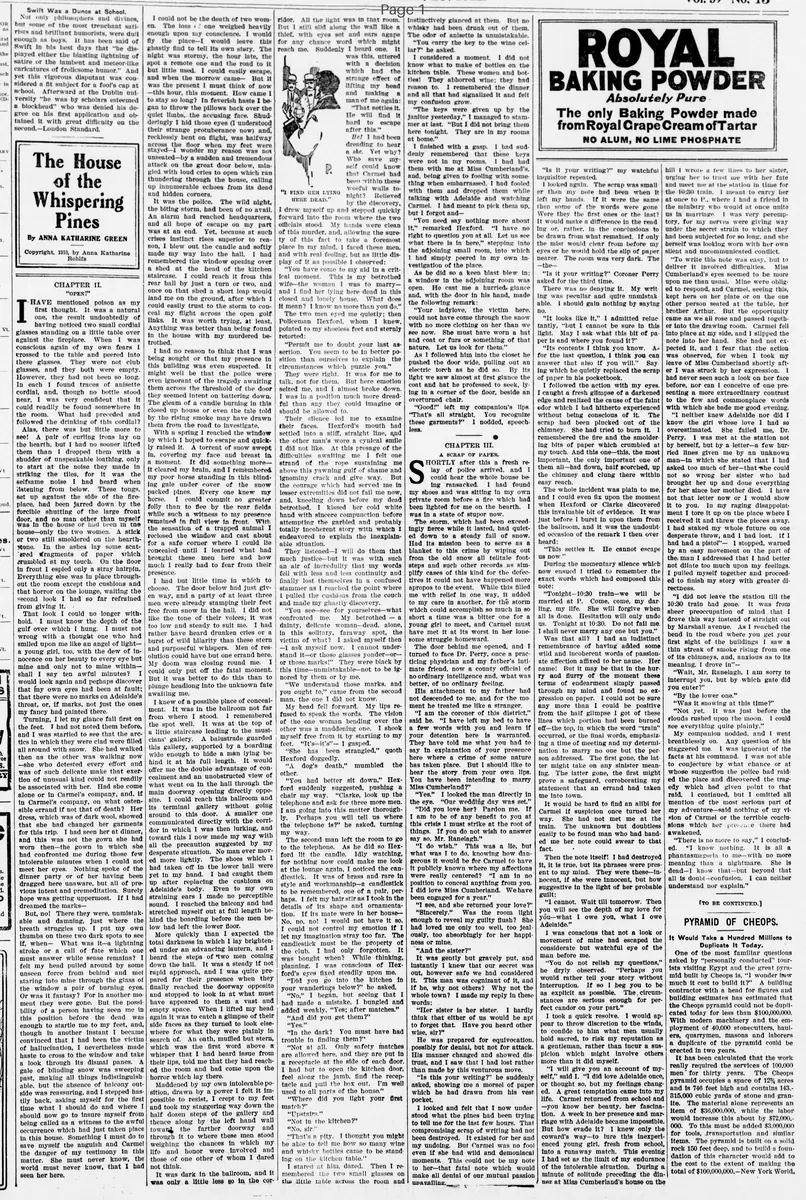
The House
of the
Whispering
Pines
By ANNA KATHARINE GREEN
Copyright, 1910, by Anna Katharine Rohlfs
CHAPTER II
"OPEN!"
I have mentioned poison as my first thought. It was a natural one, the result undoubtedly of having noticed two small cordial glasses standing on a little table over against the fireplace. When I was conscious again of my own fears I crossed to the table and peered into these glasses. They were not club glasses, and they both were empty. However, they had not been so long. In each I found traces of anisette cordial, and, though no bottle stood near, I was very confident that it could readily be found somewhere in the room. What had preceded and followed the drinking of this cordial? Alas, there was but little more to see! A pair of curling irons lay on the hearth, but I had no sooner lifted them than I dropped them with a shudder of unspeakable loathing, only to start at the noise they made in striking the tiles, for it was the selfsame noise I had heard when listening from below. These tongs, set up against the side of the fireplace, had been jarred down by the forcible shutting of the large front door, and no man other than myself was in the house or had been in the house-only the two women. A stick or two still smoldered on the hearth yonder. In the ashes lay some scattered fragments of paper which crumbled at my touch. On the floor in front I espied only a stray hairpin. Everything else was in place throughout the room except the cushions and that horror on the lounge, waiting the second look I had so far refrained from giving it.
That look I could no longer withhold. I must know the depth of the gulf over which I hung. I must not wrong with a thought one who had smiled upon me like an angel of light a young girl, too, with the dew of innocence on her beauty to every eye but mine and only not to mine within- shall I say ten awful minutes? I would look again and perhaps discover that my own eyes had been at fault: that there were no marks on Adelaide's throat, or, if marks, not just the ones my fancy had painted there.
Turning, I let my glance fall first on the feet. I had not noted them before, and I was startled to see that the arctics in which they were clad were filled all around with snow. She had walked then as the other was walking now -she who detested every effort and was of such delicate make that exertion of unusual kind could not readily be associated with her. Had she come alone or in Carmel's company, and, if in Carmel's company, on what ostensible errand if not that of death? Her dress, which was of dark wool, showed that she had changed her garments for this trip. I had seen her at dinner, and this was not the gown she had worn then-the gown in which she had confronted me during those few intolerable minutes when I could not meet her eyes. Nothing spoke of the dinner party or of her having been dragged here unaware, but all of previous intent and premeditation. Surely hope was getting uppermost. If I had dreamed the marks-
But, no! There they were, unmistakable and damning, just where the breath struggles up. I put my own thumbs on these two dark spots to see if, when- What was it-a lightning stroke or a call of fate which one must answer while sense remains? I felt my head pulled around by some unseen force from behind and met staring into mine through the glass of the window a pair of burning eyes. Or was it fantasy? For in another moment they were gone. But the possibility of a person having seen me in this position before the dead was enough to startle me to my feet, and, though in another instant I became convinced that I had been the victim of hallucination, I nevertheless made haste to cross to the window and take a look through its dismal panes. A gale of blinding snow was sweeping past, making all things indistinguishable, but the absence of balcony outside was reassuring, and I stepped hastily back, asking myself for the first time what I should do and where I should now go to insure myself from being called as a witness to the awful occurrence which had just taken place in this house. Something I must do to save myself the anguish and Carmel the danger of my testimony in this matter. She must never know, the world must never know, that I had seen her here.
I could not be the death of two women. The loss of one weighed heavily enough upon my conscience. I would fly the place-I would leave this ghastly find to tell its own story. The night was stormy, the hour late, the spot a remote one and the road to it but little used. I could easily escape and when the morrow came-
But I was the present I must think of now -this hour, this moment. How came I to stay so long? In feverish haste I began to throw the pillows back over the quiet limbs, the accusing face. Shudderingly I hid those eyes (I understood their strange protuberance now) and recklessly bent on flight, was halfway across the floor when my feet were stayed-I wonder my reason was not unseated-by a sudden and tremendous attack on the great door below, mingled with loud cries to open which ran thundering through the house, calling up innumerable echoes from its dead and hidden corners.
It was the police. The wild night the biting storm, had been of no avail. An alarm had reached headquarters, and all hope of escape on my part was at an end. Yet, because at such crises instinct rises superior to reason, I blew out the candle and softly made my way into the hall. I had remembered the window opening over a shed at the head of the kitchen staircase. I could reach it from this rear hall by just a turn or two, and once on that shed a short leap would land me on the ground, after which I could easily trust to the storm to conceal my flight across the open golf links. It was worth trying, at least. Anything was better than being found in the house with my murdered betrothed.
I had no reason to think that I was being sought or that my presence in this building was even suspected. It might well be that the police were even ignorant of the tragedy awaiting them across the threshold of the door they seemed intent on battering down. The gleam of a candle burning in this closed up house or even the tale told by the rising smoke may have drawn them from the road to investigate. With a spring I reached the window by which I hoped to escape and quickly raised it. A torrent of snow swept in, covering my face and breast in a moment. It did something more- it cleared my brain, and I remembered my poor horse standing in this blinding gale under cover of the snow packed pines. Every one knew my horse. I could commit no greater folly than to flee by the rear fields while such a witness to my presence remained in full view in front. With the sensation of a trapped animal I reclosed the window and cast about for a safe corner where I could lie concealed until I learned what had brought these men here and how much I really had to fear from their presence.
I had but little time in which to choose. The door below had just given way, and a party of at least three men were already stamping their feet free from snow in the hall. I did not like the tone of their voices; it was too low and steady to suit me. I had rather have heard drunken cries or a burst of wild hilarity than these stern and purposeful whispers. Men of resolution could have but one errand here. My doom was closing round me. I could only put off the fatal moment. But it was better to do this than to plunge headlong into the unknown fate awaiting me.
I knew of a possible place of concealment. It was in the ballroom not far from where I stood. I remembered the spot well. It was at the top of a little staircase leading to the musicians' gallery. A balustrade guarded this gallery, supported by a boarding wide enough to hide a man lying behind it at his full length. It would offer me the double advantage of concealment and an unobstructed view of what went on in the hall through the main doorway opening directly opposite. I could reach this ballroom and its terminal gallery without going around to this door. A smaller one communicated directly with the corridor in which I was then lurking, and toward this I now made my way with all the precaution suggested by my desperate situation. No man ever moved more lightly. The shoes which I had taken off in the lower hall were yet in my hand. I had caught them up after replacing the cushions on Adelaide's body. Even to my own straining ears I made no perceptible sound. I reached the balcony and had stretched myself out at full length behind the boarding before the men below had left the lower floor.
More quickly than I expected the total darkness in which I lay brightened under an advancing lantern, and I heard the steps of two men coming down the hall. It was a steady if not rapid approach, and I was quite prepared for their presence when they finally reached the doorway opposite and stopped to look in at what must have appeared to them a vast and empty space. When I lifted my head again it was to catch a glimpse of their side faces as they turned to look elsewhere for what they were plainly in search of. An oath, muffled but stern, which was the first word above a whisper that I had heard issue from their lips, told me that they had reached the room and had come upon the horror which lay there.
Maddened by my own intolerable position, drawn by a power I felt it impossible to resist, I crept to my feet and took my staggering way down the half dozen steps of the gallery and thence along by the left hand wall toward the farther doorway and through it to where these men stood weighing the chances in which my life and honor were involved and those of one other of whom I dared not think.
It was dark in the ballroom, and it was only a little less so in the corridor. All the light was in that room. But I still slid along the wall like a thief, with eyes set and ears agape for any chance word which might reach me. Suddenly I heard one. It was this, uttered with a decision which had the strange effect of lifting my head and making a man of me again:
"That settles it. He will find it hard to escape after this."
Yet I had been dreading to hear a she. Yet why? Who save my- self could know that Carmel had been within these woeful walls to-
"I FIND HER LYING HERE DEAD."
Relieved by the discovery, I drew myself up and stepped quickly forward into the room where the two officials stood. My hands were clean of this murder, and, allowing the surety of this fact to take a foremost place in my mind, I faced these men, and with real feeling, but as little display of it as possible I observed:
"You have come to my aid in a critical moment. This is my betrothed wife-the woman I was to marry- and I find her lying here dead in this closed and lonely house. What does it mean? I know no more than you do."
The two men eyed me quietly; then Policeman Hexford, whom I knew, pointed to my shoeless feet and sternly retorted:
"Permit me to doubt your last assertion. You seem to be in better position than ourselves to explain the circumstances which puzzle you."
They were right. It was for me to talk, not for them. But here emotion seized me, and I almost broke down. I was in a position much more dreadful than any they could imagine or should be allowed to Their silence led me to examine their faces. Hexford's mouth had settled into a stiff, straight line, and the other man's wore a cynical smile I did not like. At this presage of the difficulties awaiting me I felt one strand of the rope sustaining me above this yawning gulf of shame and ignominy crack and give way. But the courage which had served me in lesser extremities did not fail me now, and, kneeling down before my dead betrothed, I kissed her cold white hand with sincere compunction before attempting the garbled and probably totally incoherent story with which I endeavored to explain the inexplicable situation.
They listened-I will do them that much justice-but it was with such an air of incredulity that my words fell with less and less continuity and finally lost themselves in a confused stammer as I reached the point where I pulled the cushions from the couch and made my ghastly discovery.
"You see-see for yourselves-what confronted me. My betrothed - a dainty, delicate woman-dead, alone, in this solitary, faraway spot, the victim of what? I asked myself then -I ask myself now. I cannot understand it-or those glasses yonder-or- or those marks!" They were black by this time-unmistakable-not to be ignored by them or by me.
"We understand those marks, and you ought to," came from the second man, the one I did not know.
My head fell forward. My lips refused to speak the words. The vision of the one woman bending over the other was a maddening one. I shook myself free from it by starting to my feet. "It's-it's"- I gasped.
"She has been strangled," quoth Hexford doggedly.
"A dog's death," mumbled the other.
"You had better sit down." Hexford suddenly suggested, pushing a chair my way. "Clarke, look up the telephone and ask for three more men. I am going into this matter thoroughly. Perhaps you will tell us where the telephone is?" he asked, turning my way.
The second man left the room to go to the telephone. As he did so Hexford lit the candle. Idly watching, for nothing now could make me look at the lounge again, I noticed the candlestick. It was of brass and rare in style and workmanship-a candlestick to be remembered, one of a pair, perhaps. I felt my hair stir as I took in the details of its shape and ornamentation. If its mate were in her house- No, no, no! I would not have it so. I could not control my emotion if I let my imagination stray too far. The candlestick must be the property of the club. I had only forgotten. It was bought when? While thinking, planning, I was conscious of Hexford's eyes fixed steadily upon me.
"Did you go into the kitchen in your wanderings below?" he asked.
"No," I began, but seeing that I had made a mistake, I bungled and added weakly, "Yes; after matches."
"And did you get them?"
"Yes."
"In the dark? You must have had trouble in finding them?"
"Not at all. Only safety matches are allowed here, and they are put in a receptacle at the side of each door. I had but to open the kitchen door, feel along the jamb, find the receptacle and pull the box out. I'm well used to all parts of the house."
"Where did you light your first match?"
"Upstairs."
"Not in the kitchen?"
"No, sir."
"That's a pity. I thought you might be able to tell me how so many wine and whisky bottles came to be standing on the kitchen table."
I stared at him, dazed. Then I remembered the two small glasses on the little table across the room and instinctively glanced at them. But no whisky had been drunk out of them. The odor of anisette is unmistakable.
"You carry the key to the wine cellar?" he asked.
I considered a moment. I did not know what to make of bottles on the kitchen table. These women and bottles! They abhorred wine; they had reason to. I remembered the dinner and all that had signalized it and felt my confusion grow.
"The keys were given up by the janitor yesterday," I managed to stammer at last. "But I did not bring them here tonight. They are in my rooms at home."
I finished with a gasp. I had suddenly remembered that these keys were not in my rooms. I had had them with me at Miss Cumberland's, and, being given to fooling with something when embarrassed, I had fooled with them and dropped them while talking with Adelaide and watching Carmel. I had meant to pick them up, but I forgot and-
"You need say nothing more about it," remarked Hexford. "I have no right to question you at all. Let us see what there is in here," stepping into the adjoining small room, into which I had simply peered in my own investigation of the place.
As he did so a keen blast blew in: a window in the adjoining room was open. He cast me a hurried glance and, with the door in his hand, made the following remark:
"Your ladylove, the victim here, could not have come through the snow with no more clothing on her than we see now. She must have worn a hat and coat or furs or something of that nature. Let us look for them"
As I followed him into the closet he pushed the door wide, pulling out an electric torch as he did so. By its light we saw almost at first glance the coat and hat he professed to seek, lying in a corner of the floor, beside an overturned chair.
"Good!" left my companion's lips. "That's all straight. You recognize these garments?" I nodded, speechless.
CHAPTER III.
A SCRAP OF PAPER
Shortly after this a fresh relay of police arrived, and I could hear the whole house being ransacked. I had found my shoes and was sitting in my own private room before a fire which had been lighted for me on the hearth. I was in a state of stupor now. The storm, which had been exceedingly fierce while it lasted, had quieted down to a steady fall of snow. Had its mission been to serve as a blanket to this crime by wiping out from the old snow all telltale footsteps and such other records as simplify cases of this kind for the detectives It could not have happened more apropos to the event. While this filled me with relief in one way, it added to my care in another, for the storm which could accomplish so much in so short a time was a bitter one for a young girl to meet, and Carmel must have met it at its worst in her lonesome struggle homeward.
The door behind me opened, and I turned to face Dr. Perry, once a practicing physician and my father's intimate friend, now a county official of no ordinary intelligence and, what was better, of no ordinary feeling. His attachment to my father had not descended to me, and for the moment he treated me like a stranger.
"I am the coroner of this district," said he. "I have left my bed to have a few words with you and learn if your detention here is warranted. They have told me what you had to say in explanation of your presence here where a crime of some nature has taken place. But I should like to hear the story from your own lips. You have been intending to marry Miss Cumberland?"
"Yes." I looked the man directly in the eye. "Our wedding day was set."
"Did you love her? Pardon me. If I am to be of any benefit to you at this crisis I must strike at the root of things. If you do not wish to answer say so, Mr. Ranelagh."
"I do wish." This was a lie, but what was I to do, knowing how dangerous it would be for Carmel to have it publicly known where my affections were really centered? "I am in no position to conceal anything from you. I did love Miss Cumberland. We have been engaged for a year."
"I see, and she returned your love?"
"Sincerely." Was the room light enough to reveal my guilty flush? She had loved me only too well, too jealously, too absorbingly for her happiness or mine.
"And the sister?"
It was gently but gravely put, and instantly I knew that our secret was out, however safe we had considered it. This man was cognizant of it, and if he, why not others? Why not the whole town? I made my reply in these words:
"Her sister is her sister. I hardly think that either of us would be apt to forget that. Have you heard otherwise, sir?"
He was prepared for equivocation, possibly for denial, but not for attack. His manner changed and showed distrust, and I saw that I had lost rather than made by this venturous move.
"Is this your writing?" he suddenly asked, showing me a morsel of paper which he had drawn from his vest pocket.
I looked and felt that I now understood what the pines had been trying to tell me for the last few hours. That compromising scrap of writing had not been destroyed. It existed for her and my undoing. But Carmel was no fool even if she had wild and demoniacal moments. This could not be my note to her-that fatal note which would make all denial of our mutual passion unavailing.
"Is it your writing?" my watchful inquisitor repeated.
I looked again. The scrap was smaller than my note had been when it left my hands. If it were the same then some of the words were gone. Were they the first ones or the last? It would make a difference in the reading or, rather, in the conclusions to be drawn from what remained. If only the mist would clear from before my eyes or he would hold the slip of paper nearer. The room was very dark. The -
"Is it your writing?" Coroner Perry asked for the third time.
There was no denying it. My writing was peculiar and quite unmistakable. I should gain nothing by saying no.
"It looks like it," I admitted reluctantly, "but I cannot be sure in this light. May I ask what this bit of paper is and where you found it?"
"Its contents I think you know. As for the last question, I think you can answer that also if you will." Saying which he quietly replaced the scrap of paper in his pocketbook.
I followed the action with my eyes. I caught a fresh glimpse of a darkened edge and realized the cause of the faint odor which I had hitherto experienced without being conscious of it. The scrap had been plucked out of the chimney. She had tried to burn it. I remembered the fire and the smoldering bits of paper which crumbled at my touch. And this one-this, the most important, the only important one of them all-had flown, half scorched, up the chimney and clung there within easy reach.
The whole incident was plain to me, and I could even fix upon the moment when Hexford or Clarke discovered this invaluable bit of evidence. It was just before I burst in upon them from the ballroom, and it was the undoubted occasion of the remark I then overheard:
"This settles it. He cannot escape us now."
During the momentary silence which now ensued I tried to remember the exact words which had composed this note:
"Tonight-10:30 train-we will be married at P. Come, come, my darling, my life. She will forgive when all is done. Hesitation will only undo us. Tonight at 10:30. Do not fail me. I shall never marry any one but you."
Was that all? I had an indistinct remembrance of having added some wild and incoherent words of passionate affection affixed to her name. Her name! But it may be that in the hurry and flurry of the moment these terms of endearment simply passed through my mind and found no expression on paper. I could not be sure any more than I could be positive from the half glimpse I got of these lines which portion had been burned off-the top, in which the word "train" occurred, or the final words, emphasizing a time of meeting and my determination to marry no one but the person addressed. The first gone, the latter might take on any sinister meaning. The latter gone, the first might prove a safeguard, corroborating my statement that an errand had taken me into town.
It would be hard to find an alibi for Carmel if suspicion once turned her way. She had not met me at the train. The unknown but doubtless easily to be found man who had handed me her note could swear to that fact.
Then the note itself! I had destroyed it, it is true, but its phrases were present to my mind. They were these-innocent, if she were innocent, but how suggestive in the light of her probable guilt:
"I cannot. Wait till tomorrow. Then you will see the depth of my love for you-what I owe you, what I owe Adelaide."
I was conscious that not a look or movement of mine had escaped the considerate but watchful eye of the man before me.
"You do not relish my questions," he dryly observed. "Perhaps you would rather tell your story without interruption. If so I beg you to be as explicit as possible. The circumstances are serious enough for perfect candor on your part."
I took a quick resolve. I would appear to throw discretion to the winds, to confide to him what men usually hold sacred, to risk my reputation as a gentleman, rather than incur a suspicion which might involve others more than it did myself.
"I will give you an account of myself," said I. "I did love Adelaide once, or thought so, but my feelings changed. A great temptation came into my life. Carmel returned from school and -you know her beauty, her fascination. A week in her presence and marriage with Adelaide became impossible. But how evade it? I knew only the coward's way-to lure this inexperienced young girl, fresh from school, into a runaway match. This evening I had set as the limit of my endurance of the intolerable situation. During a minute of solitude preceding the dinner at Miss Cumberland's house on the hill I wrote a few lines to her sister, urging her to trust me with her fate and meet me at the station in time for the 10:30 train. I meant to carry her at once to P., where I had a friend in the ministry who would at once unite us in marriage. I was very peremptory, for my nerves were giving way under the secret strain to which they had been subjected for so long, and she herself was looking worn with her own silent and uncommunicated conflict.
"To write this note was easy, but to deliver it involved difficulties. Miss Cumberland's eyes seemed to be more upon me than usual. Mine were obliged to respond, and Carmel, seeing this, kept hers on her plate or on the one other person seated at the table, her brother Arthur. But the opportunity came as we all rose and passed together into the drawing room. Carmel fell into place at my side, and I slipped the note into her hand. She had not expected it, and I fear that the action was observed, for when I took my leave of Miss Cumberland shortly after I was struck by her expression. I had never seen such a look on her face before, nor can I conceive of one presenting a more extraordinary contrast to the few and commonplace words with which she bade me good evening.
"I neither knew Adelaide nor did I know the girl whose love I had so overestimated. She failed me, Dr. Perry. I was met at the station not by herself, but by a letter-a few hurried lines given me by an unknown man-in which she stated that I had asked too much of her-that she could not so wrong her sister who had brought her up and done everything for her since her mother died. I have not that letter now or I would show it to you. In my raging disappointment I tore it up on the place where I received it and threw the pieces away. I had staked my whole future on one desperate throw, and I had lost. If I had had a pistol"- I stopped, warned by an easy movement on the part of the man I addressed that I had better not dilate too much upon my feelings. I pulled myself together and proceeded to finish my story with greater directness.
"I did not leave the station till the 10:30 train had gone. It was from sheer preoccupation of mind that I drove this way instead of straight out by Marshall avenue. As I reached the bend in the road where you get your first sight of the buildings I saw a thin streak of smoke rising from one of its chimneys, and, anxious as to its meaning, I drove in"-
"Wait, Mr. Ranelagh, I am sorry to interrupt you, but by which gate did you enter?"
"By the lower one."
"Was it snowing at this time?"
"Not yet. It was just before the clouds rushed upon the moon. I could see everything quite plainly."
My companion nodded, and I went breathlessly on. Any question of his staggered me. I was ignorant of the facts at his command. I was not able to conjecture by what chance or at whose suggestion the police had raided the place and discovered the tragedy which had given point to that raid. I continued, but I omitted all mention of the most serious part of my adventure-said nothing of my vision of Carmel or the terrible conclusions which her presence there had awakened.
"There is no more to say," I concluded. "I know nothing. It is all a phantasmagoria to me with no more meaning than a nightmare. She is dead-I know that-but beyond that all is doubt-confusion. I can neither understand nor explain."
[To be continued.]
of the
Whispering
Pines
By ANNA KATHARINE GREEN
Copyright, 1910, by Anna Katharine Rohlfs
CHAPTER II
"OPEN!"
I have mentioned poison as my first thought. It was a natural one, the result undoubtedly of having noticed two small cordial glasses standing on a little table over against the fireplace. When I was conscious again of my own fears I crossed to the table and peered into these glasses. They were not club glasses, and they both were empty. However, they had not been so long. In each I found traces of anisette cordial, and, though no bottle stood near, I was very confident that it could readily be found somewhere in the room. What had preceded and followed the drinking of this cordial? Alas, there was but little more to see! A pair of curling irons lay on the hearth, but I had no sooner lifted them than I dropped them with a shudder of unspeakable loathing, only to start at the noise they made in striking the tiles, for it was the selfsame noise I had heard when listening from below. These tongs, set up against the side of the fireplace, had been jarred down by the forcible shutting of the large front door, and no man other than myself was in the house or had been in the house-only the two women. A stick or two still smoldered on the hearth yonder. In the ashes lay some scattered fragments of paper which crumbled at my touch. On the floor in front I espied only a stray hairpin. Everything else was in place throughout the room except the cushions and that horror on the lounge, waiting the second look I had so far refrained from giving it.
That look I could no longer withhold. I must know the depth of the gulf over which I hung. I must not wrong with a thought one who had smiled upon me like an angel of light a young girl, too, with the dew of innocence on her beauty to every eye but mine and only not to mine within- shall I say ten awful minutes? I would look again and perhaps discover that my own eyes had been at fault: that there were no marks on Adelaide's throat, or, if marks, not just the ones my fancy had painted there.
Turning, I let my glance fall first on the feet. I had not noted them before, and I was startled to see that the arctics in which they were clad were filled all around with snow. She had walked then as the other was walking now -she who detested every effort and was of such delicate make that exertion of unusual kind could not readily be associated with her. Had she come alone or in Carmel's company, and, if in Carmel's company, on what ostensible errand if not that of death? Her dress, which was of dark wool, showed that she had changed her garments for this trip. I had seen her at dinner, and this was not the gown she had worn then-the gown in which she had confronted me during those few intolerable minutes when I could not meet her eyes. Nothing spoke of the dinner party or of her having been dragged here unaware, but all of previous intent and premeditation. Surely hope was getting uppermost. If I had dreamed the marks-
But, no! There they were, unmistakable and damning, just where the breath struggles up. I put my own thumbs on these two dark spots to see if, when- What was it-a lightning stroke or a call of fate which one must answer while sense remains? I felt my head pulled around by some unseen force from behind and met staring into mine through the glass of the window a pair of burning eyes. Or was it fantasy? For in another moment they were gone. But the possibility of a person having seen me in this position before the dead was enough to startle me to my feet, and, though in another instant I became convinced that I had been the victim of hallucination, I nevertheless made haste to cross to the window and take a look through its dismal panes. A gale of blinding snow was sweeping past, making all things indistinguishable, but the absence of balcony outside was reassuring, and I stepped hastily back, asking myself for the first time what I should do and where I should now go to insure myself from being called as a witness to the awful occurrence which had just taken place in this house. Something I must do to save myself the anguish and Carmel the danger of my testimony in this matter. She must never know, the world must never know, that I had seen her here.
I could not be the death of two women. The loss of one weighed heavily enough upon my conscience. I would fly the place-I would leave this ghastly find to tell its own story. The night was stormy, the hour late, the spot a remote one and the road to it but little used. I could easily escape and when the morrow came-
But I was the present I must think of now -this hour, this moment. How came I to stay so long? In feverish haste I began to throw the pillows back over the quiet limbs, the accusing face. Shudderingly I hid those eyes (I understood their strange protuberance now) and recklessly bent on flight, was halfway across the floor when my feet were stayed-I wonder my reason was not unseated-by a sudden and tremendous attack on the great door below, mingled with loud cries to open which ran thundering through the house, calling up innumerable echoes from its dead and hidden corners.
It was the police. The wild night the biting storm, had been of no avail. An alarm had reached headquarters, and all hope of escape on my part was at an end. Yet, because at such crises instinct rises superior to reason, I blew out the candle and softly made my way into the hall. I had remembered the window opening over a shed at the head of the kitchen staircase. I could reach it from this rear hall by just a turn or two, and once on that shed a short leap would land me on the ground, after which I could easily trust to the storm to conceal my flight across the open golf links. It was worth trying, at least. Anything was better than being found in the house with my murdered betrothed.
I had no reason to think that I was being sought or that my presence in this building was even suspected. It might well be that the police were even ignorant of the tragedy awaiting them across the threshold of the door they seemed intent on battering down. The gleam of a candle burning in this closed up house or even the tale told by the rising smoke may have drawn them from the road to investigate. With a spring I reached the window by which I hoped to escape and quickly raised it. A torrent of snow swept in, covering my face and breast in a moment. It did something more- it cleared my brain, and I remembered my poor horse standing in this blinding gale under cover of the snow packed pines. Every one knew my horse. I could commit no greater folly than to flee by the rear fields while such a witness to my presence remained in full view in front. With the sensation of a trapped animal I reclosed the window and cast about for a safe corner where I could lie concealed until I learned what had brought these men here and how much I really had to fear from their presence.
I had but little time in which to choose. The door below had just given way, and a party of at least three men were already stamping their feet free from snow in the hall. I did not like the tone of their voices; it was too low and steady to suit me. I had rather have heard drunken cries or a burst of wild hilarity than these stern and purposeful whispers. Men of resolution could have but one errand here. My doom was closing round me. I could only put off the fatal moment. But it was better to do this than to plunge headlong into the unknown fate awaiting me.
I knew of a possible place of concealment. It was in the ballroom not far from where I stood. I remembered the spot well. It was at the top of a little staircase leading to the musicians' gallery. A balustrade guarded this gallery, supported by a boarding wide enough to hide a man lying behind it at his full length. It would offer me the double advantage of concealment and an unobstructed view of what went on in the hall through the main doorway opening directly opposite. I could reach this ballroom and its terminal gallery without going around to this door. A smaller one communicated directly with the corridor in which I was then lurking, and toward this I now made my way with all the precaution suggested by my desperate situation. No man ever moved more lightly. The shoes which I had taken off in the lower hall were yet in my hand. I had caught them up after replacing the cushions on Adelaide's body. Even to my own straining ears I made no perceptible sound. I reached the balcony and had stretched myself out at full length behind the boarding before the men below had left the lower floor.
More quickly than I expected the total darkness in which I lay brightened under an advancing lantern, and I heard the steps of two men coming down the hall. It was a steady if not rapid approach, and I was quite prepared for their presence when they finally reached the doorway opposite and stopped to look in at what must have appeared to them a vast and empty space. When I lifted my head again it was to catch a glimpse of their side faces as they turned to look elsewhere for what they were plainly in search of. An oath, muffled but stern, which was the first word above a whisper that I had heard issue from their lips, told me that they had reached the room and had come upon the horror which lay there.
Maddened by my own intolerable position, drawn by a power I felt it impossible to resist, I crept to my feet and took my staggering way down the half dozen steps of the gallery and thence along by the left hand wall toward the farther doorway and through it to where these men stood weighing the chances in which my life and honor were involved and those of one other of whom I dared not think.
It was dark in the ballroom, and it was only a little less so in the corridor. All the light was in that room. But I still slid along the wall like a thief, with eyes set and ears agape for any chance word which might reach me. Suddenly I heard one. It was this, uttered with a decision which had the strange effect of lifting my head and making a man of me again:
"That settles it. He will find it hard to escape after this."
Yet I had been dreading to hear a she. Yet why? Who save my- self could know that Carmel had been within these woeful walls to-
"I FIND HER LYING HERE DEAD."
Relieved by the discovery, I drew myself up and stepped quickly forward into the room where the two officials stood. My hands were clean of this murder, and, allowing the surety of this fact to take a foremost place in my mind, I faced these men, and with real feeling, but as little display of it as possible I observed:
"You have come to my aid in a critical moment. This is my betrothed wife-the woman I was to marry- and I find her lying here dead in this closed and lonely house. What does it mean? I know no more than you do."
The two men eyed me quietly; then Policeman Hexford, whom I knew, pointed to my shoeless feet and sternly retorted:
"Permit me to doubt your last assertion. You seem to be in better position than ourselves to explain the circumstances which puzzle you."
They were right. It was for me to talk, not for them. But here emotion seized me, and I almost broke down. I was in a position much more dreadful than any they could imagine or should be allowed to Their silence led me to examine their faces. Hexford's mouth had settled into a stiff, straight line, and the other man's wore a cynical smile I did not like. At this presage of the difficulties awaiting me I felt one strand of the rope sustaining me above this yawning gulf of shame and ignominy crack and give way. But the courage which had served me in lesser extremities did not fail me now, and, kneeling down before my dead betrothed, I kissed her cold white hand with sincere compunction before attempting the garbled and probably totally incoherent story with which I endeavored to explain the inexplicable situation.
They listened-I will do them that much justice-but it was with such an air of incredulity that my words fell with less and less continuity and finally lost themselves in a confused stammer as I reached the point where I pulled the cushions from the couch and made my ghastly discovery.
"You see-see for yourselves-what confronted me. My betrothed - a dainty, delicate woman-dead, alone, in this solitary, faraway spot, the victim of what? I asked myself then -I ask myself now. I cannot understand it-or those glasses yonder-or- or those marks!" They were black by this time-unmistakable-not to be ignored by them or by me.
"We understand those marks, and you ought to," came from the second man, the one I did not know.
My head fell forward. My lips refused to speak the words. The vision of the one woman bending over the other was a maddening one. I shook myself free from it by starting to my feet. "It's-it's"- I gasped.
"She has been strangled," quoth Hexford doggedly.
"A dog's death," mumbled the other.
"You had better sit down." Hexford suddenly suggested, pushing a chair my way. "Clarke, look up the telephone and ask for three more men. I am going into this matter thoroughly. Perhaps you will tell us where the telephone is?" he asked, turning my way.
The second man left the room to go to the telephone. As he did so Hexford lit the candle. Idly watching, for nothing now could make me look at the lounge again, I noticed the candlestick. It was of brass and rare in style and workmanship-a candlestick to be remembered, one of a pair, perhaps. I felt my hair stir as I took in the details of its shape and ornamentation. If its mate were in her house- No, no, no! I would not have it so. I could not control my emotion if I let my imagination stray too far. The candlestick must be the property of the club. I had only forgotten. It was bought when? While thinking, planning, I was conscious of Hexford's eyes fixed steadily upon me.
"Did you go into the kitchen in your wanderings below?" he asked.
"No," I began, but seeing that I had made a mistake, I bungled and added weakly, "Yes; after matches."
"And did you get them?"
"Yes."
"In the dark? You must have had trouble in finding them?"
"Not at all. Only safety matches are allowed here, and they are put in a receptacle at the side of each door. I had but to open the kitchen door, feel along the jamb, find the receptacle and pull the box out. I'm well used to all parts of the house."
"Where did you light your first match?"
"Upstairs."
"Not in the kitchen?"
"No, sir."
"That's a pity. I thought you might be able to tell me how so many wine and whisky bottles came to be standing on the kitchen table."
I stared at him, dazed. Then I remembered the two small glasses on the little table across the room and instinctively glanced at them. But no whisky had been drunk out of them. The odor of anisette is unmistakable.
"You carry the key to the wine cellar?" he asked.
I considered a moment. I did not know what to make of bottles on the kitchen table. These women and bottles! They abhorred wine; they had reason to. I remembered the dinner and all that had signalized it and felt my confusion grow.
"The keys were given up by the janitor yesterday," I managed to stammer at last. "But I did not bring them here tonight. They are in my rooms at home."
I finished with a gasp. I had suddenly remembered that these keys were not in my rooms. I had had them with me at Miss Cumberland's, and, being given to fooling with something when embarrassed, I had fooled with them and dropped them while talking with Adelaide and watching Carmel. I had meant to pick them up, but I forgot and-
"You need say nothing more about it," remarked Hexford. "I have no right to question you at all. Let us see what there is in here," stepping into the adjoining small room, into which I had simply peered in my own investigation of the place.
As he did so a keen blast blew in: a window in the adjoining room was open. He cast me a hurried glance and, with the door in his hand, made the following remark:
"Your ladylove, the victim here, could not have come through the snow with no more clothing on her than we see now. She must have worn a hat and coat or furs or something of that nature. Let us look for them"
As I followed him into the closet he pushed the door wide, pulling out an electric torch as he did so. By its light we saw almost at first glance the coat and hat he professed to seek, lying in a corner of the floor, beside an overturned chair.
"Good!" left my companion's lips. "That's all straight. You recognize these garments?" I nodded, speechless.
CHAPTER III.
A SCRAP OF PAPER
Shortly after this a fresh relay of police arrived, and I could hear the whole house being ransacked. I had found my shoes and was sitting in my own private room before a fire which had been lighted for me on the hearth. I was in a state of stupor now. The storm, which had been exceedingly fierce while it lasted, had quieted down to a steady fall of snow. Had its mission been to serve as a blanket to this crime by wiping out from the old snow all telltale footsteps and such other records as simplify cases of this kind for the detectives It could not have happened more apropos to the event. While this filled me with relief in one way, it added to my care in another, for the storm which could accomplish so much in so short a time was a bitter one for a young girl to meet, and Carmel must have met it at its worst in her lonesome struggle homeward.
The door behind me opened, and I turned to face Dr. Perry, once a practicing physician and my father's intimate friend, now a county official of no ordinary intelligence and, what was better, of no ordinary feeling. His attachment to my father had not descended to me, and for the moment he treated me like a stranger.
"I am the coroner of this district," said he. "I have left my bed to have a few words with you and learn if your detention here is warranted. They have told me what you had to say in explanation of your presence here where a crime of some nature has taken place. But I should like to hear the story from your own lips. You have been intending to marry Miss Cumberland?"
"Yes." I looked the man directly in the eye. "Our wedding day was set."
"Did you love her? Pardon me. If I am to be of any benefit to you at this crisis I must strike at the root of things. If you do not wish to answer say so, Mr. Ranelagh."
"I do wish." This was a lie, but what was I to do, knowing how dangerous it would be for Carmel to have it publicly known where my affections were really centered? "I am in no position to conceal anything from you. I did love Miss Cumberland. We have been engaged for a year."
"I see, and she returned your love?"
"Sincerely." Was the room light enough to reveal my guilty flush? She had loved me only too well, too jealously, too absorbingly for her happiness or mine.
"And the sister?"
It was gently but gravely put, and instantly I knew that our secret was out, however safe we had considered it. This man was cognizant of it, and if he, why not others? Why not the whole town? I made my reply in these words:
"Her sister is her sister. I hardly think that either of us would be apt to forget that. Have you heard otherwise, sir?"
He was prepared for equivocation, possibly for denial, but not for attack. His manner changed and showed distrust, and I saw that I had lost rather than made by this venturous move.
"Is this your writing?" he suddenly asked, showing me a morsel of paper which he had drawn from his vest pocket.
I looked and felt that I now understood what the pines had been trying to tell me for the last few hours. That compromising scrap of writing had not been destroyed. It existed for her and my undoing. But Carmel was no fool even if she had wild and demoniacal moments. This could not be my note to her-that fatal note which would make all denial of our mutual passion unavailing.
"Is it your writing?" my watchful inquisitor repeated.
I looked again. The scrap was smaller than my note had been when it left my hands. If it were the same then some of the words were gone. Were they the first ones or the last? It would make a difference in the reading or, rather, in the conclusions to be drawn from what remained. If only the mist would clear from before my eyes or he would hold the slip of paper nearer. The room was very dark. The -
"Is it your writing?" Coroner Perry asked for the third time.
There was no denying it. My writing was peculiar and quite unmistakable. I should gain nothing by saying no.
"It looks like it," I admitted reluctantly, "but I cannot be sure in this light. May I ask what this bit of paper is and where you found it?"
"Its contents I think you know. As for the last question, I think you can answer that also if you will." Saying which he quietly replaced the scrap of paper in his pocketbook.
I followed the action with my eyes. I caught a fresh glimpse of a darkened edge and realized the cause of the faint odor which I had hitherto experienced without being conscious of it. The scrap had been plucked out of the chimney. She had tried to burn it. I remembered the fire and the smoldering bits of paper which crumbled at my touch. And this one-this, the most important, the only important one of them all-had flown, half scorched, up the chimney and clung there within easy reach.
The whole incident was plain to me, and I could even fix upon the moment when Hexford or Clarke discovered this invaluable bit of evidence. It was just before I burst in upon them from the ballroom, and it was the undoubted occasion of the remark I then overheard:
"This settles it. He cannot escape us now."
During the momentary silence which now ensued I tried to remember the exact words which had composed this note:
"Tonight-10:30 train-we will be married at P. Come, come, my darling, my life. She will forgive when all is done. Hesitation will only undo us. Tonight at 10:30. Do not fail me. I shall never marry any one but you."
Was that all? I had an indistinct remembrance of having added some wild and incoherent words of passionate affection affixed to her name. Her name! But it may be that in the hurry and flurry of the moment these terms of endearment simply passed through my mind and found no expression on paper. I could not be sure any more than I could be positive from the half glimpse I got of these lines which portion had been burned off-the top, in which the word "train" occurred, or the final words, emphasizing a time of meeting and my determination to marry no one but the person addressed. The first gone, the latter might take on any sinister meaning. The latter gone, the first might prove a safeguard, corroborating my statement that an errand had taken me into town.
It would be hard to find an alibi for Carmel if suspicion once turned her way. She had not met me at the train. The unknown but doubtless easily to be found man who had handed me her note could swear to that fact.
Then the note itself! I had destroyed it, it is true, but its phrases were present to my mind. They were these-innocent, if she were innocent, but how suggestive in the light of her probable guilt:
"I cannot. Wait till tomorrow. Then you will see the depth of my love for you-what I owe you, what I owe Adelaide."
I was conscious that not a look or movement of mine had escaped the considerate but watchful eye of the man before me.
"You do not relish my questions," he dryly observed. "Perhaps you would rather tell your story without interruption. If so I beg you to be as explicit as possible. The circumstances are serious enough for perfect candor on your part."
I took a quick resolve. I would appear to throw discretion to the winds, to confide to him what men usually hold sacred, to risk my reputation as a gentleman, rather than incur a suspicion which might involve others more than it did myself.
"I will give you an account of myself," said I. "I did love Adelaide once, or thought so, but my feelings changed. A great temptation came into my life. Carmel returned from school and -you know her beauty, her fascination. A week in her presence and marriage with Adelaide became impossible. But how evade it? I knew only the coward's way-to lure this inexperienced young girl, fresh from school, into a runaway match. This evening I had set as the limit of my endurance of the intolerable situation. During a minute of solitude preceding the dinner at Miss Cumberland's house on the hill I wrote a few lines to her sister, urging her to trust me with her fate and meet me at the station in time for the 10:30 train. I meant to carry her at once to P., where I had a friend in the ministry who would at once unite us in marriage. I was very peremptory, for my nerves were giving way under the secret strain to which they had been subjected for so long, and she herself was looking worn with her own silent and uncommunicated conflict.
"To write this note was easy, but to deliver it involved difficulties. Miss Cumberland's eyes seemed to be more upon me than usual. Mine were obliged to respond, and Carmel, seeing this, kept hers on her plate or on the one other person seated at the table, her brother Arthur. But the opportunity came as we all rose and passed together into the drawing room. Carmel fell into place at my side, and I slipped the note into her hand. She had not expected it, and I fear that the action was observed, for when I took my leave of Miss Cumberland shortly after I was struck by her expression. I had never seen such a look on her face before, nor can I conceive of one presenting a more extraordinary contrast to the few and commonplace words with which she bade me good evening.
"I neither knew Adelaide nor did I know the girl whose love I had so overestimated. She failed me, Dr. Perry. I was met at the station not by herself, but by a letter-a few hurried lines given me by an unknown man-in which she stated that I had asked too much of her-that she could not so wrong her sister who had brought her up and done everything for her since her mother died. I have not that letter now or I would show it to you. In my raging disappointment I tore it up on the place where I received it and threw the pieces away. I had staked my whole future on one desperate throw, and I had lost. If I had had a pistol"- I stopped, warned by an easy movement on the part of the man I addressed that I had better not dilate too much upon my feelings. I pulled myself together and proceeded to finish my story with greater directness.
"I did not leave the station till the 10:30 train had gone. It was from sheer preoccupation of mind that I drove this way instead of straight out by Marshall avenue. As I reached the bend in the road where you get your first sight of the buildings I saw a thin streak of smoke rising from one of its chimneys, and, anxious as to its meaning, I drove in"-
"Wait, Mr. Ranelagh, I am sorry to interrupt you, but by which gate did you enter?"
"By the lower one."
"Was it snowing at this time?"
"Not yet. It was just before the clouds rushed upon the moon. I could see everything quite plainly."
My companion nodded, and I went breathlessly on. Any question of his staggered me. I was ignorant of the facts at his command. I was not able to conjecture by what chance or at whose suggestion the police had raided the place and discovered the tragedy which had given point to that raid. I continued, but I omitted all mention of the most serious part of my adventure-said nothing of my vision of Carmel or the terrible conclusions which her presence there had awakened.
"There is no more to say," I concluded. "I know nothing. It is all a phantasmagoria to me with no more meaning than a nightmare. She is dead-I know that-but beyond that all is doubt-confusion. I can neither understand nor explain."
[To be continued.]
What sub-type of article is it?
Prose Fiction
What themes does it cover?
Love Romance
Death Mortality
What keywords are associated?
Murder
Strangulation
Secret Love
Elopement
Police Interrogation
Compromising Note
Betrothal
Mystery
Snowstorm
What entities or persons were involved?
By Anna Katharine Green
Literary Details
Title
The House Of The Whispering Pines
Author
By Anna Katharine Green
Form / Style
First Person Mystery Narrative
Key Lines
"She Has Been Strangled," Quoth Hexford Doggedly.
"A Dog's Death," Mumbled The Other.
"Tonight 10:30 Train We Will Be Married At P. Come, Come, My Darling, My Life. She Will Forgive When All Is Done. Hesitation Will Only Undo Us. Tonight At 10:30. Do Not Fail Me. I Shall Never Marry Any One But You."
"I Cannot. Wait Till Tomorrow. Then You Will See The Depth Of My Love For You What I Owe You, What I Owe Adelaide."