Thank you for visiting SNEWPapers!
Sign up free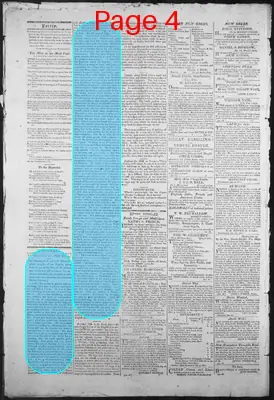
Literary
February 11, 1817
The New Hampshire Gazette
Portsmouth, Rockingham County, New Hampshire
What is this article about?
Satirical essay by Scottish reviewers portraying the English as 'John Bull': obstinate, surly, hypocritical patriots who meddle in others' affairs while claiming moral superiority, as retaliation against Dr. Johnson's critiques of Scots.
Clipping
OCR Quality
95%
Excellent
Full Text
MISCELLANY.
CHARACTER OF JOHN BULL.
The following bold and harsh delineation of the character of the English, being from the pen of the Scottish Reviewers, may be felt as a just retaliation for the severity with which the character of their countrymen was treated by the celebrated Doctor Johnson.
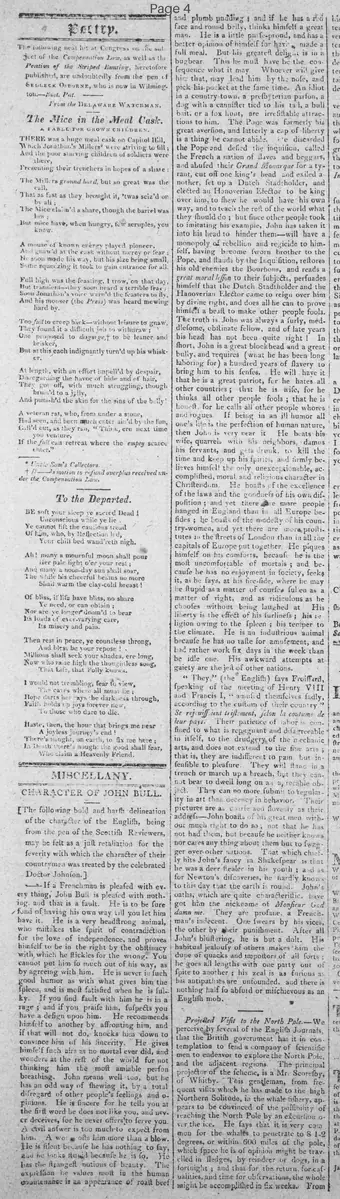
If a Frenchman is pleased with everything, John Bull is pleased with nothing. and that is a fault. He is to be sure fond of having his own way till you let him have it. He is a very headstrong animal, who mistakes the spirit of contradiction for the love of independence, and proves himself to be in the right by the obstinacy with which he sticks for the wrong. You cannot put him so much out of his way, as by agreeing with him. He is never in such good humor as with what gives him the spleen, and is most satisfied when he is sulky. If you find fault with him he is in a rage; and if you praise him, suspects you have a design upon him. He recommends himself to another by affronting him, and if that will not do,—knocks him down to convince him of his sincerity. He gives himself such airs as no mortal ever did, and wonders at the rest of the world for not thinking him the most amiable person breathing. John means well too, but he has an odd way of shewing it, by a total disregard of other people's feelings and opinions. He is sincere for he tells you at the first word he does not like you, and never deceives, or he never offers to serve you. A civil answer is too much to expect from him. A word costs him more than a blow. He is silent because he has nothing to say, and he looks stupid because he is so. He has the strangest notions of beauty. The expression he values most in the human countenance is an appearance of roast beef and plumb pudding; and if he has a red face and round belly, thinks himself a great man. He is a little purse-proud, and has a better opinion of himself for having made a full meal. But his greatest delight is in a bugbear. This he must have be the consequence what it may Whoever will give him that, may lead him by the nose, and pick his-pocket at the same time. An idiot in a country town, a presbyterian parson, a dog with a canister tied to his tail, a bull bait, or a fox hunt, are irresistible attractions to him. The Pope was formerly his great aversion, and latterly a cap of liberty is a thing he cannot abide. He discarded the Pope and defied the inquisition, called the French a nation of slaves and beggars, and abused their Grand monarque for a tyrant, cut off one king's head and exiled another, set up a Dutch Stadtholder, and elected an Hanoverian Elector to be king over him, to shew he would have his own way, and to teach the rest of the world what they should do; but since other people took to imitating his example, John has taken it into his head to hinder them—will have a monopoly of rebellion and regicide to himself, having become sworn brother to the Pope, and stands by the Inquisition, restores his old enemies the Bourbons, and reads a great moral lesson to their subjects, persuades himself that the Dutch Stadtholder and the Hanoverian Elector came to reign over him by divine right, and does all he can to prove himself a beast to make other people fools. The truth is. John was always a surly, meddlesome, obstinate fellow, and of late years his head has not been quite right! In short, John is a great blockhead and a great bully, and requires (what he has been long laboring for) a hundred years of slavery to bring him to his senses. He will have it that he is a great patriot, for he hates all other countries; that he is wise, for he thinks all other people fools; that he is honest, for he calls all other people whores and rogues. If being in an ill humor all one's life is the perfection of human nature, then John is very near it He beats his wife, quarrels with his neighbors, damns his servants, and gets drunk, to kill the time and keep up his spirits, and firmly believes himself the only unexceptionable, accomplished, moral and religious character in Christendom. He boasts of the excellence of the laws and the goodness of his own disposition; and yet there are more people hanged in England than in all Europe besides: he boasts of the modesty of his country-women, and yet there are more prostitutes in the streets of London than in all the capitals of Europe put together. He piques himself on his comforts, because he is the most uncomfortable of mortals; and because he has no enjoyment in society, seeks it, as he says, at his fire-side, where he may be stupid as a matter of course, sulen as a matter of right, and as ridiculous as he chooses without being laughed at His liberty is the effect of his surliness; his religion owing to the spleen; his temper to the climate. He is an industrious animal because he has no taste for amusement, and had rather work six days in the week than be idle one. His awkward attempts at gaiety are the jest of other nations. "They," (the English) says Froissart, speaking of the meeting of Henry VIII and Francis I, "amused themselves sadly, according to the custom of their country Se rejouiffient tristement, selon la coutume de leur pays. Their patience of labor is confined to what is repugnant and disagreeable in itself, to the drudgery of the mechanic arts, and does not extend to the fine arts; that is, they are indifferent to pain but insensible to pleasure. They will stand in a trench or march up a breach, but they cannot bear to dwell long on a gay recable object. They can no more submit to regularity in art than decency in behavior. Their pictures are as coarse and slovenly as their address—John boasts of his great men without much right to do so, not that he has not had them, but because he neither knows nor cares anything about them but to swagger over other nations. That which chiefly hits John's fancy in Shakspeare is that he was a deer stealer in his youth; and as for Newton's discoveries, he hardly knows to this day that the earth is round. John's oaths, which are quite characteristic, have got him the nickname of Monsieur God damn me. They are profane, a Frenchman's indecent. One swears by his vices, the other by their punishment. After all John's blustering, he is but a dolt. His habitual jealousy of others makes him the dupe of quacks and impostors of all sorts; he goes all lengths with one party out of spite to another; his zeal is as furious as his antipathies are unfounded, and there is nothing half so absurd or mischievous as an English mob.
CHARACTER OF JOHN BULL.
The following bold and harsh delineation of the character of the English, being from the pen of the Scottish Reviewers, may be felt as a just retaliation for the severity with which the character of their countrymen was treated by the celebrated Doctor Johnson.
If a Frenchman is pleased with everything, John Bull is pleased with nothing. and that is a fault. He is to be sure fond of having his own way till you let him have it. He is a very headstrong animal, who mistakes the spirit of contradiction for the love of independence, and proves himself to be in the right by the obstinacy with which he sticks for the wrong. You cannot put him so much out of his way, as by agreeing with him. He is never in such good humor as with what gives him the spleen, and is most satisfied when he is sulky. If you find fault with him he is in a rage; and if you praise him, suspects you have a design upon him. He recommends himself to another by affronting him, and if that will not do,—knocks him down to convince him of his sincerity. He gives himself such airs as no mortal ever did, and wonders at the rest of the world for not thinking him the most amiable person breathing. John means well too, but he has an odd way of shewing it, by a total disregard of other people's feelings and opinions. He is sincere for he tells you at the first word he does not like you, and never deceives, or he never offers to serve you. A civil answer is too much to expect from him. A word costs him more than a blow. He is silent because he has nothing to say, and he looks stupid because he is so. He has the strangest notions of beauty. The expression he values most in the human countenance is an appearance of roast beef and plumb pudding; and if he has a red face and round belly, thinks himself a great man. He is a little purse-proud, and has a better opinion of himself for having made a full meal. But his greatest delight is in a bugbear. This he must have be the consequence what it may Whoever will give him that, may lead him by the nose, and pick his-pocket at the same time. An idiot in a country town, a presbyterian parson, a dog with a canister tied to his tail, a bull bait, or a fox hunt, are irresistible attractions to him. The Pope was formerly his great aversion, and latterly a cap of liberty is a thing he cannot abide. He discarded the Pope and defied the inquisition, called the French a nation of slaves and beggars, and abused their Grand monarque for a tyrant, cut off one king's head and exiled another, set up a Dutch Stadtholder, and elected an Hanoverian Elector to be king over him, to shew he would have his own way, and to teach the rest of the world what they should do; but since other people took to imitating his example, John has taken it into his head to hinder them—will have a monopoly of rebellion and regicide to himself, having become sworn brother to the Pope, and stands by the Inquisition, restores his old enemies the Bourbons, and reads a great moral lesson to their subjects, persuades himself that the Dutch Stadtholder and the Hanoverian Elector came to reign over him by divine right, and does all he can to prove himself a beast to make other people fools. The truth is. John was always a surly, meddlesome, obstinate fellow, and of late years his head has not been quite right! In short, John is a great blockhead and a great bully, and requires (what he has been long laboring for) a hundred years of slavery to bring him to his senses. He will have it that he is a great patriot, for he hates all other countries; that he is wise, for he thinks all other people fools; that he is honest, for he calls all other people whores and rogues. If being in an ill humor all one's life is the perfection of human nature, then John is very near it He beats his wife, quarrels with his neighbors, damns his servants, and gets drunk, to kill the time and keep up his spirits, and firmly believes himself the only unexceptionable, accomplished, moral and religious character in Christendom. He boasts of the excellence of the laws and the goodness of his own disposition; and yet there are more people hanged in England than in all Europe besides: he boasts of the modesty of his country-women, and yet there are more prostitutes in the streets of London than in all the capitals of Europe put together. He piques himself on his comforts, because he is the most uncomfortable of mortals; and because he has no enjoyment in society, seeks it, as he says, at his fire-side, where he may be stupid as a matter of course, sulen as a matter of right, and as ridiculous as he chooses without being laughed at His liberty is the effect of his surliness; his religion owing to the spleen; his temper to the climate. He is an industrious animal because he has no taste for amusement, and had rather work six days in the week than be idle one. His awkward attempts at gaiety are the jest of other nations. "They," (the English) says Froissart, speaking of the meeting of Henry VIII and Francis I, "amused themselves sadly, according to the custom of their country Se rejouiffient tristement, selon la coutume de leur pays. Their patience of labor is confined to what is repugnant and disagreeable in itself, to the drudgery of the mechanic arts, and does not extend to the fine arts; that is, they are indifferent to pain but insensible to pleasure. They will stand in a trench or march up a breach, but they cannot bear to dwell long on a gay recable object. They can no more submit to regularity in art than decency in behavior. Their pictures are as coarse and slovenly as their address—John boasts of his great men without much right to do so, not that he has not had them, but because he neither knows nor cares anything about them but to swagger over other nations. That which chiefly hits John's fancy in Shakspeare is that he was a deer stealer in his youth; and as for Newton's discoveries, he hardly knows to this day that the earth is round. John's oaths, which are quite characteristic, have got him the nickname of Monsieur God damn me. They are profane, a Frenchman's indecent. One swears by his vices, the other by their punishment. After all John's blustering, he is but a dolt. His habitual jealousy of others makes him the dupe of quacks and impostors of all sorts; he goes all lengths with one party out of spite to another; his zeal is as furious as his antipathies are unfounded, and there is nothing half so absurd or mischievous as an English mob.
What sub-type of article is it?
Satire
Essay
What themes does it cover?
Social Manners
Political
Patriotism
What keywords are associated?
John Bull
English Character
Satire
Scottish Reviewers
Dr Johnson
Obstinacy
Hypocrisy
Patriotism
What entities or persons were involved?
The Scottish Reviewers
Literary Details
Title
Character Of John Bull
Author
The Scottish Reviewers
Subject
Retaliation For The Severity With Which The Character Of Their Countrymen Was Treated By The Celebrated Doctor Johnson
Form / Style
Satirical Prose Delineation
Key Lines
If A Frenchman Is Pleased With Everything, John Bull Is Pleased With Nothing. And That Is A Fault.
He Is A Very Headstrong Animal, Who Mistakes The Spirit Of Contradiction For The Love Of Independence
In Short, John Is A Great Blockhead And A Great Bully, And Requires (What He Has Been Long Laboring For) A Hundred Years Of Slavery To Bring Him To His Senses.
He Will Have It That He Is A Great Patriot, For He Hates All Other Countries; That He Is Wise, For He Thinks All Other People Fools; That He Is Honest, For He Calls All Other People Whores And Rogues.
"They," (The English) Says Froissart, Speaking Of The Meeting Of Henry Viii And Francis I, "Amused Themselves Sadly, According To The Custom Of Their Country Se Rejouiffient Tristement, Selon La Coutume De Leur Pays.