Thank you for visiting SNEWPapers!
Sign up free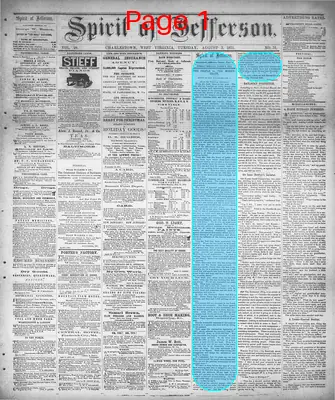
Spirit Of Jefferson
Charles Town, Jefferson County, West Virginia
What is this article about?
Post-Civil War editorial from Wheeling Standard, republished in Spirit of Jefferson, lambasts moneycrats and Wall Street for currency contraction causing economic hardship for laborers and farmers, advocates expansion, lower taxes, and popular uprising against financial elite before 1876 election.
Merged-components note: The second component is a direct textual continuation of the first editorial piece on 'THE PEOPLE VS. THE MONEY-CRATS,' split likely due to page or parsing boundaries; merging into a single coherent editorial.
Clipping
OCR Quality
Full Text
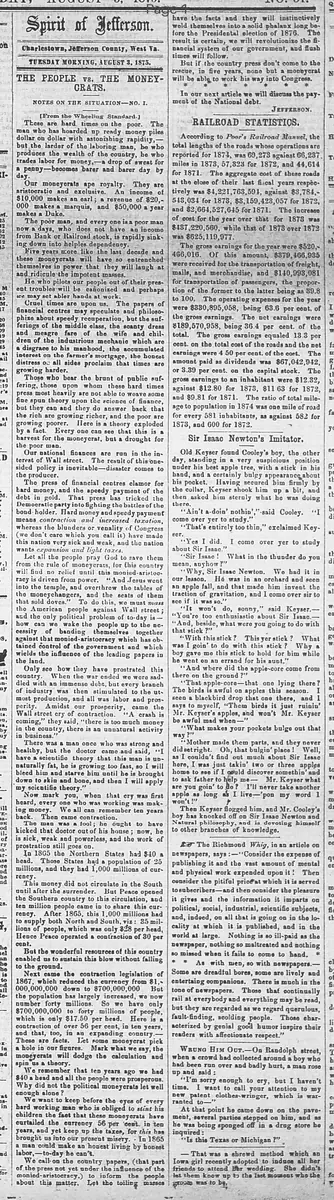
Charlestown, Jefferson County, West Va.
TUESDAY MORNING, AUGUST 3, 1875.
THE PEOPLE VS. THE MONEY-CRATS.
NOTES ON THE SITUATION - NO. 1.
[From the Wheeling Standard.]
These are hard times on the poor. The man who has hoarded up ready money piles dollar on dollar with astonishing rapidity, but the larder of the laboring man, he who produces the wealth of the country, he who trades labor for money, a drop of sweat for a penny - becomes barer and barer day by day.
Our moneycrats ape royalty. They are aristocratic and exclusive. An income of $10,000 makes an earl; revenue of $20,000 makes a marquis, and $50,000 a year makes a Duke.
The poor man, and every one is a poor man now a days, who does not have an income from Bank or Railroad stock, is rapidly sinking down into helpless dependency.
Five years more like the last decade and these moneycrats will have so entrenched themselves in power that they will laugh at and ridicule the impotent masses.
He who pilots our people out of their present troubles will be canonized and perhaps set abler hands at work.
Cruel times are upon us. The papers of financial centres may speculate and philosophize about speedy recuperation, but the sufferings of the middle class, the scanty dress and meagre fare of the wife and children of the industrious mechanic which are disgrace to his manhood, the accumulated interest on the farmer's mortgage, the honest distress on all sides proclaim that times are growing harder.
Those who bear the brunt of public suffering, those upon whom these hard times press most heavily are not able to weave some fine spun theory upon the science of finance, but they can and they do answer back that the rich are growing richer, and the poor are growing poorer.
Here is a theory exploded by a fact. Every one can see that this is a harvest of the moneycrat, but a drought for the poor man.
Our national finances are run in the interest of Wall street. The result of this one-sided policy is inevitable - disaster comes to the producer.
The press of financial centres clamor for hard money, and the speedy payment of the debt in gold. That press has tricked the Democratic party into fighting the battles of the bond-holder. Hard money and speedy payment means contraction and increased taxation, whereas the blunders or venality of Congress (we don't care which you call it) have made this nation very sick and weak, and the nation wants expansion and light taxes.
Let all the people pray God to save them from the rule of moneycrats, for this country will find no relief until this monied-aristocracy is driven from power. "And Jesus went into the temple, and overthrew the tables of the moneychangers, and the seats of them that sold doves." To do this, we must mass the American people against Wall street; and the only political problem of to-day is - how can we wake the people up to the necessity of banding themselves together against that monied-aristocracy which has obtained control of the government and which wields the influence of the leading papers in the land.
Only see how they have prostrated this country. When the war ended we were saddled with an immense debt, but every branch of industry was then stimulated to the utmost production, and all was labor and prosperity. Amidst our prosperity, came the Wall street cry of contraction. "A crash is coming," they said, "there is too much money in the country, there is an unnatural activity in business."
There was a man once who was strong and healthy, but the doctor came and said, "I have a scientific theory that this man is unnaturally fat, he is growing too fast, so I will bleed him and starve him until he is brought down to skin and bone, and then I will apply my scientific theory."
Now mark you, when that cry was first heard, every one who was working was making money. We all can remember ten years back. Then came contraction.
The man was a fool; he ought to have kicked that doctor out of his house; now, he is sick, weak and powerless, and the work of prostration still goes on.
In 1865 the Northern States had $40 a head. Those States had a population of 25 millions, and they had 1,000 millions of currency.
This money did not circulate in the South until after the surrender. But Peace opened the Southern country to this circulation, and ten million people came in to share this currency. After 1865, this 1,000 millions had to supply both North and South, viz: 35 millions of people, which was only $28 per head. Hence Peace operated a contraction of 30 per cent.
But the wonderful resources of this country enabled us to sustain this blow without falling to the ground.
Next came the contraction legislation of 1867, which reduced the currency from $1,000,000,000 down to $700,000,000 But the population has largely increased, we now number forty millions.
So we have only $700,000,000 to forty millions of people, which is only $17.50 per head. Here is a contraction of over 56 per cent. in ten years, and that, too, in an expanding country.
These are facts. Let some moneycrat pick a hole in our figures.
Mark what we say, the moneycrats will dodge the calculation and spin us a theory.
We remember that ten years ago we had $40 a head and all the people were prosperous. Why did not the political moneycrats let well enough alone?
We want to keep before the eyes of every hard working man who is obliged to stint his children the fact that these moneycrats have curtailed the currency 56 per cent. in ten years, and yet keep up the taxes, for this has brought us into our present misery. In 1865 a man could make an honest living by honest labor, to-day he can't.
We call on the country papers, (that part of the press not yet under the influence of the monied-aristocracy.) to inform the people about this matter. Let the toiling masses have the facts and they will instinctively weld themselves into a solid phalanx long before the Presidential election of 1876. The result is certain, we will revolutionize the financial system of our government, and flush times will follow.
But if the country press don't come to the rescue, in five years, none but a moneycrat will be able to work his way into Congress.
In our next article we will discuss the payment of the National debt.
Jefferson.
What sub-type of article is it?
What keywords are associated?
What entities or persons were involved?
Editorial Details
Primary Topic
Criticism Of Currency Contraction And Moneycrat Dominance
Stance / Tone
Strongly Anti Moneycrat And Pro Currency Expansion
Key Figures
Key Arguments