Thank you for visiting SNEWPapers!
Sign up free
Phenix Gazette
Alexandria, Virginia
What is this article about?
Satirical depiction of a chaotic legislative debate in Congress or state assembly over 'questions of order' involving motions to tax gingerbread and molasses candy, with verbose speeches by Messrs. Hurley, Burly, Higgledy, Piggledy, and Struldbrug, parodying political grandstanding.
Merged-components note: These two components form a single continuous story on parliamentary usages and debates, split due to parsing boundaries.
Clipping
OCR Quality
Full Text
USAGES.
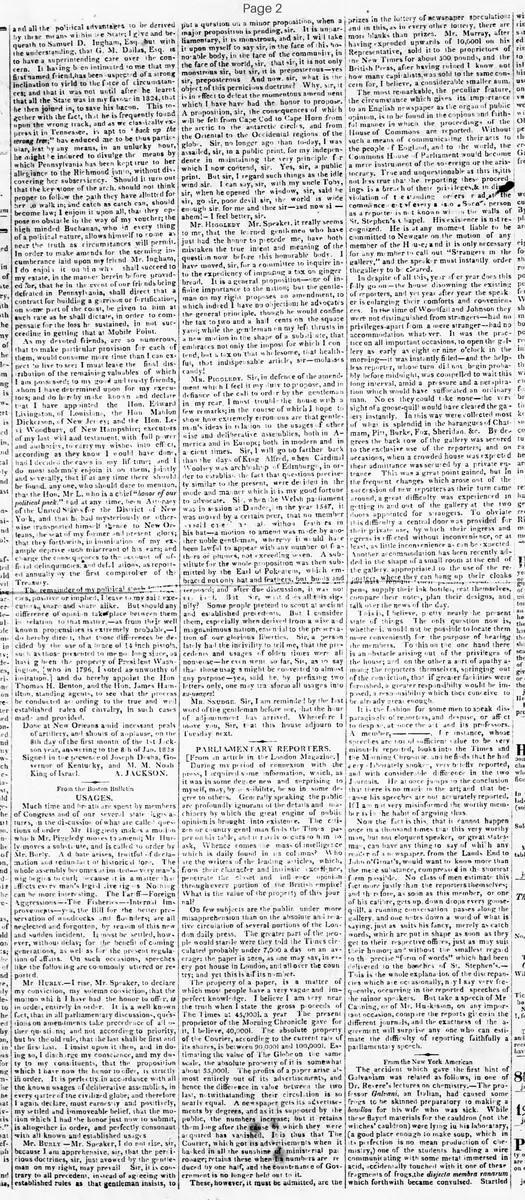
Much time and breath are spent by members of Congress and of our several state legislatures, in the discussion of what are called questions of order. Mr Higgledy makes a motion which Mr. Piggledy moves to amend; Mr Hurley moves a substitute, and is called to order by Mr. Burly. A debate arises, fruitful of declamation and redundancies of historical lore. The whole assembly becomes animated—every man's wig begins to curl; because it is a matter that affects every man's legislative rights. Nothing can be more interesting. The Tariff—Foreign Aggressions—The Fisheries—Internal Improvements—yea, the Bill for the better preservation of woodcocks and founders; are all neglected and forgotten, by reason of this new and sudden incident. It must be settled, however, without delay; for the benefit of coming generations, as well as for the present regulation of affairs. On such occasions, speeches like the following are commonly uttered or reported.
Mr Hurley.—I rise, Mr. Speaker, to declare my conviction, my solemn conviction, that the motion which I have had the honor to offer, is in order, entirely in order. It is a well known fact, that in all parliamentary discussions, questions on amendments take precedence of all other questions; and not according to priority, but by the old rule, that the last shall be first and the first last. I insist upon it then, and in doing so, I discharge my conscience, and my duty to my constituents, that the proposition which I have now the honor to offer, is strictly in order. It is perfectly in accordance with all the known usages of deliberative assemblies, in every quarter of the civilized globe; and therefore I again declare, most earnestly and positively, my settled and immoveable belief, that the motion which I had the honor just now to submit, is altogether in order. and perfectly consonant with all known and established usages
Mr. Burly —Mr. Speaker, I do not rise, sir, because I am apprehensive. sir, that the pernicious doctrines, sir, just avowed by the gentleman on my right, may prevail Sir, it is contrary to all precedent, in lead of agreeing with established rules as that gentleman insists, to put a question on a minor proposition, when a major proposition is pending, sir. It is unparliamentary, it is monstrous, and sir, I will take upon myself to say sir, in the face of this honorable body, in the face of the community, in the face of the world, sir, that sir, it is not only monstrous sir, but sir, it is preposterous—yes sir, preposterous And now, sir, what is the object of this pernicious doctrine? Why. sir, it is in effect to defeat the momentous amendment which I have had the honor to propose.
A proposition, sir, the consequences of which will be felt from Cape Cod to Cape Horn from the arctic to the antarctic circles, and from the Oriental to the Occidental regions of the globe. Sir, no longer ago than to-day, I was assailed, sir, in a public print, for my independence in maintaining the very principle for which I now contend, sir. Yes, sir, a public print. But sir, I regard such things as the idle wind sir. I can say, sir, with my uncle Toby, sir, when he opened the window, sir, said he sir, go sir, poor devil sir, the world is wide enough sir, for me and thee sir—and now si -abem!—I feel better, sir.
Mr. Higgledy Mr. Speaker. it really seems to me, that the learned gentlemen who have just had the honor to precede me, have both mistaken the true intent and meaning of the question now before this honorable body. I have moved, sir, for a committee to inquire into the expediency of imposing a tax on ginger bread. It is a general proposition—one of infinite importance to the nation; but the gentleman on my right proposes an amendment, to which indeed I have no objection: he advocates the general principle, though he would confine the tax to two and a half cents on the square yard; while the gentleman on my left thrusts in a new motion in the shape of a substitute, that embraces not only the impost for which I contend, but a tax on that wholesome, that healthful, that indispensable article, sir—molasses candy!
Mr. Piggledy. Sir, in defence of the amendment which I feel it my duty to propose, and in defiance of the call to order by the gentleman in my rear. I must trouble the house with a few remarks: in the course of which I hope to show how extremely erroneous are that gen'le-man's ideas in relation to the usages of other wise and deliberative assemblies, both in A-merica and in Europe; both in modern and in ancient times. Sir, I will go no farther back than the days of King Alfred, when Cardinal Woolsey was archbishop of Edinburgh, in order to establish, the fact that questions precise-ly similar to the present, were decided in the mode and manner which it is my good fortune to advocate. Sir, when the Welsh parliament was in session at Dundee, in the year 1547, it was moved by a certain peer, that no member should enter the hall without feathers in his hat—a motion to amend was made by ano-ther noble gentleman, whereby it would have been lawful to appear with any number of fea-th ers or plumes, not exceeding seven. A sub-stitute for the whole proposition was then sub-mitted by the Earl of Pokealem, which em-braced not only hat and feathers, but bonnets and
terposed; and after due discussion, it was not settled. But Sir, what does all this signify? Some people pretend to scout at ancient and established precedents. But I consider them, especially when derived from a wise and magnanimous nation, essential to the preserva-tion of our glorious liberties. Sir, a person lately had the incivility to tell me, that the pre-cedents and usages of olden times were all nonsense—he even went so far, Sir, as to say that those usages might be converted to almost any purpose—yea, said he, by prefixing two letters only, one may transform all usages into su-usages!
Mr. Struldbrug. Sir, I am reminded by the last word of the gentleman before me, that the hour of adjournment has arrived. Wherefore I move you, Sir, that this house adjourn to Tuesday next.
What sub-type of article is it?
What themes does it cover?
What keywords are associated?
What entities or persons were involved?
Where did it happen?
Story Details
Key Persons
Location
Congress And State Legislatures
Story Details
Satirical debate on parliamentary order involving motions to tax gingerbread and molasses candy, with exaggerated speeches citing absurd historical precedents and ignoring major issues.