Thank you for visiting SNEWPapers!
Sign up free
The Key West Citizen
Key West, Monroe County, Florida
What is this article about?
In 1936, a building boomlet is predicted with over 250,000 new private homes to be constructed, driven by housing shortages from the depression, federal financing innovations by the FHA allowing longer mortgages up to 20 years and higher loan percentages, and social factors like family separations. Loans doubled from 1935, totaling millions for new builds and modernizations.
Clipping
OCR Quality
Full Text
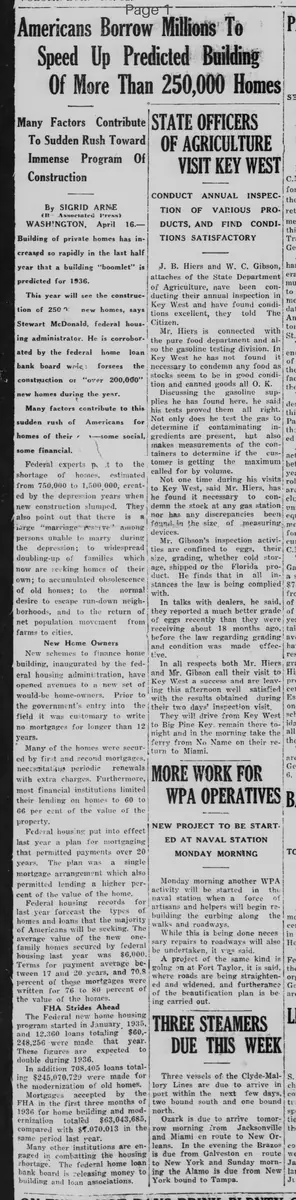
Many Factors Contribute To Sudden Rush Toward Immense Program Of Construction
By SIGRID ARME
(H: Associated Press)
WASHINGTON, April 16.-
Building of private homes has increased so rapidly in the last half year that a building "boomlet" is predicted for 1936.
This year will see the construction of 250,000 new homes, says Stewart McDonald, federal housing administrator. He is corroborated by the federal home loan bank board which foresees the construction of "over 200,000" new homes during the year.
Many factors contribute to this sudden rush of Americans for homes of their own—some social, some financial.
Federal experts point to the shortage of homes, estimated from 750,000 to 1,500,000, created by the depression years when new construction slumped. They also point out that there is a large "marriage reserve" among persons unable to marry during the depression; to widespread doubling-up of families which now are seeking homes of their own; to accumulated obsolescence of old homes; to the normal desire to escape run-down neighborhoods, and to the return of net population movement from farms to cities.
New Home Owners
New schemes to finance home building, inaugurated by the federal housing administration, have opened avenues to a new set of would-be home-owners. Prior to the government's entry into the field it was customary to write no mortgages for longer than 12 years.
Many of the homes were secured by first and second mortgages, necessitating periodic renewals with extra charges. Furthermore, most financial institutions limited their lending on homes to 60 to 66 per cent of the value of the property.
Federal housing put into effect last year a plan for mortgaging that permitted payments over 20 years. The plan was a single mortgage arrangement which also permitted lending a higher per cent of the value of the home.
Federal housing records for last year forecast the types of homes and loans that the majority of Americans will be seeking. The average value of the new one-family homes secured by federal housing last year was $6,000.
Terms for payment average between 17 and 20 years, and 70.8 percent of those mortgages were written for 76 to 80 percent of the value of the homes.
FHA Strides Ahead
The Federal new home housing program started in January, 1935, and 12,360 loans totaling $60,248,256 were made that year.
These figures are expected to double during 1936.
In addition 708,405 loans totaling $245,070,729 were made for the modernization of old homes.
Mortgages accepted by the FHA in the first three months of 1936 for home building and modernization totaled $63,043,685, compared with $7,070,013 in the same period last year.
Many other institutions are engaged in combatting the housing shortage. The federal home loan bank board is releasing money to building and loan associations.
What sub-type of article is it?
What keywords are associated?
What entities or persons were involved?
Where did it happen?
Domestic News Details
Primary Location
Washington
Event Date
1936
Key Persons
Outcome
predicted construction of 250,000 new homes in 1936; fha loans expected to double from 1935's $60,248,256 for new homes and $245,070,729 for modernizations; first quarter 1936 mortgages totaled $63,043,685 vs. $7,070,013 in 1935.
Event Details
Rapid increase in private home building over the last half year leads to a predicted 1936 boomlet of over 200,000-250,000 new homes due to depression-era shortages of 750,000-1,500,000 units, social factors like marriage delays and family doubling-up, and FHA's new 20-year mortgage plans allowing up to 80% of home value financing for average $6,000 one-family homes.