Thank you for visiting SNEWPapers!
Sign up free
Foreign News
December 23, 1847
Sentinel Of The Valley
Woodstock, Shenandoah County, Virginia
What is this article about?
Lieut. Wm. F. Lynch announces a U.S. naval expedition aboard the Supply to explore the Dead Sea, investigating its geological origins, refuting infidel theories, and gathering scientific data on this biblical site in the Middle East.
Clipping
OCR Quality
98%
Excellent
Full Text
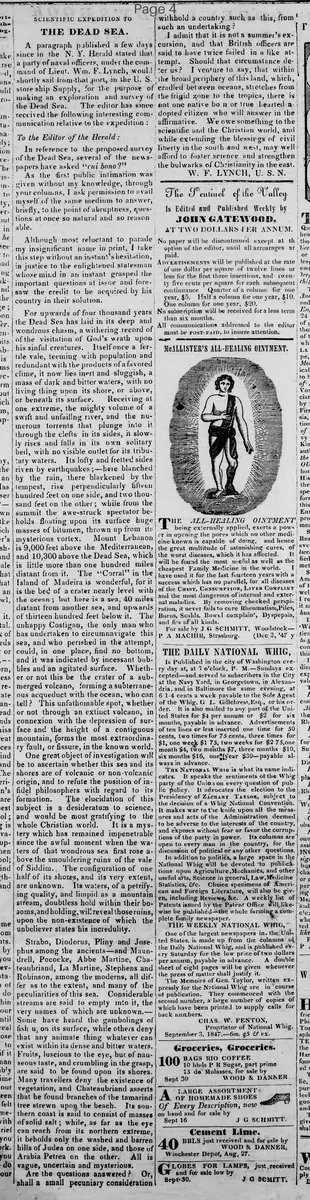
SCIENTIFIC EXPEDITION TO THE DEAD SEA.
A paragraph published a few days since in the N. Y. Herald stated that a party of naval officers, under the command of Lieut. Wm. F. Lynch, would shortly sail from that port, in the U. S. store ship Supply, for the purpose of making an exploration and survey of the Dead Sea.
The editor has since received the following interesting communication relative to the expedition.:
To the Editor of the Herald:
In reference to the proposed survey of the Dead Sea, several of the newspapers have asked "cui bono?"
As the first public intimation was given without my knowledge, through your columns, I ask permission to avail myself of the same medium to answer, briefly, to the point of abruptness, questions at once so natural and so reasonable.
Although most reluctant to parade my insignificant name in print, I take this step without an instant's hesitation, in justice to the enlightened statesman whose mind in an instant grasped the important questions at issue and foresaw the credit to be acquired by his country in their solution.
For upwards of four thousand years the Dead Sea has laid in its deep and wondrous chasm, a withering record of the visitation of God's wrath upon his sinful creatures. Itself once a fertile vale, teeming with population and redundant with the products of a favored clime, it now lies inert and sluggish, a mass of dark and bitter waters, with no living thing upon its shore, or above, or beneath its surface. Receiving at one extreme, the mighty volume of a swift and unfailing river, and the numerous torrents that plunge into it through the clefts in its sides, it slowly rises and falls in its own solitary bed, with no visible outlet for its tributary waters. Its lofty and fretted sides riven by earthquakes;—here blanched by the rain, there blackened by the tempest, rise perpendicularly fifteen hundred feet on one side, and two thousand feet on the other: while from the summit the awe-struck spectator beholds floating upon its surface huge masses of bitumen, thrown up from its mysterious vortex. Mount Lebanon is 9,000 feet above the Mediterranean, and 10,300 above the Dead Sea, which is little more than one hundred miles distant from it. The "Corral" in the Island of Madeira is wonderful, or it is the bed of a crater nearly level with the ocean; but here is a sea, 40 miles distant from another sea, and upwards of thirteen hundred feet below it. The unhappy Costigan, the only man who has undertaken to circumnavigate this sea, and who perished in the attempt, could, in one place, find no bottom, and it was indicated by incessant bubbles and an agitated surface. Whether or not this be the crater of a submerged volcano, forming a subterranean aqueduct with the ocean, who can tell? This unfathomable spot, whether or not through an extinct volcano, in connexion with the depression of surface and the height of a contiguous mountain, forms the most extraordinary fault, or fissure, in the known world.
One great object of investigation will be to ascertain whether this sea and its shores are of volcanic or non-volcanic origin, and to refute the position of infidel philosophers with regard to its formation. The elucidation of this subject is a desideratum to science, and would be most gratifying to the whole Christian world. It is a mystery which has remained impenetrable since the awful moment when the waters of that wondrous sea first rose above the smouldering ruins of the vale of Siddim.. The configuration of one half of its shores, and its very extent, are unknown. Its waters, of a petrifying quality, and limpid as a mountain stream, doubtless hold within their bosoms, and holding, will reveal those ruins, upon the non-existence of which the unbeliever states his incredulity.
Strabo, Diodorus, Pliny and Josephus among the ancients—and Mandrell, Pococke, Abbe Martine, Chateaubriand, La Martine, Stephens and Robinson, among the moderns, all differ as to the extent, and many of the peculiarities of this sea. Considerable streams are said to empty into it, the very names of which are unknown.—Some have heard the gambolings of fish upon its surface, while others deny that any animate thing whatever can exist within its dense and bitter waters. Fruits, luscious to the eye, but of nauseous taste, and crumbling in the grasp, are said to be found upon its shores. Many travellers deny the existence of vegetation, and Chateaubriand asserts that he found branches of the tamarind tree strewn upon the beach. Its southern coast is said to consist of masses of solid salt; while, as far as the eye can reach from its northern extreme, it beholds only the washed and barren hills of Judea on one side, and those of Arabia Petrea on the other. All is vague, uncertain and mysterious.
Are the questions answered? Or, shall a small pecuniary consideration withhold a country such as this, from such an undertaking?
I admit that it is not a summer's excursion, and that British officers are said to have twice failed in a like attempt. Should that circumstance deter us? I venture to say, that within the broad periphery of this land, which, cradled between oceans, stretches from the frigid zone to the tropics, there is not one native born or true hearted adopted citizen who will answer in the affirmative. We owe something to the scientific and the Christian world, and while extending the blessings of civil liberty in the south and west, may well afford to foster science and strengthen the bulwarks of Christianity in the east.
W. F. LYNCH. U. S. N.
A paragraph published a few days since in the N. Y. Herald stated that a party of naval officers, under the command of Lieut. Wm. F. Lynch, would shortly sail from that port, in the U. S. store ship Supply, for the purpose of making an exploration and survey of the Dead Sea.
The editor has since received the following interesting communication relative to the expedition.:
To the Editor of the Herald:
In reference to the proposed survey of the Dead Sea, several of the newspapers have asked "cui bono?"
As the first public intimation was given without my knowledge, through your columns, I ask permission to avail myself of the same medium to answer, briefly, to the point of abruptness, questions at once so natural and so reasonable.
Although most reluctant to parade my insignificant name in print, I take this step without an instant's hesitation, in justice to the enlightened statesman whose mind in an instant grasped the important questions at issue and foresaw the credit to be acquired by his country in their solution.
For upwards of four thousand years the Dead Sea has laid in its deep and wondrous chasm, a withering record of the visitation of God's wrath upon his sinful creatures. Itself once a fertile vale, teeming with population and redundant with the products of a favored clime, it now lies inert and sluggish, a mass of dark and bitter waters, with no living thing upon its shore, or above, or beneath its surface. Receiving at one extreme, the mighty volume of a swift and unfailing river, and the numerous torrents that plunge into it through the clefts in its sides, it slowly rises and falls in its own solitary bed, with no visible outlet for its tributary waters. Its lofty and fretted sides riven by earthquakes;—here blanched by the rain, there blackened by the tempest, rise perpendicularly fifteen hundred feet on one side, and two thousand feet on the other: while from the summit the awe-struck spectator beholds floating upon its surface huge masses of bitumen, thrown up from its mysterious vortex. Mount Lebanon is 9,000 feet above the Mediterranean, and 10,300 above the Dead Sea, which is little more than one hundred miles distant from it. The "Corral" in the Island of Madeira is wonderful, or it is the bed of a crater nearly level with the ocean; but here is a sea, 40 miles distant from another sea, and upwards of thirteen hundred feet below it. The unhappy Costigan, the only man who has undertaken to circumnavigate this sea, and who perished in the attempt, could, in one place, find no bottom, and it was indicated by incessant bubbles and an agitated surface. Whether or not this be the crater of a submerged volcano, forming a subterranean aqueduct with the ocean, who can tell? This unfathomable spot, whether or not through an extinct volcano, in connexion with the depression of surface and the height of a contiguous mountain, forms the most extraordinary fault, or fissure, in the known world.
One great object of investigation will be to ascertain whether this sea and its shores are of volcanic or non-volcanic origin, and to refute the position of infidel philosophers with regard to its formation. The elucidation of this subject is a desideratum to science, and would be most gratifying to the whole Christian world. It is a mystery which has remained impenetrable since the awful moment when the waters of that wondrous sea first rose above the smouldering ruins of the vale of Siddim.. The configuration of one half of its shores, and its very extent, are unknown. Its waters, of a petrifying quality, and limpid as a mountain stream, doubtless hold within their bosoms, and holding, will reveal those ruins, upon the non-existence of which the unbeliever states his incredulity.
Strabo, Diodorus, Pliny and Josephus among the ancients—and Mandrell, Pococke, Abbe Martine, Chateaubriand, La Martine, Stephens and Robinson, among the moderns, all differ as to the extent, and many of the peculiarities of this sea. Considerable streams are said to empty into it, the very names of which are unknown.—Some have heard the gambolings of fish upon its surface, while others deny that any animate thing whatever can exist within its dense and bitter waters. Fruits, luscious to the eye, but of nauseous taste, and crumbling in the grasp, are said to be found upon its shores. Many travellers deny the existence of vegetation, and Chateaubriand asserts that he found branches of the tamarind tree strewn upon the beach. Its southern coast is said to consist of masses of solid salt; while, as far as the eye can reach from its northern extreme, it beholds only the washed and barren hills of Judea on one side, and those of Arabia Petrea on the other. All is vague, uncertain and mysterious.
Are the questions answered? Or, shall a small pecuniary consideration withhold a country such as this, from such an undertaking?
I admit that it is not a summer's excursion, and that British officers are said to have twice failed in a like attempt. Should that circumstance deter us? I venture to say, that within the broad periphery of this land, which, cradled between oceans, stretches from the frigid zone to the tropics, there is not one native born or true hearted adopted citizen who will answer in the affirmative. We owe something to the scientific and the Christian world, and while extending the blessings of civil liberty in the south and west, may well afford to foster science and strengthen the bulwarks of Christianity in the east.
W. F. LYNCH. U. S. N.
What sub-type of article is it?
Scientific Expedition
Biblical Exploration
What keywords are associated?
Dead Sea Survey
Lynch Expedition
Us Navy Exploration
Biblical Site
Volcanic Origin
What entities or persons were involved?
Lieut. Wm. F. Lynch
Where did it happen?
Dead Sea
Foreign News Details
Primary Location
Dead Sea
Event Date
Would Shortly Sail
Key Persons
Lieut. Wm. F. Lynch
Event Details
Lieut. Wm. F. Lynch writes to the New York Herald explaining the purpose of a proposed U.S. naval expedition to survey and explore the Dead Sea, including investigating its volcanic origins, extent, peculiarities, and refuting infidel views on its biblical formation, amid historical mysteries and failed prior attempts.