Thank you for visiting SNEWPapers!
Sign up free
Editorial
December 21, 1858
Lynchburg Daily Virginian
Lynchburg, Virginia
What is this article about?
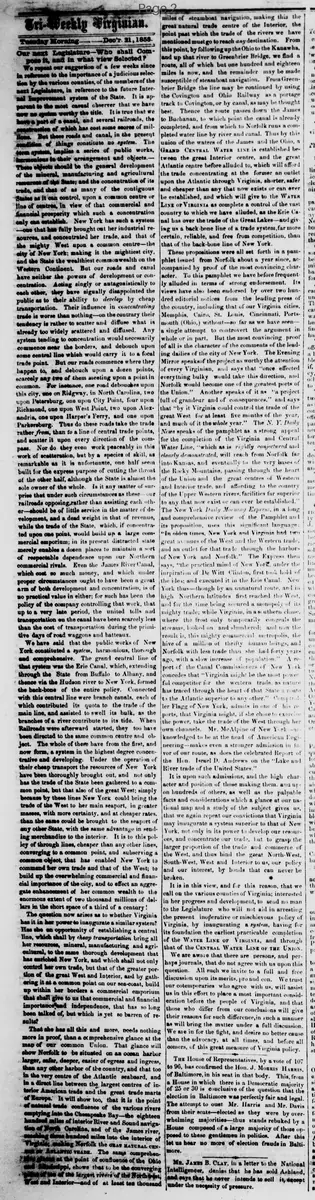
Editorial urges Virginia counties to elect legislators who will prioritize a unified internal improvement system, centered on a Water Line from the Ohio River to Norfolk via James River, to develop state resources, concentrate trade, and rival New York's Erie Canal dominance over Western commerce.
Clipping
OCR Quality
75%
Good
Full Text
CRI deekly irginian.
romoday Korpins........ Dod'r. 3l, 1858
Our naxt Lerinlature-Wbo shall Com
Pose it, and in what view Seleoted P
We repeat our suggertion of a few wecks since
in reforence to the importance of a judicious selec-
tiom by the various counties, of the members of the
aext Legialature, in reference to the future Inter-
mal Improromont system of the State. It is ap-
parent to the most casual observer that we have
mow me gyodom worthy the title. It is true that we
hove a pert ef a eanal, and several railroads, the
comntrgetion of which has cost some sooree of mil-
Hond. But these roads and canal, in the present
-condition of things constituto no system. The
term syatom, implies a serics of publio works,
Pbarmonious in their errengement and objects.--
These Ohiects shoald be the genersl development
of the mineral, manufacturing and agricultural
resouroei of thg State; aod the concentration of its
trade, and chat of as many of the contiguous
States as it can control, upon a common centre or
line of oentred, in view of that commercial and
financial proesperity which such a concentration
Lomly can establich. New York has such a aystemn
one that hae fully brought out her industrial re-
aources, and concentrated her trade, and that of
the mighty West upon a common centre-the
city of Now York; makingit the mightiest city,
and the State the wealthiest eommonwealth on the
Western Continent. But our roads and canal
have neitber the powers of development or con-
centration. Aoting singly or antagonistically to
eacb otbor, they bave sigually diaappointed the
public as to their ability to develop by cheap
trunsportation. Their influence in concentrating
trade is worse than nothing-on the contrary their
tendoncy is rather to scatter and diffuse what is
already too widely scattered and diffused. Any
system tending to concentration would necessarily
commenoe near the borders, and debouch upon
somo oentral line whieh would carry it to a focal
trade point. But our roads cominence where they
bappen to, and debouch upon a dozen points,
scaroely any twe of them meoting upon a point in
common. For inotance, one road debouobes upon
this city. one on Ridgway, in North Carolinn, two
upon Petorsburg, ono upon City Point, four upon
Richmond, one upon West Point, two upon Alex-
andria, one upon Harper's Ferry, and one upon
Parkorsburg. Tbus do these roads take the trnde
rathor from, than to a line of central trade points,
and scatter it upon every direction of the com-
pass. Nor do they even work peaceably in this
work of scatteration, but by a species of akill, as
remarkable as it is anortunnte, one half seom
built for the express purpose of cutting the thront
of the other half, although the State is almost the
sole owper of the whole. Is it any inatter of sur-
prise that under suob circumstances as these-our
railroads opposing,rather than assisting each oth-
or-should be of little service in the matter of de-
velopment, and a dead weight in that of revenue,
while the trede of the State. which. if copeentra-
tod upon one point, would build up a large com-
mercial omporium; in its present distructed state
merely onables a dozen places to maintain a sort
of reopootable dependence upon our Northern
commercial rivals. Even the Jamies River Canal.
which ooet o much money, and which under
proper ciroumstances ought to have been n great
arm of both development and concontrntion, is of
no praotical value in cither; for such has been the
policy of tbe company controlling that work, that
up to a very late period, the unitod tolls nnd
tranoportation on the caual have been scarcely less
than the cost of transportation during the primi-
tive days of road waggons and batteaux.
We have said that the public works of New
York oonstituted a system, harmonious, thorongh
and comprehoneive. The grand central line of
that system was the Erie Canal, which, extending
through the State from Buffalo to Albany, and
thence via the Hudson river to New York, formed
the back-bone of the entire policv. Connected
with this central line were branch canals, each of
which cootributed its guota to the trade of the
main line, and assisted to swell its bulk, as the
brapcbes of s river contribute to its tide. When
Railroads were afterward started, they too have
been directed to the same common centre and ob-
joot. The whole of these have from the first, and
now form, a syatem in the highest degree concen-
trative and developing: Under the operation of
their cheap transport the resources of New York
have been thoroughly brought out, and not only
has the trade of the State been gathered to a com-
mon point, but that also of the great West; sinply
because by those lines New York could bring the
trade of the Weat to her main seaport, in greater
masses, with more certainty, and at cheaper rates.
tban the same could be brought to the seaport of
any otber Stato, with the same advantngo in send-
ing mercbandize to the interior. It is to thie pol-
icy of through lines, cheaper than any other lines,
converging to a common point, and subserving a
commonobjeot, that has enabled New York to
command ber own trade aud that of the West; to
build up the overwhelming commercial and finan-
cial importance of tbe city, aud to effect an aggre-
gate enbanoement of ber common wealth to the
enormous extent of two thousand millions of dol-
lars in the short space of a third of a century!
Tbe question now arises as to whether Virginia
has it in her power to inaugurate a siznilar system?
Has obe an opportunity of establishing a central
line, which shall by cheap traneportation bring all
her resources, mineral, manufacturing and agri-
cultural, to the same thorough developmnent that
has enricbed New York, and which shall not only
control her own trade, but that of the greater por-
tlon of the great West and Interior, avd by gath-
ering it at a common point on our sea-coast, build
up within her borders a commercial emporium
that shall give to us tbat commercial and financial
importance land independence, that has so long
been talkod of, but which is yet so barren of re-
sulta?
That ahe has all this and more, needs nothing
more in proof, than a cx mprehensive giance at the
map of our common Union. That glance will
show Norfolk to be situated on an occan harbor
, larger, safer, deeper, easier of egress and ingress,
than any other harbor of the country, and that too
in the very centre of the Atlantic seaboard, and
in a direct line between the largest centres of in-
torior American trade and the great trade marts
of Europe.' It will showr too, that it is the point
ifmatural trade confluence of the various rivers
emptying into the Chesapeake Bay-the oighteen
hundeed ilee of interior River and Sound naviga-
tioe f Mond Carolina, and of the James river,
765
hundred miles into the interior of
E gSing Norfolk the GRat xATURaL. CEN-
hyric rxipx. The same comprehen.
if the point of confluence of the Obio
ppi, showe that to be the converging
the largest rivers of the North wat
a and Interior--and of at least ten thoueand
miles of steamboat navigation. making this the
great natural trade centre of the Interior, the
point past wbich the trade of the rivers we have
montioned must go toreach anydestination. From
this point, by following up the Ohio to the Kanawha.
and up that river to Greenbrier Bridge, we find a
route, all of which but one hundred and eighteen
miles is now, and the reinainder may bo made
susceptible of steamboat navigation. From Grecn-
brier Bridge the line may be continued by using
the Covington and Ohio Railway as a portage
track to Covington, or by canal, as may be thought
best. Thence the route passes down the James
to Buchanan, to which point the canal is already
completed, and from which to Norfolk runs a com-
pleted water line by river and canal. Thus by this
upion of the waters of the James and the Ohio, a
Granp CentraL WaTeR Lise is established be-
tween the great Interior centre, and the great
Atlantie centre before alluded to, which will afford
the trade concentrating at the foruner an outlet
upon the Atlantic through Vriginia, shorter, safer
and cheaper than any that now exists or can erer
be established. apd which will give to the Warer
Lisr or Viroinia as complete a control of the vast
country to which we have alluded, as the Erie Ca-
nal bas over the trade of the Great Lakes-aud giv-
ing us a back-bone line of a trade system, far more
certain, reliable, and free from competition, than
that of the back-bone lipe of New York.
These propositions were all set forth in a pain-
phlet issued from Norfolk about n vear since, ac-
companied by proof of the most convincing char-
ncter. To this pamphlet we have before frequent
ly alluded in terma of strong endorsement. Its
views have also beon endorsed by over two hun-
dred editorial notices from the leading press of
the country, including that of our Virginia cities
Memphis, Cairo, St. Louis, Cincinnati, Ports-
mouth (Ohio,) without--po far as we have seen-
a single attempt to controvert the argument in
whole or in part. But the most convincing proof
of all is the character of the comments of the lead.
ing dailies of the city of New York. The Evening
Mirror speaksof the project as worthy the attention
of every Virginian, and says thnt "once effected
everytuing bulky would take this direction, and
Nortolk would become one of the greatest ports of
the Union." Another spenks of it ns "a project
full of grandeur and of consequences." and says
that "by it Virginia could control the trade of the
great West for at least five months of the year.
and much of it tho whole year." The N. Y. Daily
Newos speaks of the pamphlet as a strong appeal
for the completion of the Virginia and Central
Water Line, "which as is rightly conjectured and
clearly demonstrated, will reach from Norfolk far
into Kansas, and eventaally to the very bases of
the Rocky Mountains, passing through the heart
of the Uniou and the great centres of Western
and Interior trade, and affording to the country
of the Upper Western rivers, facilities far superior
to any that now exist or can ever be established."
The New York Dauly Mornung Express, in a long
and comprehensive review of the Pampblet and
its proposition, uses this significant language.
"In olden times, New York and Virginin hnd two
great as nues of the West and the Western trade
and an outlet for that tralc through the harbors
of New York and Norfolk." The Express thew
says, "the practical mind of New York. under the
inrpiration of De Witt Clinton, first took hold of
the idoc; and executed it in the Erie Canal. New
York thus--though by an unnatural route, and in
high Northern latitudes first reached the West.
and for tho time being secured a monopoly of its
mighty trade; while Virginin, in a sc uthern clune,
where the frost only temporarilv congeals the
streamns, looked on and slumlered; and now the
resuleis, this mighty commercial metropolis, the
hive of a million of thrifty human beings, and
Norfolk with less trade than she had forty vear
ago, with a slow increase of population." A re.
port of the Canal Commissioners of New Y rk
concedes that "Virginia might be the most power
ful competitor for the western trade. as nature
has traced through the heart of that State a route
to the Atlantie superior to anv other." (omt tr!
ler Flagg of New York, admits in one of his re
ports, that Virginia uight. if she choseto exercise
the power, take the trade of the West through her
osrn cbannels..Mr. MeAlpine of New York -a
knowledged to be at the head of Anerican Engi
neering-makes even a stronger admission in fn
vor of our route, as does the celebrated Report of
the lon. Israel D. Andrews on the "Lake and
River trnde of the United States."
It is upon such admissions, and the high char
acter and position of those making them. ana ur-
on hundreds of others, as well as the palpable
facts and cousiderations which a glance at our na-
tional map and a study of the subject gives us.
that we again repent our convictions that Virginiu
may inaugurate a system superior to that of New
York, not only in its power to develop our resour-
ces, and concentrate our trade, lut to grasp the
larger proportion of the trade and cominerle of
the West, and thus bind the gaeat North-West.
South-West, West and Interior to us, our policy
and our interest, by bonds that can never be
broken.
It is in this view, and for this reason, that we
call on the various counties of Virginia; interested
in her progress and development, to send no man
to the Legislature who will not aid in arresting
the present inoperative or mischievous policy of
Virginia, by inaugurating a syslem, baving for
lits foundation the earlicst practicable completion
of the WateR LInE oF VIrginiA, and through
that of the Central Water Line of the Usion.
We are aware that there are persons, and per-
haps journals, that do not agree with us upon this
question. All such we invite to a full and free
discussion upon its merits, pro and con. We trust
our cotemporaries who agree with us, will assist
us in this effort to place a most important consid-
eration before the people of Virginia, and that
those who differ from our conclusions will give
their reasons for such difference,in tuch a manner
as will bring the matter under a full discussion.
We aie in for the fight, and desire no better causo
than the advocacy. at all times, and before all
comers, of this great measure of Virginia policy.
romoday Korpins........ Dod'r. 3l, 1858
Our naxt Lerinlature-Wbo shall Com
Pose it, and in what view Seleoted P
We repeat our suggertion of a few wecks since
in reforence to the importance of a judicious selec-
tiom by the various counties, of the members of the
aext Legialature, in reference to the future Inter-
mal Improromont system of the State. It is ap-
parent to the most casual observer that we have
mow me gyodom worthy the title. It is true that we
hove a pert ef a eanal, and several railroads, the
comntrgetion of which has cost some sooree of mil-
Hond. But these roads and canal, in the present
-condition of things constituto no system. The
term syatom, implies a serics of publio works,
Pbarmonious in their errengement and objects.--
These Ohiects shoald be the genersl development
of the mineral, manufacturing and agricultural
resouroei of thg State; aod the concentration of its
trade, and chat of as many of the contiguous
States as it can control, upon a common centre or
line of oentred, in view of that commercial and
financial proesperity which such a concentration
Lomly can establich. New York has such a aystemn
one that hae fully brought out her industrial re-
aources, and concentrated her trade, and that of
the mighty West upon a common centre-the
city of Now York; makingit the mightiest city,
and the State the wealthiest eommonwealth on the
Western Continent. But our roads and canal
have neitber the powers of development or con-
centration. Aoting singly or antagonistically to
eacb otbor, they bave sigually diaappointed the
public as to their ability to develop by cheap
trunsportation. Their influence in concentrating
trade is worse than nothing-on the contrary their
tendoncy is rather to scatter and diffuse what is
already too widely scattered and diffused. Any
system tending to concentration would necessarily
commenoe near the borders, and debouch upon
somo oentral line whieh would carry it to a focal
trade point. But our roads cominence where they
bappen to, and debouch upon a dozen points,
scaroely any twe of them meoting upon a point in
common. For inotance, one road debouobes upon
this city. one on Ridgway, in North Carolinn, two
upon Petorsburg, ono upon City Point, four upon
Richmond, one upon West Point, two upon Alex-
andria, one upon Harper's Ferry, and one upon
Parkorsburg. Tbus do these roads take the trnde
rathor from, than to a line of central trade points,
and scatter it upon every direction of the com-
pass. Nor do they even work peaceably in this
work of scatteration, but by a species of akill, as
remarkable as it is anortunnte, one half seom
built for the express purpose of cutting the thront
of the other half, although the State is almost the
sole owper of the whole. Is it any inatter of sur-
prise that under suob circumstances as these-our
railroads opposing,rather than assisting each oth-
or-should be of little service in the matter of de-
velopment, and a dead weight in that of revenue,
while the trede of the State. which. if copeentra-
tod upon one point, would build up a large com-
mercial omporium; in its present distructed state
merely onables a dozen places to maintain a sort
of reopootable dependence upon our Northern
commercial rivals. Even the Jamies River Canal.
which ooet o much money, and which under
proper ciroumstances ought to have been n great
arm of both development and concontrntion, is of
no praotical value in cither; for such has been the
policy of tbe company controlling that work, that
up to a very late period, the unitod tolls nnd
tranoportation on the caual have been scarcely less
than the cost of transportation during the primi-
tive days of road waggons and batteaux.
We have said that the public works of New
York oonstituted a system, harmonious, thorongh
and comprehoneive. The grand central line of
that system was the Erie Canal, which, extending
through the State from Buffalo to Albany, and
thence via the Hudson river to New York, formed
the back-bone of the entire policv. Connected
with this central line were branch canals, each of
which cootributed its guota to the trade of the
main line, and assisted to swell its bulk, as the
brapcbes of s river contribute to its tide. When
Railroads were afterward started, they too have
been directed to the same common centre and ob-
joot. The whole of these have from the first, and
now form, a syatem in the highest degree concen-
trative and developing: Under the operation of
their cheap transport the resources of New York
have been thoroughly brought out, and not only
has the trade of the State been gathered to a com-
mon point, but that also of the great West; sinply
because by those lines New York could bring the
trade of the Weat to her main seaport, in greater
masses, with more certainty, and at cheaper rates.
tban the same could be brought to the seaport of
any otber Stato, with the same advantngo in send-
ing mercbandize to the interior. It is to thie pol-
icy of through lines, cheaper than any other lines,
converging to a common point, and subserving a
commonobjeot, that has enabled New York to
command ber own trade aud that of the West; to
build up the overwhelming commercial and finan-
cial importance of tbe city, aud to effect an aggre-
gate enbanoement of ber common wealth to the
enormous extent of two thousand millions of dol-
lars in the short space of a third of a century!
Tbe question now arises as to whether Virginia
has it in her power to inaugurate a siznilar system?
Has obe an opportunity of establishing a central
line, which shall by cheap traneportation bring all
her resources, mineral, manufacturing and agri-
cultural, to the same thorough developmnent that
has enricbed New York, and which shall not only
control her own trade, but that of the greater por-
tlon of the great West and Interior, avd by gath-
ering it at a common point on our sea-coast, build
up within her borders a commercial emporium
that shall give to us tbat commercial and financial
importance land independence, that has so long
been talkod of, but which is yet so barren of re-
sulta?
That ahe has all this and more, needs nothing
more in proof, than a cx mprehensive giance at the
map of our common Union. That glance will
show Norfolk to be situated on an occan harbor
, larger, safer, deeper, easier of egress and ingress,
than any other harbor of the country, and that too
in the very centre of the Atlantic seaboard, and
in a direct line between the largest centres of in-
torior American trade and the great trade marts
of Europe.' It will showr too, that it is the point
ifmatural trade confluence of the various rivers
emptying into the Chesapeake Bay-the oighteen
hundeed ilee of interior River and Sound naviga-
tioe f Mond Carolina, and of the James river,
765
hundred miles into the interior of
E gSing Norfolk the GRat xATURaL. CEN-
hyric rxipx. The same comprehen.
if the point of confluence of the Obio
ppi, showe that to be the converging
the largest rivers of the North wat
a and Interior--and of at least ten thoueand
miles of steamboat navigation. making this the
great natural trade centre of the Interior, the
point past wbich the trade of the rivers we have
montioned must go toreach anydestination. From
this point, by following up the Ohio to the Kanawha.
and up that river to Greenbrier Bridge, we find a
route, all of which but one hundred and eighteen
miles is now, and the reinainder may bo made
susceptible of steamboat navigation. From Grecn-
brier Bridge the line may be continued by using
the Covington and Ohio Railway as a portage
track to Covington, or by canal, as may be thought
best. Thence the route passes down the James
to Buchanan, to which point the canal is already
completed, and from which to Norfolk runs a com-
pleted water line by river and canal. Thus by this
upion of the waters of the James and the Ohio, a
Granp CentraL WaTeR Lise is established be-
tween the great Interior centre, and the great
Atlantie centre before alluded to, which will afford
the trade concentrating at the foruner an outlet
upon the Atlantic through Vriginia, shorter, safer
and cheaper than any that now exists or can erer
be established. apd which will give to the Warer
Lisr or Viroinia as complete a control of the vast
country to which we have alluded, as the Erie Ca-
nal bas over the trade of the Great Lakes-aud giv-
ing us a back-bone line of a trade system, far more
certain, reliable, and free from competition, than
that of the back-bone lipe of New York.
These propositions were all set forth in a pain-
phlet issued from Norfolk about n vear since, ac-
companied by proof of the most convincing char-
ncter. To this pamphlet we have before frequent
ly alluded in terma of strong endorsement. Its
views have also beon endorsed by over two hun-
dred editorial notices from the leading press of
the country, including that of our Virginia cities
Memphis, Cairo, St. Louis, Cincinnati, Ports-
mouth (Ohio,) without--po far as we have seen-
a single attempt to controvert the argument in
whole or in part. But the most convincing proof
of all is the character of the comments of the lead.
ing dailies of the city of New York. The Evening
Mirror speaksof the project as worthy the attention
of every Virginian, and says thnt "once effected
everytuing bulky would take this direction, and
Nortolk would become one of the greatest ports of
the Union." Another spenks of it ns "a project
full of grandeur and of consequences." and says
that "by it Virginia could control the trade of the
great West for at least five months of the year.
and much of it tho whole year." The N. Y. Daily
Newos speaks of the pamphlet as a strong appeal
for the completion of the Virginia and Central
Water Line, "which as is rightly conjectured and
clearly demonstrated, will reach from Norfolk far
into Kansas, and eventaally to the very bases of
the Rocky Mountains, passing through the heart
of the Uniou and the great centres of Western
and Interior trade, and affording to the country
of the Upper Western rivers, facilities far superior
to any that now exist or can ever be established."
The New York Dauly Mornung Express, in a long
and comprehensive review of the Pampblet and
its proposition, uses this significant language.
"In olden times, New York and Virginin hnd two
great as nues of the West and the Western trade
and an outlet for that tralc through the harbors
of New York and Norfolk." The Express thew
says, "the practical mind of New York. under the
inrpiration of De Witt Clinton, first took hold of
the idoc; and executed it in the Erie Canal. New
York thus--though by an unnatural route, and in
high Northern latitudes first reached the West.
and for tho time being secured a monopoly of its
mighty trade; while Virginin, in a sc uthern clune,
where the frost only temporarilv congeals the
streamns, looked on and slumlered; and now the
resuleis, this mighty commercial metropolis, the
hive of a million of thrifty human beings, and
Norfolk with less trade than she had forty vear
ago, with a slow increase of population." A re.
port of the Canal Commissioners of New Y rk
concedes that "Virginia might be the most power
ful competitor for the western trade. as nature
has traced through the heart of that State a route
to the Atlantie superior to anv other." (omt tr!
ler Flagg of New York, admits in one of his re
ports, that Virginia uight. if she choseto exercise
the power, take the trade of the West through her
osrn cbannels..Mr. MeAlpine of New York -a
knowledged to be at the head of Anerican Engi
neering-makes even a stronger admission in fn
vor of our route, as does the celebrated Report of
the lon. Israel D. Andrews on the "Lake and
River trnde of the United States."
It is upon such admissions, and the high char
acter and position of those making them. ana ur-
on hundreds of others, as well as the palpable
facts and cousiderations which a glance at our na-
tional map and a study of the subject gives us.
that we again repent our convictions that Virginiu
may inaugurate a system superior to that of New
York, not only in its power to develop our resour-
ces, and concentrate our trade, lut to grasp the
larger proportion of the trade and cominerle of
the West, and thus bind the gaeat North-West.
South-West, West and Interior to us, our policy
and our interest, by bonds that can never be
broken.
It is in this view, and for this reason, that we
call on the various counties of Virginia; interested
in her progress and development, to send no man
to the Legislature who will not aid in arresting
the present inoperative or mischievous policy of
Virginia, by inaugurating a syslem, baving for
lits foundation the earlicst practicable completion
of the WateR LInE oF VIrginiA, and through
that of the Central Water Line of the Usion.
We are aware that there are persons, and per-
haps journals, that do not agree with us upon this
question. All such we invite to a full and free
discussion upon its merits, pro and con. We trust
our cotemporaries who agree with us, will assist
us in this effort to place a most important consid-
eration before the people of Virginia, and that
those who differ from our conclusions will give
their reasons for such difference,in tuch a manner
as will bring the matter under a full discussion.
We aie in for the fight, and desire no better causo
than the advocacy. at all times, and before all
comers, of this great measure of Virginia policy.
What sub-type of article is it?
Infrastructure
Economic Policy
Trade Or Commerce
What keywords are associated?
Internal Improvements
Virginia Infrastructure
Central Water Line
Norfolk Commerce
Western Trade
Erie Canal
Legislature Election
Trade Concentration
What entities or persons were involved?
Virginia Legislature
Norfolk
New York
Erie Canal
James River Canal
Ohio River
Richmond
Petersburg
Editorial Details
Primary Topic
Advocacy For Virginia's Central Water Line To Develop Resources And Capture Western Trade
Stance / Tone
Strongly Supportive Of Unified Internal Improvements
Key Figures
Virginia Legislature
Norfolk
New York
Erie Canal
James River Canal
Ohio River
Richmond
Petersburg
Key Arguments
Current Virginia Railroads And Canals Lack A Harmonious System And Fail To Develop Resources Or Concentrate Trade
New York's Erie Canal System Successfully Develops Resources And Concentrates Trade From The West On New York City
Virginia Can Establish A Superior Central Water Line Connecting The Ohio River Via Kanawha And James River To Norfolk
This Line Would Provide Cheaper, Safer Transport, Controlling Western Trade
Endorsed By Numerous Newspapers And Experts, Including New York Publications
Counties Should Elect Legislators Committed To Completing The Water Line Of Virginia