Thank you for visiting SNEWPapers!
Sign up free
Rhode Island American And Providence Gazette
Providence, Providence County, Rhode Island
What is this article about?
Excerpts from Michael Kelly's 'Reminiscences' published in the London Literary Gazette, sharing humorous and eccentric anecdotes about theater figures including Tate Wilkinson, John Kemble, Edmund Kean, and Richard Brinsley Sheridan, covering their quirks, early careers, and witty exchanges in the late 18th and early 19th centuries.
Merged-components note: These components contain continuous excerpts from 'Kelly's Reminiscences' with sequential reading order and adjacent spatial positioning, forming a single literary piece.
Clipping
OCR Quality
Full Text
KELLY'S REMINISCENCES,
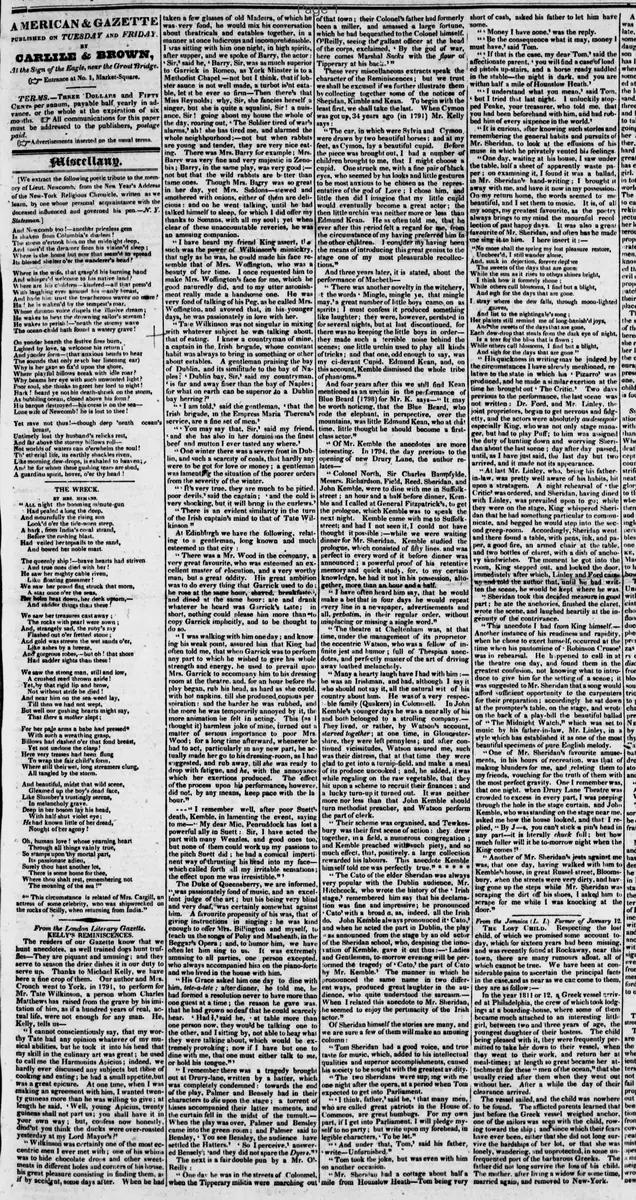
The readers of our Gazette know that we hunt anecdotes, as well trained dogs hunt truffles—They are piquant and amusing; and they serve to season the drier dishes it is our duty to serve up. Thanks to Michael Kelly, we have here a fine crop of them. Our author and Mrs. Crouch went to York, in 1791, to perform for Mr. Tate Wilkinson, a person whom Charles Matthews has raised from the grave by his imitation of him, as if a hundred years of real, actual life, were not enough for any man. He, Kelly, tells us
"I cannot conscientiously say, that my worthy Tate had any opinion whatever of my musical abilities, but he took it into his head that my skill in the culinary art was great; he used to call me the Harmonious Apicius; indeed, we hardly ever discussed any subjects but those of cooking and eating: he had a small appetite, but was a great epicure. At one time, when I was making an agreement with him, I wanted twenty guineas more than he was willing to give; at length he said, Well, young Apicius, twenty guineas shall not part us; you shall have it in your own way;' but, confess now honestly, didn't you think the ducks were over-roasted yesterday at my Lord Mayor's?"
Wilkinson was certainly one of the most eccentric men I ever met with; one of his whims was to hide chocolate drops and other sweetmeats in different holes and corners of his house, his great pleasure consisting in finding them, as if by accident, some days after. When he had taken a few glasses of old Madeira, of which he was very fond, he would mix his conversation about theatricals and eatables together, in a manner at once ludicrous and incomprehensible. I was sitting with him one night, in high spirits after supper, and we spoke of Barry, the actor: 'Sir,' said he, 'Barry, Sir, was as much superior to Garrick in Romeo, as York Minster is to a Methodist Chapel—not but I think, that if lobster sauce is not well made, a turbot isn't eatable, let it be ever so firm—Then there's that Miss Reynolds; why, Sir, she fancies herself a singer, but she is quite a squalini, Sir! a nuisance, Sir! going about my house the whole of the day, roaring out, 'The Soldier tired of war's alarms,' ah! she has tired me, and alarmed the whole neighbourhood;—not but when rabbits are young and tender, they are very nice eating. There was Mrs. Barry for example; Mrs. Barry was very fine and very majestic in Zenobia; Barry, in the same play, was very good;—not but that the wild rabbits are better than tame ones. Though Mrs. Barry was so great in her day, yet Mrs. Siddons—stewed and smothered with onions, either of them are delicious: and on he went talking, until he had talked himself to sleep, for which I did offer my thanks to Somnus, with all my soul; yet when clear of these unaccountable reveries, he was an amusing companion."
"I have heard my friend King assert, that such was the power of Wilkinson's mimicry, that ugly as he was, he could make his face resemble that of Mrs. Woffington, who was a beauty of her time. I once requested him to make Mrs. Woffington's face for me, which he good naturedly did, and to my utter astonishment really made a handsome one. He was very fond of talking of his Peg, as he called Mrs. Woffington, and avowed that, in his younger days, he was passionately in love with her."
"Tate Wilkinson was not singular in mixing with whatever subject he was talking about, that of eating. I knew a countryman of mine, a captain in the Irish brigade, whose constant habit was always to bring in something or other about eatables. A gentleman praising the bay of Dublin, and its similitude to the bay of Naples; 'Dublin bay, Sir,' said my countryman, 'is far and away finer than the bay of Naples: for what on earth can be superior to a Dublin bay herring?'
I am told,' said the gentleman, 'that the Irish brigade, in the Empress Maria Theresa's service, are a fine set of men.'
'You may say that, Sir,' said my friend, 'and she has also in her dominions the finest beef and mutton I ever tasted anywhere.'"
"One winter there was a severe frost in Dublin, and such a scarcity of coals, that hardly any were to be got for love or money; a gentleman was lamenting the situation of the poorer classes from the severity of the winter.
"'Tis very true, they are much to be pitied, poor devils,' said the captain; 'and the cold is very shocking, but it will bring in the curlews.'"
"There is an evident similarity in the turn of the Irish captain's mind to that of Tate Wilkinson."
At Edinburgh we have the following, relating to a gentleman, long known and much esteemed in that city:
"There was a Mr. Wood in the company, a very great favourite, who was esteemed an excellent master of elocution, and a very worthy man, but a great oddity. His great ambition was to do every thing that Garrick used to do; he rose at the same hour, shaved, breakfasted, and dined at the same hour: ate and drank whatever he heard was Garrick's taste; in short, nothing could please him more than to copy Garrick implicitly, and to be thought to do so.
"I was walking with him one day; and knowing his weak point, assured him that King had often told me, that when Garrick was to perform any part to which he wished to give his whole strength and energy, he used to prevail upon Mrs. Garrick to accompany him to his dressing room at the theatre, and, for an hour before the play began, rub his head, as hard as she could, with hot napkins, till she produced copious perspiration: and the harder he was rubbed, and the more he was temporarily annoyed by it, the more animation he felt in acting. This (as I thought it) harmless joke of mine, turned out a matter of serious importance to poor Mrs. Wood; for a long time afterward, whenever he had to act, particularly in any new part, he actually made her go to his dressing-room, as I had suggested, and rub away, till she was ready to drop with fatigue, and he, with the annoyance which her exertions produced. The effect of the process upon his performance, however, did not, by any means, keep pace with the labour."
"I remember well, after poor Suett's death, Kemble, in lamenting the event, saying to me—'My dear Mic, Penruddock has lost a powerful ally in Suett: Sir, I have acted the part with many Weazles, and good ones too; but none of them could work up my passions to the pitch Suett did; he had a comical impertinent way of thrusting his head into my face—which called forth all my irritable sensations; the effect upon me was irresistible.'"
The Duke of Queensberry, we are informed,
"was passionately fond of music, and an excellent judge of the art; but his being very blind and very deaf, was certainly somewhat against him. A favourite propensity of his was, that of giving instructions in singing: he was kind enough to offer Mrs. Billington and myself, to teach us the songs of Polly and Macheath, in the Beggar's Opera; and, to humor him, we have often let him sing to us. It was extremely amusing to all parties, one person excepted, who always accompanied him on the piano-forte and who lived in the house with him.
"His Grace asked him one day to dine with him, tete-a-tete; after dinner, he told me, he had formed a resolution never to have more than one guest at a time; the reason he gave was, that he had grown so deaf that he could scarcely hear. 'Had I,' said he, 'at table more than one person now, they would be talking one to the other, and I sitting by, not able to hear what they were talking about, which would be extremely provoking; now if I have but one to dine with me, that one must either talk to me, or hold his tongue.'"
"I remember there was a tragedy brought out at Drury-lane, written by a hatter, which was completely condemned: towards the end of the play, Palmer and Bensley had in their characters to die upon the stage; a torrent of hisses accompanied their latter moments, and the curtain fell in the midst of the tumult.—When the play was over, Palmer and Bensley came into the green-room; and Palmer said to Bensley, 'You see, Bensley, the audience have settled the Hatters.' 'So I perceive,' answered Bensley; 'and they did not spare the Dyers.'"
The next is a fair double pun by a Mr. O'Reilly:
"One day he was in the streets of Clonmel when the Tipperary militia were marching out of that town: their Colonel's father had formerly been a miller, and amassed a large fortune, which he had bequeathed to the Colonel himself. O'Reilly, seeing the gallant officer at the head of the corps, exclaimed, 'By the god of war, here comes Marshal Sacks with the flour of Tipperary at his back.'"
These very miscellaneous extracts speak the character of the Reminiscences; but we trust we shall be excused if we further illustrate them by collecting together some of the notices of Sheridan, Kemble and Kean. To begin with the least first, we shall take the last. When Cymon was got up, 34 years ago (in 1791) Mr. Kelly says:
"The car, in which were Sylvia and Cymon were drawn by two beautiful horses; and at my feet, as Cymon, lay a beautiful cupid. Before the piece was brought out, I had a number of children brought to me, that I might choose a cupid. One struck me, with a fine pair of black eyes, who seemed by his looks and little gestures to be most anxious to be chosen as the representative of the god of Love; I chose him, and little then did I imagine that my little cupid would eventually become a great actor; the then little urchin was neither more or less than Edmund Kean. He has often told me, that he ever after this period felt a regard for me, from the circumstance of my having preferred him to the other children. I consider my having been the means of introducing this great genius to the stage one of my most pleasurable recollections."
And three years later, it is stated, about the performance of Macbeth—
"There was another novelty in the witchery, in the words 'Mingle, mingle, ye that mingle may,' a great number of little boys came on as spirits; I must confess it produced something like laughter; they were, however, persisted in for several nights, but at last discontinued, for there was no keeping the little boys in order—they made such a terrible noise behind the scenes; one little urchin used to play all kinds of tricks; and that one, odd enough to say, was my ci-devant Cupid, Edmund Kean, and, on this account, Kemble dismissed the whole tribe of phantoms."
And four years after this we still find Kean mentioned as an urchin in the performance of Blue Beard (1798) for Mr. K. says—“It may be worth noticing, that the Blue Beard, who rode the elephant, in perspective, over the mountains, was little Edmund Kean, who at that time, little thought he should become a first-class actor."
"Of Mr. Kemble the anecdotes are more interesting.
In 1794, the day previous to the opening of new Drury Lane, the author relates—
"Colonel North, Sir Charles Bampfylde, Messrs. Richardson, Field, Reed, Sheridan, and John Kemble, were to dine with me in Suffolk-street: an hour and a half before dinner, Kemble and I called at General Fitzpatrick's, to get the prologue, which Kemble was to speak the next night. Kemble came with me to Suffolk-street; and had I not seen it, I could not have thought it possible:—while we were waiting dinner for Mr. Sheridan, Kemble studied the prologue, which consisted of fifty lines, and was perfect in every word of it before dinner was announced; a powerful proof of his retentive memory and quick study, for, to my certain knowledge, he had it not in his possession, altogether, more than an hour and a half."
"I have often heard him say, that he would make a bet that in four days he would repeat every line in a newspaper, advertisements and all, verbatim, in their regular order, without misplacing or missing a single word."
"The theatre at Cheltenham was, at that time, under the management of its proprietor the eccentric Watson, who was a fellow of infinite jest and humor; full of Thespian anecdotes, and perfectly master of the art of driving away loathed melancholy.
"Many a hearty laugh have I had with him;—he was an Irishman, and had, although I say it who should not say it, all the natural wit of his country about him. He was of a very respectable family (Quakers) in Clonmel. In John Kemble's younger days he was a near ally of his and both belonged to a strolling company.—They lived, or rather, by Watson's account, starved together; at one time, in Gloucestershire, they were left penniless; and after continued vicissitudes, Watson assured me, such was their distress, that at that time they were glad to get into a turnip-field, and make a meal of its produce uncooked; and, he added, it was while regaling on the raw vegetable, that they hit upon a scheme to recruit their finances; and a lucky turn-up it turned out. It was neither more nor less than that John Kemble should turn methodist preacher, and Watson perform the part of clerk.
"Their scheme was organised, and Tewkesbury was their first scene of action: they drew together, in a field, a numerous congregation; and Kemble preached with such piety, and so much effect, that, positively, a large collection rewarded his labours. This anecdote Kemble himself told me was perfectly true."
"The Cato of the elder Sheridan was always very popular with the Dublin audience, Mr. Hitchcock, who wrote the history of the 'Irish stage,' remembered him say that his declamation was fine and impressive; he pronounced 'Cato' with a broad a, as, indeed, all the Irish do. John Kemble always pronounced it 'Cato,' and when he acted the part in Dublin, the play was announced from the stage by an old actor of the Sheridan school, who, despising the innovation of Kemble, gave it out thus:—'Ladies and Gentlemen, to-morrow evening will be performed the tragedy of 'Cato,' the part of 'Cato' by Mr. Kemble.' The manner in which he pronounced the same name in two different ways, produced great laughter in the audience, who quite understood the sarcasm.—When I related this anecdote to Mr. Sheridan, he seemed to enjoy the pertinacity of the Irish actor."
Of Sheridan himself the stories are many, and we are sure a few of them will make an amusing column:
"Tom Sheridan had a good voice, and true taste for music, which, added to his intellectual qualities and superior accomplishments, caused his society to be sought with the greatest avidity.
"The two Sheridans were supping with me one night after the opera, at a period when Tom expected to get into Parliament.
"'I think, father,' said he, 'that many men, who are called great patriots in the House of Commons, are great humbugs. For my own part, if I get into Parliament, I will pledge myself to no party; but write upon my forehead, in legible characters, 'To be let.'"
"'And under that, Tom,' said his father, 'write—Unfurnished.'"
"Tom took the joke, but was even with him on another occasion.
Mr. Sheridan had a cottage about half a mile from Hounslow Heath—Tom being very short of cash, asked his father to let him have some.
"'Money I have none,' was the reply.
"'Be the consequence what it may, money I must have,' said Tom.
"'If that is the case, my dear Tom,' said the affectionate parent, 'you will find a case of loaded pistols up-stairs, and a horse ready saddled in the stable—the night is dark, and you are within half a mile of Hounslow Heath.'"
"'I understand what you mean,' said Tom, 'but I tried that last night. I unluckily stopped Peake, your treasurer, who told me, that you had been beforehand with him, and had robbed him of every sixpence in the world.'"
"It is curious, after knowing such stories and remembering the general habits and pursuits of Mr. Sheridan, to look at the effusions of his muse in which he privately vented his feelings.
"One day, waiting at his house, I saw under the table, half a sheet of apparently waste paper: on examining it, I found it was a ballad, in Mr. Sheridan's hand-writing; I brought it away with me, and have it now in my possession. On my return home, the words seemed to me beautiful, and I set them to music. It is, of all my songs, my greatest favourite, as the poetry always brings to my mind the mournful recollection of past happy days. It was also a great favourite of Mr. Sheridan, and often has he made me sing it to him. I here insert it:—
"No more shall the spring my lost pleasure restore,
Uncheer'd, I still wander alone,
And sunk in dejection, forever deplore
The sweets of the days that are gone:
While the sun as it rises to others shines bright,
I think how it formerly shone;
While others cull blossoms, I find but a blight,
And sigh for the days that are gone.
I stray where the dew falls, through moon-lighted groves,
And list to the nightingale's song;
Her plaints still remind me of long-banish'd joys,
And the sweets of the days that are gone.
Each dew-drop that steals from the dark eye of night,
Is a tear for the bliss that is flown;
While others cull blossoms, I find but a blight,
And sigh for the days that are gone."
"His quickness in writing may be judged by the circumstances I have already mentioned, relative to the state in which his 'Pizarro' was produced, and he made a similar exertion at the time he brought out 'The Critic.' Two days previous to the performance, the last scene was not written: Dr. Ford, and Mr. Linley, the joint proprietors, began to get nervous and fidgetty, and the actors were absolutely au desespoir especially King, who was not only stage manager, but had to play Puff; to him was assigned the duty of hunting down and worrying Sheridan about the last scene; day after day passed, until, as I have just said, the last day but two arrived, and it made not its appearance.
At last Mr. Linley, who, being his father-in-law, was pretty well aware of his habits, hit upon a stratagem. A night rehearsal of 'The Critic' was ordered, and Sheridan, having dined with Linley, was prevailed upon to go; while they were on the stage, King whispered Sheridan that he had something particular to communicate, and begged he would step into the second green-room. Accordingly, Sheridan went and there found a table, with pens, ink, and paper, a good fire, an armed chair at the table, and two bottles of claret, with a dish of anchovy sandwiches. The moment he got into the room, King stepped out, and locked the door. Immediately after which, Linley and Ford came up and told the author that, until he had written the scene, he would be kept where he was.
"Sheridan took this decided measure in good part; he ate the anchovies, finished the claret, wrote the scene, and laughed heartily at the ingenuity of the contrivance.
"This anecdote I had from King himself.—Another instance of his readiness and rapidity, when he chose to exert himself, occurred at the time when his pantomime of 'Robinson Crusoe' was in rehearsal. He happened to call in at the theatre one day, and found them in the greatest confusion, not knowing what to introduce to give him for the setting of a scene; it was suggested to Mr. Sheridan that a song would afford sufficient opportunity to the carpenters for their preparation; accordingly he sat down at the prompter's table, on the stage, and wrote on the back of a play-bill the beautiful ballad of 'The Midnight Watch,' which was set to music by his father-in-law, Mr. Linley, in a style which has established it as one of the most beautiful specimens of pure English melody.
One of Mr. Sheridan's favourite amusements, in his hours of recreation, was that of making blunders for me, and relating them to my friends, vouching for the truth of them with the most perfect gravity. One I remember was, that one night, when Drury Lane Theatre was crowded to excess in every part, I was peeping through the hole in the stage curtain, and John Kemble, who was standing on the stage near me, asked me how the house looked, and that I replied, 'By J—s, you can't stick a pin's head in any part—it is literally chuck full; but how much fuller will it be to-morrow night when the King comes!'
"Another of Mr. Sheridan's jests against me was, that one day, having walked with him to Kemble's house, in great Russell-street, Bloomsbury, when the streets were very dirty, and having gone up the steps while Mr. Sheridan was scraping the dirt off his shoes, I asked him to scrape for me while I was knocking at the door."
What sub-type of article is it?
What themes does it cover?
What keywords are associated?
What entities or persons were involved?
Literary Details
Title
Kelly's Reminiscences
Author
Michael Kelly
Subject
Anecdotes From The Theater World
Form / Style
Anecdotal Prose Memoir Excerpts With Dialogues
Key Lines