Thank you for visiting SNEWPapers!
Sign up free
Winchester Gazette
Winchester, Virginia
What is this article about?
A Virginian urges removal of Virginia's seat of government from Richmond to a central interior location for equity, convenience, safety, and cost savings, arguing no new taxes needed and annual state expenses reduced by $65,000 through lower legislator pay, no public guard, and shorter sessions.
Merged-components note: These two components continue the same letter to the editor discussing the removal of the seat of government from Richmond; the second was mislabeled as editorial but is part of the reader letter signed 'A VIRGINIAN.'
Clippings
1 of 2
OCR Quality
Full Text
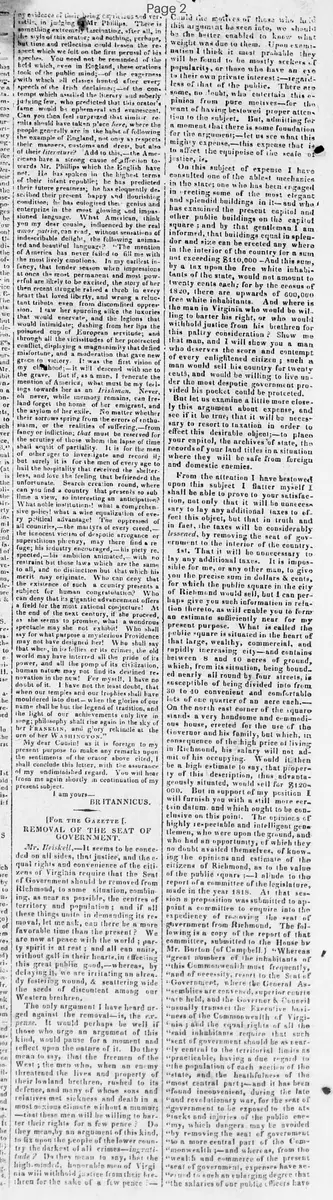
REMOVAL OF THE SEAT OF GOVERNMENT.
Mr. Heiskell,-It seems to be conceded on all sides, that justice, and the equal rights and convenience of the citizens of Virginia require that the Seat of Government should be removed from Richmond, to some situation, combining, as near as possible, the centres of territory and population; and if all these things unite in demanding its removal, let me ask, can there be a more favorable time than the present? We are now at peace with the world; party spirit is at rest; and all can unite, without gall in their hearts, in effecting this great public good,-whereas, by delaying it, we are irritating an already festering wound, & scattering wide the seeds of discontent among our Western brethren,
The only argument I have heard urged against the removal-is, the expense. It would perhaps be well if those who urge an argument of this kind, would pause for a moment and reflect upon the nature of it. Do they mean to say, that the freemen of the West ; the men who, when an enemy threatened the lives and property of their lowland brethren, rushed to its defence, and many of whose sons and relatives met sickness and death in a most anxious climate without a murmur; —that these men will be willing to barter their rights for a few pence? Do they mean, by an argument of this kind, to fix upon the people of the lower country the darkest of all crimes--ingratitude? Do they mean to say, that the high-minded, honorable men of Virginia will withhold justice from their brethren for the sake of a few pence :-
Could the motives of those who use this argument be seen into, we should be the better enabled to know what weight was due to them. Upon examination I think it most probable they will be found to be mostly seekers of popularity, or those who have an eye to their own private interest;-regardless of that of the public. There are some, no doubt, who entertain this opinion from pure motives-for the want of having bestowed proper attention to the subject. But, admitting for a moment that there is some foundation for the argument;-let us see what this mighty expense,--this expense that is to affect the equipoise of the scale of justice, is.
On this subject of expense I have consulted one of the ablest mechanics in the state; one who has been engaged in erecting some of the most elegant and splendid buildings in it-and who has examined the present capitol and other public buildings on the capitol square ; and by that gentleman I am informed, that buildings equal in splendor and size can be erected anywhere in the interior of the country for a sum not exceeding $110,000 -And this sum, by a tax upon the free white inhabitants of the state, would not amount to twenty cents each; for by the census of 1820, there are upwards of 500,000 free white inhabitants. And where is the man in Virginia who would be willing to barter his right, or who would withhold justice from his brethren for this paltry consideration ? Show me that man, and I will shew you a man who deserves the scorn and contempt of every enlightened citizen ; such a man would sell his country for twenty cents, and would be willing to live under the most despotic government provided his pocket could be protected.
But let us examine a little more closely this argument about expense, and see if it be true, that it will be necessary to resort to taxation in order to effect this desirable object;-to place your capitol, the archives of state, the records of your land titles in a situation where they will be safe from foreign and domestic enemies.
From the attention I have bestowed upon this subject I flatter myself I shall be able to prove to your satisfaction, not only that it will be unnecessary to lay any additional taxes to effect this object, but that in truth and in fact, the taxes will be considerably lessened, by removing the seat of government to the interior of the country- 1st. That it will be unnecessary to lay any additional taxes. It is impossible for me, or any other man, to give you the precise sum in dollars & cents, for which the public square in the city of Richmond would sell, but I can perhaps give you such information in relation thereto, as will enable you to form an estimate sufficiently near for my present purpose. What is called the public square is situated in the heart of that large, wealthy, commercial, and rapidly increasing city-and contains between 8 and 10 acres of ground, which, from its situation, being bounded nearly all round by four streets, is susceptible of being divided into from 30 to 40 convenient and comfortable lots of one quarter of an acre each.-- On the north-east corner of the square stands a very handsome and commodious house, erected for the use of the Governor and his Family, but which, in consequence of the high price of living in Richmond, his salary will not admit of his occupying. Would it then be a high estimate to say, that property of this description, thus advantageously situated, would sell for $120,000. But in support of my position I will furnish you with a still more certain datum. and which ought to be conclusive on this point. The opinions of highly respectable and intelligent gentlemen, who were upon the ground, and who had an opportunity, of which they no doubt availed themselves, of knowing the opinions and estimate of the citizens of Richmond, as to the value of the public square ;-) I allude to the report of a committee of the legislature, made in the year 1818. At that session a proposition was submitted to appoint a committee to enquire into the expediency of removing the seat of government from Richmond. The following is a copy of the report of that committee, submitted to the House by Mr. Burton (of Campbell.) "Whereas great numbers of the inhabitants of this Commonwealth must frequently, and of necessity, resort to the Seat of Government, where the General Assemblies are convened, superior courts are held, and the Governor & Council usually transact the Executive business of the Commonwealth of Virginia : and the equal rights of all the said inhabitants require that such seat of government should be as nearly central to the territorial limits as practicable, having a due regard to the population of each section of the state, and the healthfulness of the most central parts--and it has been found inconvenient, during the late and revolutionary war. for the seat of government to be exposed to the attacks and injuries of the public enemy, which dangers may be avoided by removing the seat of government to a more central part of the Commonwealth ;and whereas, from the wealth and commerce of the present seat of government, expenses have accrued to such an enlarging degree that the salaries of our public officers have
The immense guide inadequate to their support and maintenance in the city of Richmond, but your committee do humbly conceive that they would be adequate in a central part of the Commonwealth—and your committee are further informed and believe, that it will not be a pecuniary inconvenience to the good people of this commonwealth to remove the Seat of Government, as all the public property in the city of Richmond will sell for a price sufficient to defray any expenses that may arise in erecting better public buildings in any other part of the state. Are not these facts, and the report of this respectable committee, sufficient to authorize me in saying, that no additional taxes will be necessary in order to effect a removal of the seat of government? Believing that they will be so considered by candid and reflecting men, I forbear to take notice of other public property, which right, in case of necessity, be resorted to, and come now to the second part of the enquiry—which is, That by a removal of the seat of government to a central and healthy situation, the taxes, or expenses of the state, may be considerably lessened.
This may, at the first blush, be a bold assertion—but in my humble opinion, it is not less bold than true.
It is a fact, known I presume to every man, that at the sessions of 1819-20 an act passed raising the wages of the members of the general assembly from three dollars per day to four—which act still continues, and ought to continue in force as long as your seat of government remains at Richmond. The principal reason urged in favor of an increase of the pay of the members, was, the high and extravagant price of living in Richmond. It was said, and surely not without truth, that three dollars per day would not support a member comfortably and decently in the city of Richmond;—by removing then your seat of government from Richmond, to the interior of the country, where luxury and extravagance do not so much abound—where the main necessaries of life are to be had in great abundance, and from 25 to 33 1-3 per cent cheaper than in Richmond,—you at once take away the reason of continuing their pay at four dollars—and by the reduction of the pay from 4 to 3 you reduce the expenses of the General Assembly one fourth—which, estimating the expenses at $100,000, & that was the expense of the last General Assembly, will be an annual saving to the state of $25,000. By removing the seat of government to the interior of the country, the public guard which is kept up in the city of Richmond at an expense of $15,000 a year, for the protection of our public property, might be dispensed with. The object in first establishing a public guard, was the protection and security of the public property, in case of insurrection.—Now by a removal of the seat of government to the interior of the country, no danger whatever is to be apprehended from any thing of this sort; the slave population being thin and much dispersed.
Again; by removing the Seat of Government to a healthy situation in the interior of the Country, the Session of the Legislature might be changed from the cold, cheerless and disagreeable winter, to the Summer or Fall;—by which means the Sessions would be greatly abridged. It is a fact well known to every man who has had any experience in Legislation, that in consequence of the shortness of the days in the winter season, the House cannot, for the two first months in each session, meet with convenience before 12 o'clock, and continue in session longer than 3 o'clock—making a session of three hours—whereas, in the summer or fall, when the days are long and the mornings pleasant, they could, with as much ease, meet at 10 o'clock, as they can in the winter at 12—and sit until 4—making the session six, instead of three hours.—By this rule the sessions would be abridged one half: which, estimating the expense to be (after the reduction of the pay to $3) $75,000, would be a saving to the state of one half; (deducting the mileage) but, mileage and all considered, it would abridge the session, say, one third—which would be $25,000 annually saved to the Commonwealth.
Many other reasons might be urged in favor of a Summer or Fall session: permit me barely to suggest one—Would it not have the effect of introducing more talents in our Legislature? The idea of a man's being absent from his business, and separated from his family, between two and three months in each year, are sacrifices of interest and feeling, which many men of talents are unwilling to make,—and the summer is the time when many of our brethren of the lower country, select to visit the upper; that they may avoid the sickly season, which commences in the lower country about the month of August. If I am correct in these estimates, then it follows that there would be saved the following sums to the state, viz:
By reducing the pay from $4 to 3, $25,000
By dispensing with the Public Guard, 15,000
By abridgement of the sessions, 25,000
making in the whole the sum of sixty-five thousand dollars saved annually to the state! a sum sufficient in two years to defray all the expenses of a removal of the seat of government.
A VIRGINIAN.
What sub-type of article is it?
What themes does it cover?
What keywords are associated?
What entities or persons were involved?
Letter to Editor Details
Author
A Virginian
Recipient
Mr. Heiskell
Main Argument
the seat of government should be removed from richmond to a central interior location in virginia to ensure justice and convenience for all citizens, especially western ones, as it is feasible without additional taxes—public property sale would cover costs—and would reduce state expenses by $65,000 annually through lower legislator pay, eliminating the public guard, and shorter sessions.
Notable Details