Thank you for visiting SNEWPapers!
Sign up free
Literary
September 10, 1915
The Owosso Times
Owosso, Shiawassee County, Michigan
What is this article about?
In the frontier town of Deadshot, men impose a $1,000 fine per bullet for gunplay to protect women and children, funding an orphan asylum. Desperado Arkansaw Bill defies the law until eliminated by Mrs. Billings, saving her husband and bringing peace. The town civilizes and renames in her honor.
Clipping
OCR Quality
85%
Good
Full Text
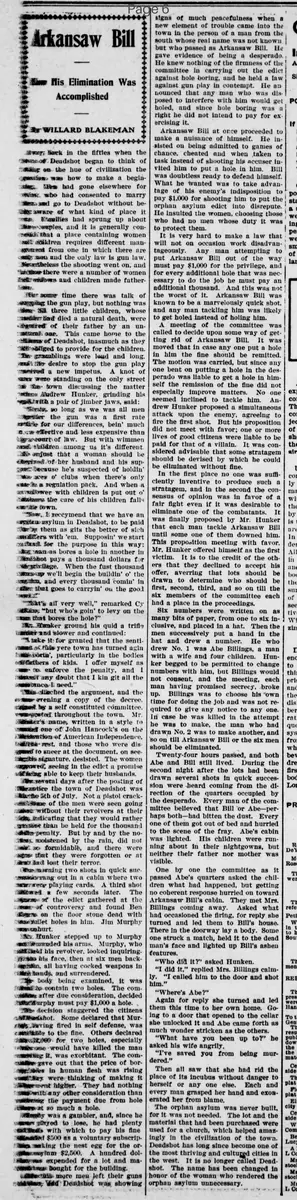
Arkansaw Bill
His Elimination
Was Accomplished
S. WILLARD BLAKEMAN
Grey Dane in the fifties when the
said Deadshot began to think of
a touch of civilization the
Cañada was
how to make a begin-
ning.
Miss
had gone elsewhere for
her honeymoon, who had consented to marry
her and go to Deadshot without be-
coming aware of what kind of place it
was. Families had sprung up about
the staples, and it is generally con-
sidered a place containing women
and children requires different man-
agement from one in which there are
cowboys and the only law is gun law.
Lawless the shooting went on, and
yet there were a number of women
and grateful children made father-
less some time there was talk of
the gun play, but nothing was
done until three little children, whose
father had died a natural death, were
carried off their father by an un-
usual one. This came home to the
men of Deadshot, inasmuch as they
were obliged to provide for the children.
The grumblings were loud and long.
By desire to stop the gun play
gave a new impetus. A knot of
men were standing on the only street
in town discussing the matter
and Andrew Hunker, grinding his
teeth with a pair of timber jaws, said:
"Gent, so long as we was all men
over the gun was a first rate
sort for our differences, bein' much
more active and less expensive than
practice of law. But with wimmen
and children among us it's different.
I trust that a woman should be
widowed of her husband and his sup-
port because he's suspected of holdin'
a stacked deck when there's only
a straight regulation pack. And when a
man with children is put out of
business the care of his children falls
on the whole town.
"I recommend that we have an
orphan asylum in Deadshot, to be paid
for by them as gits the better of sich
quarrels with 'em. Supposin' we start
collectin' for the purpose in this way:
When one man bores a hole in another he
pays a thousand dollars for the
privilege. When the fust thousand
is in we'll begin the buildin' o' the
asylum, and every thousand comin' in
goes to carryin' on the school
at all very well," remarked Cy
Baker; "but who's goin' to levy on the
man that bores the hole?"
Hunker ground his quid a little
harder and slower and continued:
"Take it for granted that the senti-
ment of this yere town has turned agin
gunplay, particularly in the vicinity
of kids. I offer myself as
one to enforce the penalty, and I
have no doubt that I kin git all the
assistance-I need."
This clinched the argument, and the
self-constituted committee
circulated a copy of the decree.
The news was posted throughout the town. Mr.
Hunker's name, written in a style to
remind one of John Hancock's on the
Declaration of American Independence.
The rest, and those who were dis-
posed to sneer at the document, on seeing
its signature, desisted. The women
wept, seeing in the edict a promise
of being able to keep their husbands
alive several days after the posting of
the notice the town of Deadshot was
as quiet as the 5th of July. Not a pistol crack-
was heard, and some of the men were seen going
about their business without their revolvers at their
hips, indicating that they would rather
mingle than be held for the thousand
dollar penalty. But by and by the no-
tice, moistened by the rain, did not
look so formidable, and there were
signs that they were forgotten or at
least had lost their terror.
Two shots in quick suc-
cession rang out in a cabin where two
men were playing cards. A third shot
followed a few seconds later. The
signs of the edict gathered at the
scene of the controversy and found Ben
Landy on the floor stone dead with
two bullet holes in him. Jim Murphy
was unhurt.
Mr. Hunker stepped up to Murphy
and commanded his arms. Murphy, who
had dropped his revolver, looked inquiring-
ly in his face, then at six men back-
ing him, all having cocked weapons in
their hands, and surrendered.
The body being examined, it was
found to contain two holes. The com-
mittee, after due consideration, decided
that Murphy must pay $1,000 a hole.
A decision staggered the citizens
of Deadshot. Some declared that Mur-
phy, having fired in self defense, was
not liable to the fine. Others declared
that $1,000 for two holes, especially
at such close range, would have killed the man
anyway; it was exorbitant. The com-
mittee held out that the price of bor-
ing holes in human flesh was rising
rapidly, and some were thinking of making it
still higher. They had nothing
but humanity as their consideration than
variety; the payment due from hole to hole
was not so much a hole
as a principle.
Landy was a gambler, and, since he
was always prepared to lose, he had plenty
of money with which to pay his fine.
He added $500 as a voluntary subscrip-
tion, making the nest egg for the or-
phan asylum fund $2,500. A hundred dol-
lars expended for a lot and ma-
terial bought for the building.
After this more men left their guns
at home; Deadshot was showing
signs of much peacefulness when a
new element of trouble came into the
town in the person of a man from the
south whose real name was not known
but who passed as Arkansaw Bill. He
gave evidence of being a desperado.
He knew nothing of the firmness of the
committee in carrying out the edict
against hole boring, and he held a law
against gun play in contempt. He an-
nounced that any man who was dis-
posed to interfere with him would get
holed, and since hole boring was a
right he did not intend to pay for ex-
ercising it.
Arkansaw Bill at once proceeded to
make a nuisance of himself. He in-
sisted on being admitted to games of
chance, cheated and when taken to
task instead of shooting his accuser in-
vited him to put a hole in him. Bill
was doubtless ready to defend himself.
What he wanted was to take advan-
tage of his enemy's indisposition to
pay $1,000 for shooting him to put the
orphan asylum edict into disrepute.
He insulted the women, choosing those
who had no men whose duty it was
to protect them.
It is very hard to make a law that
will not on occasion work disadvan-
tageously. Any man attempting to
put Arkansaw Bill out of the way
must pay $1,000 for the privilege, and
for every additional hole that was nec-
essary to do the job he must pay an
additional thousand. And this was not
the worst of it. Arkansaw Bill was
known to be a marvelously quick shot.
and any man tackling him was likely
to get holed instead of holing him.
A meeting of the committee was
called to decide upon some way of get-
ting rid of Arkansaw Bill. It was
moved that in case any one put a hole
in him the fine should be remitted.
The motion was carried, but since any
one bent on putting a hole in the des-
perado was liable to get a hole in him
self the remission of the fine did not
especially improve matters. No one
seemed inclined to tackle him. An-
drew Hunker proposed a simultaneous
attack upon the enemy, agreeing to
fire the first shot. But his proposition
did not meet with favor; one or more
lives of good citizens were liable to be
paid for that of a villain. It was con-
sidered advisable that some stratagem
should be devised by which he could
be eliminated without fine.
In the first place no one was suffi-
iently inventive to produce such a
stratagem, and in the second the con-
sensus of opinion was in favor of a
fair fight even if it was desirable to
eliminate one of the combatants. It
was finally proposed by Mr. Hunker
that each man tackle Arkansaw Bill
until some one of them downed him.
This proposition meeting with favor,
Mr. Hunker offered himself as the first
victim. It is to the credit of the oth-
ers that they declined to accept his
offer, averring that lots should be
drawn to determine who should be
first, second, third, and so on till the
six members of the committee each
had a place in the proceedings.
Six numbers were written on as
many bits of paper, from one to six in-
clusive, and placed in a hat. Then the
men successively put a hand in the
hat and drew a number. He who
drew No. 1 was Abe Billings, a man
with a wife and four children. Hun-
ker begged to be permitted to change
numbers with him, but Billings would
not consent, and the meeting, each
man having promised secrecy, broke
up.
Billings was to choose his own
time for doing the job and was not re-
quired to give any notice to any one.
In case he was killed in the attempt
he was to make, the man who had
drawn No. 2 was to make another, and
so on till Arkansaw Bill or the six men
should be eliminated.
Twenty-four hours passed, and both
Abe and Bill still lived. During the
second night after the lots had been
drawn several shots in quick succes-
sion were heard coming from the di-
rection of the quarters occupied by
the desperado. Every man of the com-
mittee believed that Bill or Abe-per-
haps both-had bitten the dust. Every
one of them got out of bed and hurried
to the scene of the fray. Abe's cabin
was lighted. His children were run-
ning about in their nightgowns, but
neither their father nor mother was
visible.
One by one the committee as it
passed Abe's quarters asked the chil-
dren what had happened, but getting
no coherent response hurried on toward
Arkansaw Bill's cabin. They met Mrs.
Billings coming away. Asked what
had occasioned the firing, for reply she
turned and led them to Bill's house.
There in the doorway lay a body. Some
one struck a match, held it to the dead
man's face and lighted up Bill's ashen
features.
"Who did it?" asked Hunker.
"I did it," replied Mrs. Billings caIm-
ly. "I called him to the door and shot
him."
"Where's Abe?"
Again for reply she turned and led
them this time to her own home. Go-
ing to a door that opened to the cellar
she unlocked it and Abe came forth as
much wonder stricken as the others.
"What have you been up to?" he
asked his wife angrily.
"I've saved you from being mur-
dered."
Then all saw that she had rid the
place of its incubus without danger to
herself or any one else. Each and
every man grasped her hand and exon-
erated her from blame.
The orphan asylum was never built
for it was not needed. The lot and the
material that had been purchased were
used for a church, which helped amaz-
ingly in the civilization of the town.
Deadshot has long since become one of
the most thriving and cultured cities in
the west. It is no longer called Dead-
shot. The name has been changed in
honor of the woman who rendered the
orphan asylum unnecessary.
His Elimination
Was Accomplished
S. WILLARD BLAKEMAN
Grey Dane in the fifties when the
said Deadshot began to think of
a touch of civilization the
Cañada was
how to make a begin-
ning.
Miss
had gone elsewhere for
her honeymoon, who had consented to marry
her and go to Deadshot without be-
coming aware of what kind of place it
was. Families had sprung up about
the staples, and it is generally con-
sidered a place containing women
and children requires different man-
agement from one in which there are
cowboys and the only law is gun law.
Lawless the shooting went on, and
yet there were a number of women
and grateful children made father-
less some time there was talk of
the gun play, but nothing was
done until three little children, whose
father had died a natural death, were
carried off their father by an un-
usual one. This came home to the
men of Deadshot, inasmuch as they
were obliged to provide for the children.
The grumblings were loud and long.
By desire to stop the gun play
gave a new impetus. A knot of
men were standing on the only street
in town discussing the matter
and Andrew Hunker, grinding his
teeth with a pair of timber jaws, said:
"Gent, so long as we was all men
over the gun was a first rate
sort for our differences, bein' much
more active and less expensive than
practice of law. But with wimmen
and children among us it's different.
I trust that a woman should be
widowed of her husband and his sup-
port because he's suspected of holdin'
a stacked deck when there's only
a straight regulation pack. And when a
man with children is put out of
business the care of his children falls
on the whole town.
"I recommend that we have an
orphan asylum in Deadshot, to be paid
for by them as gits the better of sich
quarrels with 'em. Supposin' we start
collectin' for the purpose in this way:
When one man bores a hole in another he
pays a thousand dollars for the
privilege. When the fust thousand
is in we'll begin the buildin' o' the
asylum, and every thousand comin' in
goes to carryin' on the school
at all very well," remarked Cy
Baker; "but who's goin' to levy on the
man that bores the hole?"
Hunker ground his quid a little
harder and slower and continued:
"Take it for granted that the senti-
ment of this yere town has turned agin
gunplay, particularly in the vicinity
of kids. I offer myself as
one to enforce the penalty, and I
have no doubt that I kin git all the
assistance-I need."
This clinched the argument, and the
self-constituted committee
circulated a copy of the decree.
The news was posted throughout the town. Mr.
Hunker's name, written in a style to
remind one of John Hancock's on the
Declaration of American Independence.
The rest, and those who were dis-
posed to sneer at the document, on seeing
its signature, desisted. The women
wept, seeing in the edict a promise
of being able to keep their husbands
alive several days after the posting of
the notice the town of Deadshot was
as quiet as the 5th of July. Not a pistol crack-
was heard, and some of the men were seen going
about their business without their revolvers at their
hips, indicating that they would rather
mingle than be held for the thousand
dollar penalty. But by and by the no-
tice, moistened by the rain, did not
look so formidable, and there were
signs that they were forgotten or at
least had lost their terror.
Two shots in quick suc-
cession rang out in a cabin where two
men were playing cards. A third shot
followed a few seconds later. The
signs of the edict gathered at the
scene of the controversy and found Ben
Landy on the floor stone dead with
two bullet holes in him. Jim Murphy
was unhurt.
Mr. Hunker stepped up to Murphy
and commanded his arms. Murphy, who
had dropped his revolver, looked inquiring-
ly in his face, then at six men back-
ing him, all having cocked weapons in
their hands, and surrendered.
The body being examined, it was
found to contain two holes. The com-
mittee, after due consideration, decided
that Murphy must pay $1,000 a hole.
A decision staggered the citizens
of Deadshot. Some declared that Mur-
phy, having fired in self defense, was
not liable to the fine. Others declared
that $1,000 for two holes, especially
at such close range, would have killed the man
anyway; it was exorbitant. The com-
mittee held out that the price of bor-
ing holes in human flesh was rising
rapidly, and some were thinking of making it
still higher. They had nothing
but humanity as their consideration than
variety; the payment due from hole to hole
was not so much a hole
as a principle.
Landy was a gambler, and, since he
was always prepared to lose, he had plenty
of money with which to pay his fine.
He added $500 as a voluntary subscrip-
tion, making the nest egg for the or-
phan asylum fund $2,500. A hundred dol-
lars expended for a lot and ma-
terial bought for the building.
After this more men left their guns
at home; Deadshot was showing
signs of much peacefulness when a
new element of trouble came into the
town in the person of a man from the
south whose real name was not known
but who passed as Arkansaw Bill. He
gave evidence of being a desperado.
He knew nothing of the firmness of the
committee in carrying out the edict
against hole boring, and he held a law
against gun play in contempt. He an-
nounced that any man who was dis-
posed to interfere with him would get
holed, and since hole boring was a
right he did not intend to pay for ex-
ercising it.
Arkansaw Bill at once proceeded to
make a nuisance of himself. He in-
sisted on being admitted to games of
chance, cheated and when taken to
task instead of shooting his accuser in-
vited him to put a hole in him. Bill
was doubtless ready to defend himself.
What he wanted was to take advan-
tage of his enemy's indisposition to
pay $1,000 for shooting him to put the
orphan asylum edict into disrepute.
He insulted the women, choosing those
who had no men whose duty it was
to protect them.
It is very hard to make a law that
will not on occasion work disadvan-
tageously. Any man attempting to
put Arkansaw Bill out of the way
must pay $1,000 for the privilege, and
for every additional hole that was nec-
essary to do the job he must pay an
additional thousand. And this was not
the worst of it. Arkansaw Bill was
known to be a marvelously quick shot.
and any man tackling him was likely
to get holed instead of holing him.
A meeting of the committee was
called to decide upon some way of get-
ting rid of Arkansaw Bill. It was
moved that in case any one put a hole
in him the fine should be remitted.
The motion was carried, but since any
one bent on putting a hole in the des-
perado was liable to get a hole in him
self the remission of the fine did not
especially improve matters. No one
seemed inclined to tackle him. An-
drew Hunker proposed a simultaneous
attack upon the enemy, agreeing to
fire the first shot. But his proposition
did not meet with favor; one or more
lives of good citizens were liable to be
paid for that of a villain. It was con-
sidered advisable that some stratagem
should be devised by which he could
be eliminated without fine.
In the first place no one was suffi-
iently inventive to produce such a
stratagem, and in the second the con-
sensus of opinion was in favor of a
fair fight even if it was desirable to
eliminate one of the combatants. It
was finally proposed by Mr. Hunker
that each man tackle Arkansaw Bill
until some one of them downed him.
This proposition meeting with favor,
Mr. Hunker offered himself as the first
victim. It is to the credit of the oth-
ers that they declined to accept his
offer, averring that lots should be
drawn to determine who should be
first, second, third, and so on till the
six members of the committee each
had a place in the proceedings.
Six numbers were written on as
many bits of paper, from one to six in-
clusive, and placed in a hat. Then the
men successively put a hand in the
hat and drew a number. He who
drew No. 1 was Abe Billings, a man
with a wife and four children. Hun-
ker begged to be permitted to change
numbers with him, but Billings would
not consent, and the meeting, each
man having promised secrecy, broke
up.
Billings was to choose his own
time for doing the job and was not re-
quired to give any notice to any one.
In case he was killed in the attempt
he was to make, the man who had
drawn No. 2 was to make another, and
so on till Arkansaw Bill or the six men
should be eliminated.
Twenty-four hours passed, and both
Abe and Bill still lived. During the
second night after the lots had been
drawn several shots in quick succes-
sion were heard coming from the di-
rection of the quarters occupied by
the desperado. Every man of the com-
mittee believed that Bill or Abe-per-
haps both-had bitten the dust. Every
one of them got out of bed and hurried
to the scene of the fray. Abe's cabin
was lighted. His children were run-
ning about in their nightgowns, but
neither their father nor mother was
visible.
One by one the committee as it
passed Abe's quarters asked the chil-
dren what had happened, but getting
no coherent response hurried on toward
Arkansaw Bill's cabin. They met Mrs.
Billings coming away. Asked what
had occasioned the firing, for reply she
turned and led them to Bill's house.
There in the doorway lay a body. Some
one struck a match, held it to the dead
man's face and lighted up Bill's ashen
features.
"Who did it?" asked Hunker.
"I did it," replied Mrs. Billings caIm-
ly. "I called him to the door and shot
him."
"Where's Abe?"
Again for reply she turned and led
them this time to her own home. Go-
ing to a door that opened to the cellar
she unlocked it and Abe came forth as
much wonder stricken as the others.
"What have you been up to?" he
asked his wife angrily.
"I've saved you from being mur-
dered."
Then all saw that she had rid the
place of its incubus without danger to
herself or any one else. Each and
every man grasped her hand and exon-
erated her from blame.
The orphan asylum was never built
for it was not needed. The lot and the
material that had been purchased were
used for a church, which helped amaz-
ingly in the civilization of the town.
Deadshot has long since become one of
the most thriving and cultured cities in
the west. It is no longer called Dead-
shot. The name has been changed in
honor of the woman who rendered the
orphan asylum unnecessary.
What sub-type of article is it?
Prose Fiction
Satire
What themes does it cover?
Political
Moral Virtue
War Peace
What keywords are associated?
Western Tale
Gun Law
Desperado
Orphan Asylum
Frontier Justice
Civilizing Town
What entities or persons were involved?
S. Willard Blakeman
Literary Details
Title
Arkansaw Bill His Elimination Was Accomplished
Author
S. Willard Blakeman
Key Lines
"Gent, So Long As We Was All Men Over The Gun Was A First Rate Sort For Our Differences, Bein' Much More Active And Less Expensive Than Practice Of Law. But With Wimmen And Children Among Us It's Different."
"I Recommend That We Have An Orphan Asylum In Deadshot, To Be Paid For By Them As Gits The Better Of Sich Quarrels With 'Em."
"I Did It," Replied Mrs. Billings Calmly. "I Called Him To The Door And Shot Him."