Thank you for visiting SNEWPapers!
Sign up free
Story
February 14, 1879
The Charlotte Democrat
Charlotte, Mecklenburg County, North Carolina
What is this article about?
Article compares wages and commodity prices from 1200 to modern times, noting labor pay has increased over sevenfold while food costs rose less, easing subsistence but fueling discontent as desires outpace means. Source: N.Y. Times.
Clipping
OCR Quality
95%
Excellent
Full Text
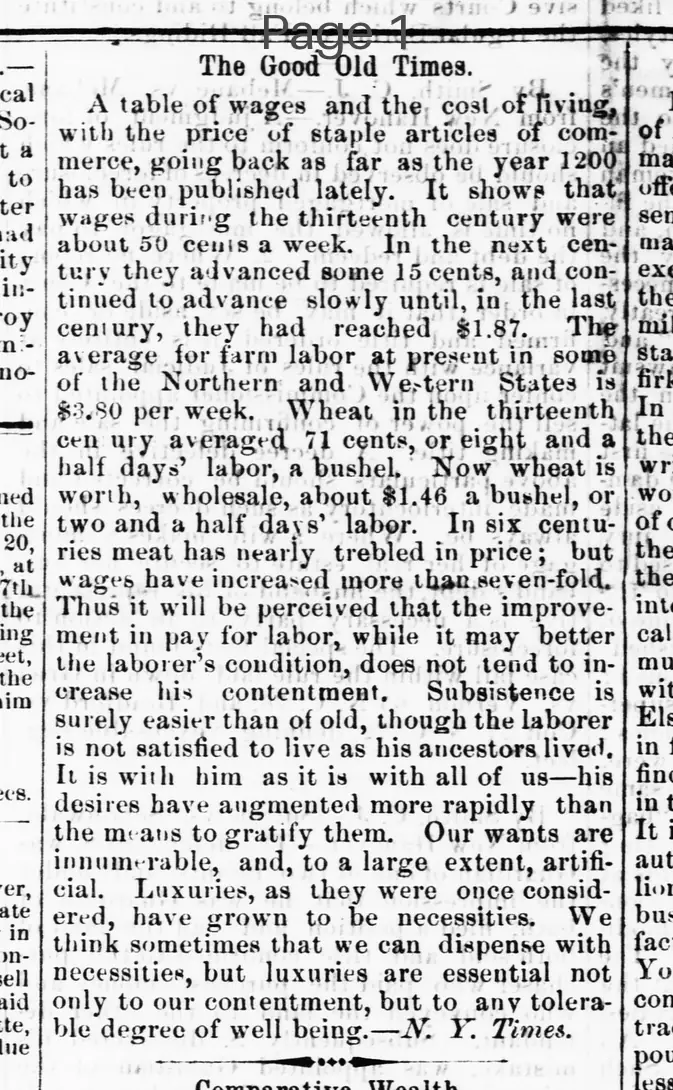
The Good Old Times.
A table of wages and the cost of living, with the price of staple articles of commerce, going back as far as the year 1200 has been published lately. It shows that wages during the thirteenth century were about 50 cents a week. In the next century they advanced some 15 cents, and continued to advance slowly until, in the last century, they had reached $1.87.... The average for farm labor at present in some of the Northern and Western States is $13.50 per week. Wheat in the thirteenth century averaged 71 cents, or eight and a half days' labor, a bushel. Now wheat is worth, wholesale, about $1.46 a bushel, or two and a half days' labor. In six centuries meat has nearly trebled in price; but wages have increased more than seven-fold. Thus it will be perceived that the improvement in pay for labor, while it may better the laborer's condition, does not tend to increase his contentment. Subsistence is surely easier than of old, though the laborer is not satisfied to live as his ancestors lived. It is with him as it is with all of us—his desires have augmented more rapidly than the means to gratify them. Our wants are innumerable, and, to a large extent, artificial. Luxuries, as they were once considered, have grown to be necessities. We think sometimes that we can dispense with necessities, but luxuries are essential not only to our contentment, but to any tolerable degree of well being.—N. Y. Times.
A table of wages and the cost of living, with the price of staple articles of commerce, going back as far as the year 1200 has been published lately. It shows that wages during the thirteenth century were about 50 cents a week. In the next century they advanced some 15 cents, and continued to advance slowly until, in the last century, they had reached $1.87.... The average for farm labor at present in some of the Northern and Western States is $13.50 per week. Wheat in the thirteenth century averaged 71 cents, or eight and a half days' labor, a bushel. Now wheat is worth, wholesale, about $1.46 a bushel, or two and a half days' labor. In six centuries meat has nearly trebled in price; but wages have increased more than seven-fold. Thus it will be perceived that the improvement in pay for labor, while it may better the laborer's condition, does not tend to increase his contentment. Subsistence is surely easier than of old, though the laborer is not satisfied to live as his ancestors lived. It is with him as it is with all of us—his desires have augmented more rapidly than the means to gratify them. Our wants are innumerable, and, to a large extent, artificial. Luxuries, as they were once considered, have grown to be necessities. We think sometimes that we can dispense with necessities, but luxuries are essential not only to our contentment, but to any tolerable degree of well being.—N. Y. Times.
What sub-type of article is it?
Historical Event
Curiosity
What themes does it cover?
Fortune Reversal
Moral Virtue
What keywords are associated?
Historical Wages
Cost Of Living
Economic Progress
Labor Discontent
Price Comparison
Where did it happen?
Northern And Western States
Story Details
Location
Northern And Western States
Event Date
From 1200 To Present
Story Details
Historical data shows wages rising from 50 cents per week in the 13th century to $13.50 today, outpacing increases in staple prices like wheat and meat, improving laborers' conditions but not their contentment due to growing artificial desires and luxuries becoming necessities.